
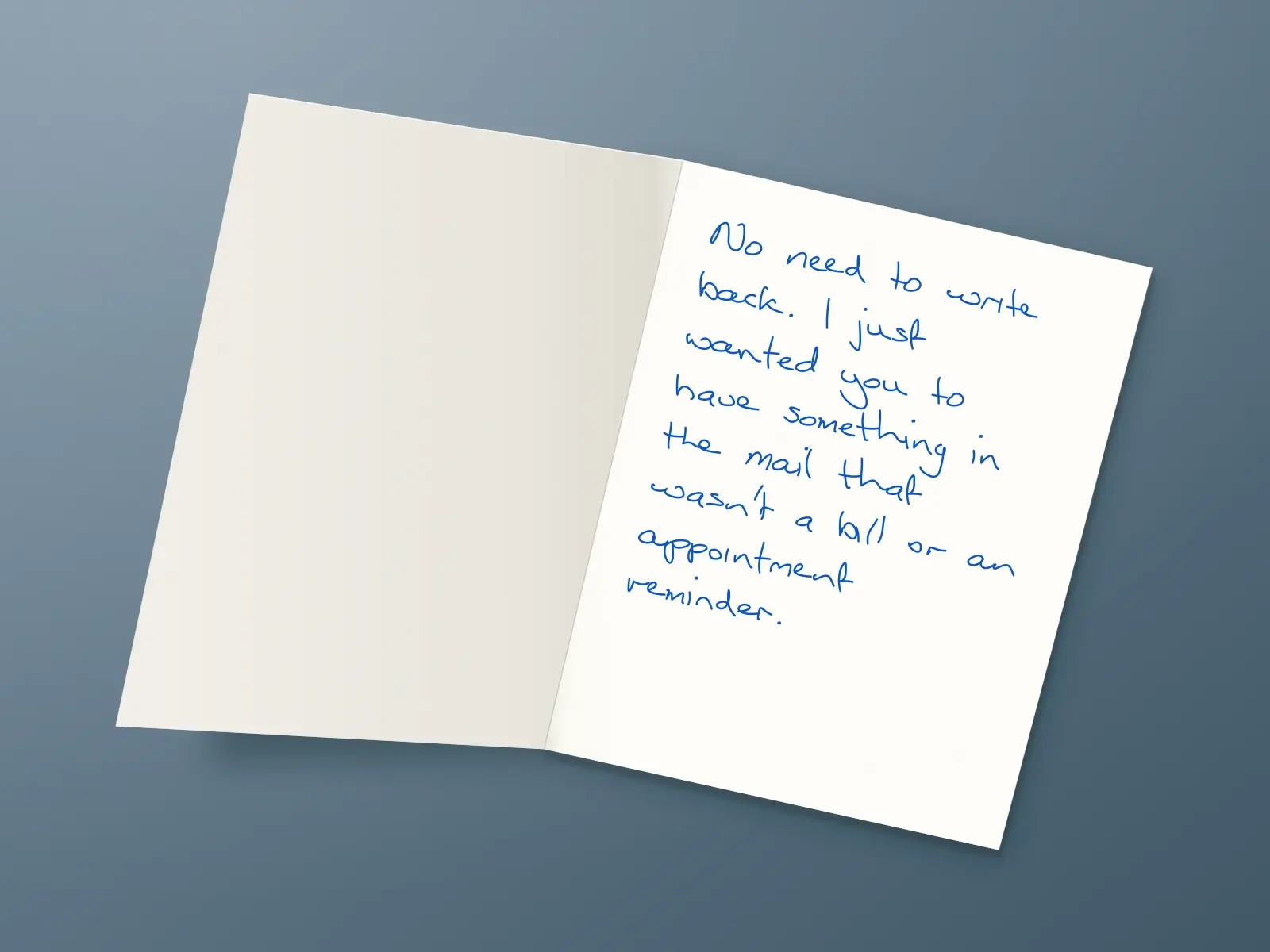
A get-well card can be a short wish, an ordinary bit of news, or a longer note that offers company. Write to the person you know. You don't need to explain their illness, predict recovery, or find something positive about it. If you offer help, choose something you can do and check that it's welcome.
No need to write back. I just wanted you to have something in the mail that wasn't a bill or an appointment reminder.
I've been thinking about you this week. I hope today is a little easier. If you'd like some company, I'd be glad to come by at a time that suits you.
I can bring dinner on Thursday if that would help. I'll check what you can eat and a good delivery time before I make anything. Sending lots of love.
There are 288 ready-to-use examples here, including the three above, grouped by relationship and situation. Some are deliberately brief; others give you a complete note. Keep a personal detail only if it's true. Change the day in an offer to one you can manage, and confirm any visits, food, or practical help with the recipient first.
What the research actually says
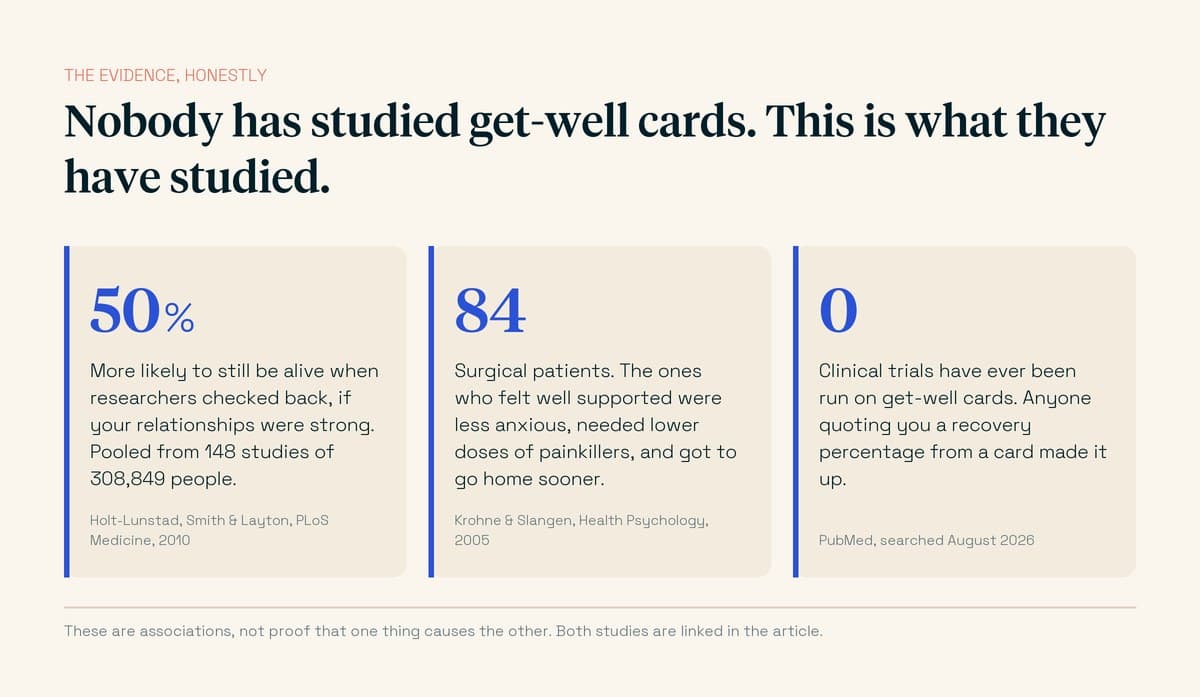
The studies below concern social relationships and support, not a tested treatment involving greeting cards. They can't tell us that sending one card changes a person's recovery. The useful reason to write is more modest: to let someone know you are thinking of them.
A review by Holt-Lunstad and colleagues combined 148 studies covering 308,849 people and found an association between stronger social relationships and higher odds of survival over follow-up. It studied relationships broadly, so its result cannot be read as the effect of a get-well card.
Other research separates the support people receive from how supported they feel. A meta-analysis found those measures were only loosely related. Researchers have also looked at support around surgery, including one study of 84 people. These are useful background reading, not evidence that a card speeds healing.
A card is one way to communicate care. Whether it feels helpful depends on the recipient and the wording; it isn't automatically welcome or a substitute for practical support. Ask what someone wants and respect the answer. Related source: a handwritten card still does something an email does not
Put it in a card.
Choose a front, make the words yours. We’ll write it with a real pen and mail it for you.
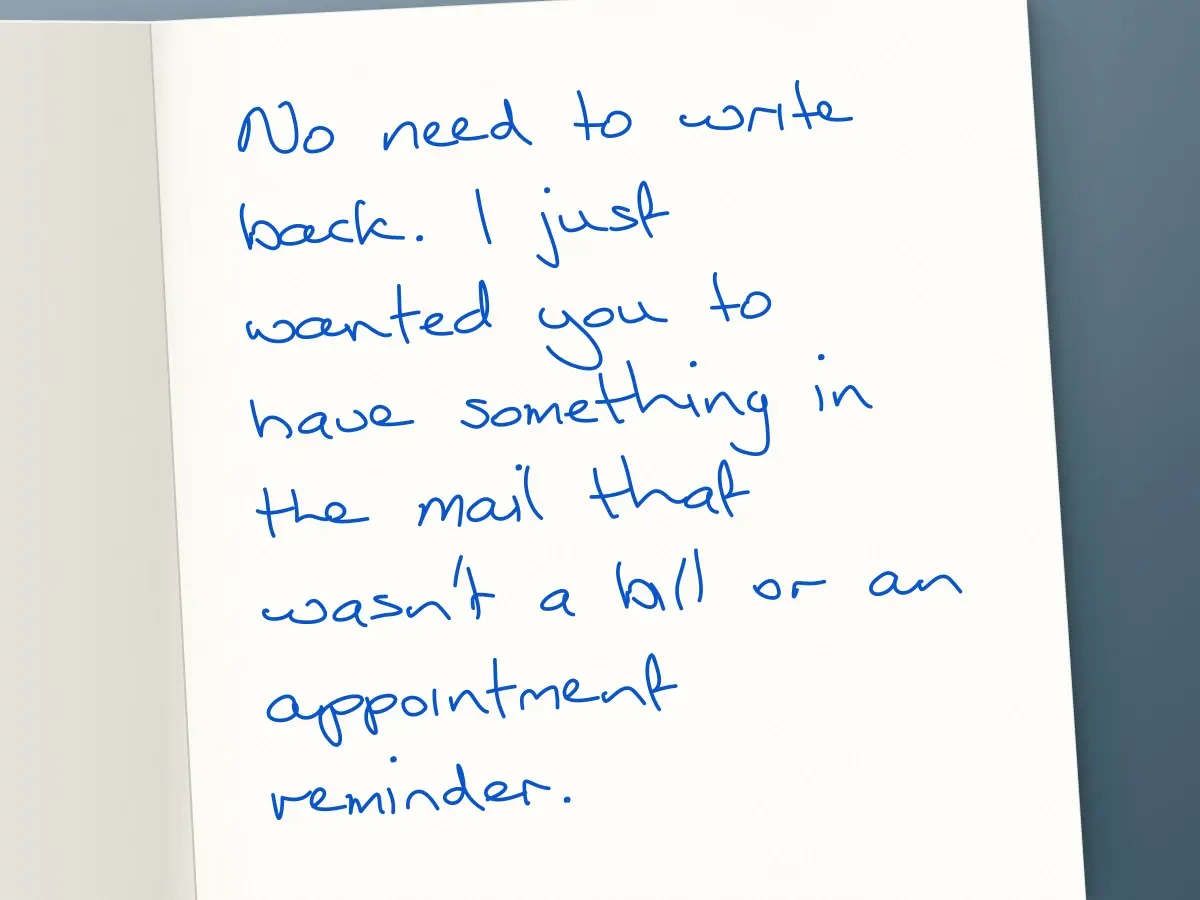
Handwriting example · Ruth
Your edited message is previewed in the designer.
How to write one that lands
Name the actual thing. Not “everything you are going through.” The surgery. The diagnosis. The fall your mom had in March. Specificity is the whole difference between a card that gets kept and one that goes out with the flowers.
Cut the timeline. Any sentence predicting how fast someone will recover is a promise you cannot keep. MD Anderson’s list of things to never say to someone with cancer includes “Don’t worry. I’m sure you’ll be fine.” A wish for comfort avoids making a forecast.
Make the offer specific, or leave it out. “Let me know if you need anything” is the most criticized line in this whole category. Valentina Ogaryan, a psychologist at the Simms/Mann UCLA Center for Integrative Oncology, points out that it puts the work on the patient: someone newly diagnosed often does not know what they need, or cannot put it into words. Oncology psychotherapist Kelly Grosklags, quoted by Living Beyond Breast Cancer, is blunter about “Call me if there is anything you need”: “No one is ever going to call.” Offer a day and a task, then check that the help is wanted before making arrangements.
Say the awkward part out loud. Some version of “I’m not sure what to say, but I want you to know I care” is recommended by the American Cancer Society, Living Beyond Breast Cancer, UCLA Health and City of Hope. It works because it is true, and because it does not ask a sick person to reassure you.
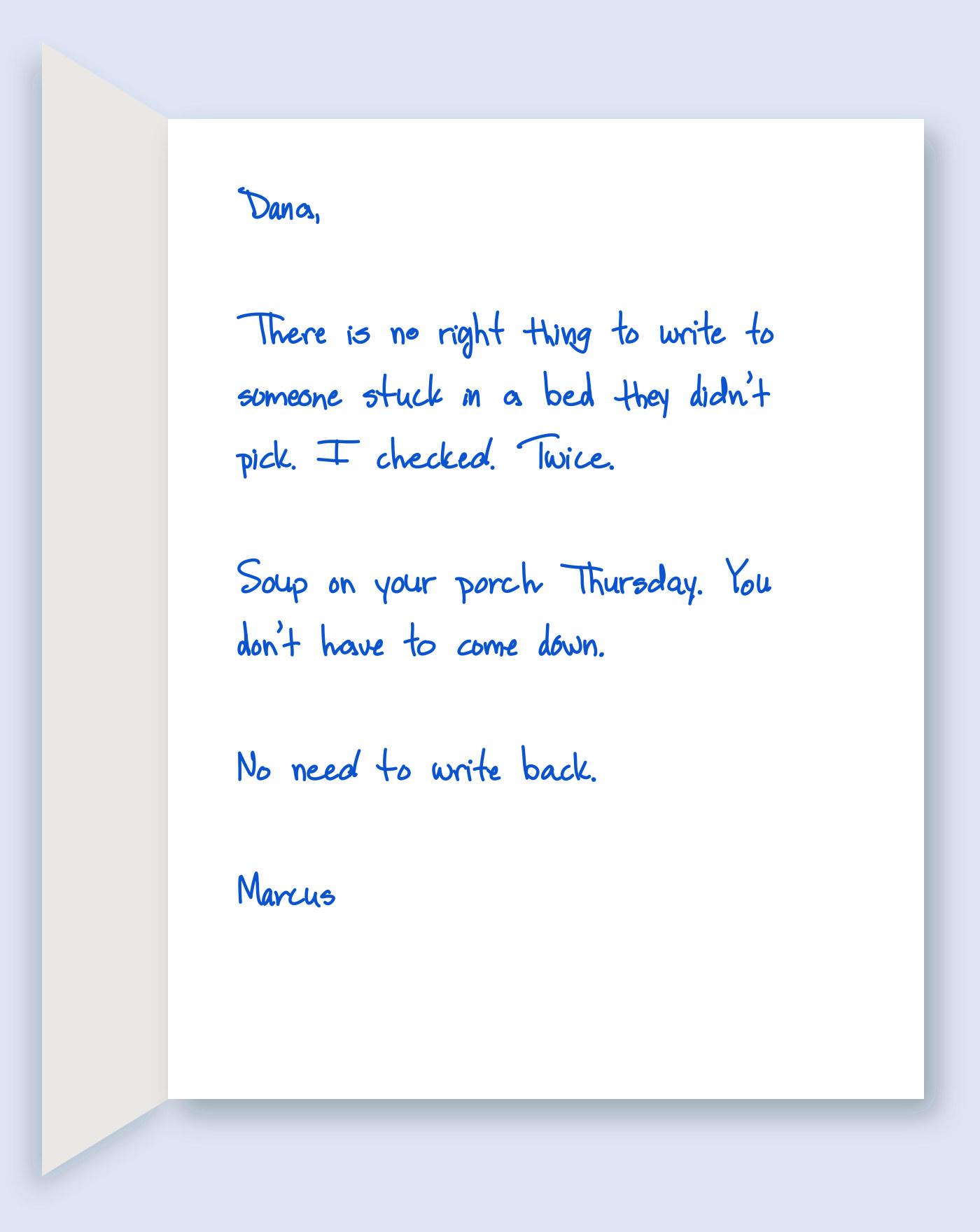
Take the reply off the table. Someone on day three after surgery has a phone full of messages they cannot answer and feel guilty about. “No need to write back” is a gift.
Short get well messages
A short card can be enough for an acquaintance, a group message, or someone who has little energy to read. A plain 'thinking of you' is useful when you don't know the details.
Thinking of you and hoping today is a little easier.
Something for your bedside table, with love from me.
No need to reply. I just wanted to say hello.
Sending a hug until I can give you one.
I hope you get some comfortable rest today.
You're on my mind. I'll check before I visit.
You don't have to be cheerful for this card.
Lots of love for a difficult week.
Read this whenever you feel like it. It keeps.
I found a show you might like. No homework attached.
Thinking of you from all of us at work.
Saved you every Sunday crossword you've missed.
When you have no idea what to say
You can admit you're unsure without making them reassure you. Keep the focus on your care and leave them free not to answer.
I've started this card a few times because I wanted to get it right. What I really want you to know is that I care about you. There's no need to find an answer.
I don't know what would be most helpful today. I can offer a ride or a quiet visit this weekend, if either would make the day easier.
I'm sorry you're dealing with this. I won't try to find a lesson in it. I just wanted to send you some love and say that I'm thinking of you.
The front of this card says get well, and the inside says I'd be glad to hear about anything you want to talk about. Ordinary news counts, too.
Thinking of you as you wait for news. You don't have to keep me updated. I'd be happy to provide a little distraction if you'd like one.
I may not always find the best words, but I want to stay in touch. You can tell me what you'd rather talk about, and I'll follow your lead.
I wish we could have one of our ordinary afternoons together. Until we can, I'm sending a card and hoping you feel well cared for.
I wasn't sure whether a call would come at a good time, so I thought I'd write. Read this whenever you like, and don't worry about answering.
I can help with laundry on Sunday or drive you to an appointment next week. If either would help, we can work out the details. No need to decide right now.
For a close friend
Use the humor and everyday subjects that belong to your friendship. If you offer food or a visit, check what is welcome and fits the person's circumstances.
I'm sorry this week has been so rough. I'd happily sit with you and complain about it for a while, or talk about something completely different.
I saw your favorite ginger ale at the store and thought of you. If it sounds good and fits what you can have, I'll bring some when we agree a time.
I paused our show. There is no deadline for catching up; I simply wanted us to have it waiting.
Our conversation doesn't have to become a health update. Send me a picture of your lunch or tell me what the neighbors are doing. Or take a break from replying.
I'd love to bring our usual catch-up to you when you feel like company. We can keep it short, and you can change your mind on the day.
You don't have to tidy up or entertain me if I visit. A quiet hour together would be lovely. Tell me if that sounds good, and we'll find a time.
I walked our usual route this week and missed your running commentary. I'm saving up a few stories for you, whenever you feel like hearing them.
If you're awake at an odd hour and want to send a message, you can. I may be asleep, but I'll reply when I see it. You don't have to apologize for the timing.
I'm free to help with a ride on Wednesday if you need one. We can make a plan that works for you, including a very quiet drive if conversation feels tiring.
I hope we get a visit soon. I'll check first, bring my own entertainment if you want to rest, and leave when you've had enough company.
You don't have to put on a brave face with me. I'm glad to see you as you are, or to give you some space when that's what you need.
If people are asking for updates, I can help pass on exactly what you'd like them to know. I won't share anything without checking with you.
I miss your opinions on things that don't matter. When you have the energy, I'd welcome your thoughts on the very questionable television I've been watching.
Your place in our trivia team is safe. Nobody else knows that round as well as you do. We'll be happy to see you whenever joining us feels right.
If a load of laundry would help, I'm free Sunday. I'll check with you about what needs doing and return it folded to whatever standard we can both reasonably expect from me.
I wish I could take some of this off your hands. What I can do is stay in touch and listen. Sending lots of love, my friend.
I hope tonight is more comfortable. There's no need to reply to this; I just wanted the last thing on the card to be that I'm thinking of you.
For your mom or dad
Speak to your parent as an adult who gets to make choices. Offer help without taking over appointments or making arrangements behind their back.
Dad, I'd like to help with the ride to your appointment if you'd welcome it. You drove me to so many things over the years. Let me know what works, and we'll make a plan.
Mom, you don't have to tell me you're fine if you aren't. I can listen without trying to turn it into a solution. I love you.
I'm free to mow the lawn on Saturday if you'd like that taken care of. You can give me instructions beforehand, and I'll do my best to remember them.
When you'd like a distraction, call me and I'll tell one of our family stories badly enough that you'll have to correct me. Sending love until then.
If arranging an appointment feels like one more job, I can sit with you while you make the call. You stay in charge; I'd just like to help.
Dad, I know you usually prefer to get on with things. You don't have to explain how you're feeling if you don't want to. I'm here to keep you company, too.
Mom, I've been thinking of you all week. I can bring dinner when it suits you, or just stop by for a chat if that sounds better. I love you.
I don't always find it easy to say this out loud, but I love you. I'd be glad to sit with you for a while, even if neither of us has much to say.
I hope someone has made you laugh today. I've been saving a family story that should help if they haven't. Sending love, and I'll check before I call.
The dog is fed and the tomatoes are watered, just as we agreed. I left the ripe ones for you. Lots of love from home.
Thank you for all the times you've looked after me. I'd be glad to help now, in the ways you actually want. You don't have to accept every suggestion I make.
If you want someone beside you for the insurance calls, I can make time. I can take notes while you talk, or simply keep you company during the hold music.
I love you. If the evening feels long, you're welcome to call. We don't need any news to have a conversation.
For a partner or spouse
A partner may welcome reassurance about ordinary life as much as a get-well wish. Keep the affection and let them choose when they want help, conversation, or privacy.
The laundry is done and tomorrow's things are ready. I hope that takes a small job off your mind. I love you, and I'm glad to be here with you.
You don't need to make this easier for me by pretending to feel better. I love you on the difficult days, too. Tell me when you want company and when you want quiet.
I'd like to keep the little choices that are yours, including which mug you want and whether we talk. I love you. You don't have to go along with all my attempts to help.
I miss our ordinary routine, and I'm glad we still have little moments together within this different one. I love you. We can take today as it comes.
I know resting hasn't been easy for you. I'm not going to add a list of things you should be doing. I'd be happy just to sit beside you for a while.
I've put our agreed appointment time on the calendar and sorted the ride. You don't need to keep track of that part as well. I love you.
You're allowed to hate the recliner. I'll still make room beside it for some time with you.
I'm learning when to help and when to stop hovering. Please tell me when I get it wrong. I love you, and I want this to feel like support you actually want.
The house is quieter without our conversations about entirely unimportant things. I'd like one of those whenever you feel up to it. No big discussion required.
It was good to have a quiet evening with you, even though we missed most of the show. I hope we get more little pockets of comfortable time together.
Whenever you'd like to do our usual thing again, I'd be happy to. We can change the plan to fit your energy or leave it for another day. I love you either way.
For a brother or sister
A familiar joke can be comforting when it really belongs to your relationship. Avoid insults about appearance or pressure to share news before they're ready.
I won't use this card to remind you that you still owe me help moving the couch. Except that I just did. Love you, and I'm thinking of you.
I'd rather hear what you want to tell me than collect updates from everyone else. No report required. I just wanted to send a note from your sibling.
Still your sibling. Still available for terrible television and opinions you didn't ask for. I'd love to spend some time with you when you want company.
I've been remembering our childhood adventures and wondering how we explained some of them away. I'll save the stories for when a laugh would be welcome. Love you.
You don't have to organize the whole family while you're unwell. If you want, I can help with the messages and pass on only what you've agreed to share.
I'm sorry this is happening. I can listen to the unfair parts without looking for a silver lining. I'm thinking of you and sending a lot of love.
I wanted you to have something from me that didn't ask a question. So here it is: I love you, and I'm glad you're my sibling. No need to reply.
Our last call was the best part of my week. I like hearing your voice, even when neither of us has much news. I'm looking forward to the next one whenever you're up to it.
For a grandparent
Use the name you call your grandparent and a detail you share. Don't assume they're frail or unable to decide what help they want.
The garden can wait. I hope today gives you some comfortable rest.
Your tomatoes are watered as we agreed. I haven't tried the pruning; I remember your instructions about that part. Sending love from the garden.
I'll check whether our usual Sunday call suits you this week. If you'd like to listen while I talk, I have plenty of ordinary news to bring.
I drew you a picture for your room. I hope you like the colors. I love you and would like to visit when it's a good time.
I love you, Grandma. You can tell me about the hard parts as well as the things that went well. I'm glad to listen.
I'm available for a ride on Tuesday or Thursday if either would help. We can choose the time together. I'd be happy to have some company in the car.
Grandpa, I wanted you to have a card from me. I hope somebody has made you laugh today. If not, I have a joke ready for our next call.
I tried your recipe and have a question about it. It can wait until you feel like talking, but I thought you might enjoy knowing you're still my first choice for kitchen advice.
You've brought so many meals to other people over the years. I'd like to bring you something you enjoy, if that would be welcome. I'll check before I cook.
Whoever is reading this out loud, please read this part twice: I love you. I'm thinking of you and looking forward to seeing you when the time is right.
We missed having you at Sunday dinner. There will be a place for you whenever you want to join us, and we can bring a visit to you in the meantime.
I'm looking forward to hearing more of your stories when you feel like telling them. There's no need to use your energy writing back. Sending lots of love.
For a coworker
Keep work updates to accurate, agreed arrangements. Don't promise leave, change schedules, share a diagnosis, or claim to have covered tasks unless that's true and within your role.
Thursday's client call went well, and the agreed follow-up is in hand. No response needed. I hope you have the space to focus on yourself.
Your out-of-office arrangement is working as planned. Anything urgent goes to the person you've nominated. Sending good wishes from the team.
The presentation went out on Tuesday, using the order you suggested. It worked well. I thought you might like that small bit of news, with no action attached.
The revised deadline is confirmed. There's nothing you need to do about it. I wanted to send a note and wish you well.
I can bring a coffee when you're up to having one and a visit is welcome. Until then, I'm sending a card and good wishes.
We miss our lunches together. I hope you have a comfortable day, and I'm looking forward to catching up when you feel like it.
No reply needed to this card. I just wanted to say I'm thinking of you and hope today brings a little more comfort.
If there's a work question worrying you, you can send it through the agreed contact. You don't need to track everything yourself while you're away.
I'm free for a ride on Tuesday if that would be useful. We can check the details beforehand. No pressure if you already have it covered.
If a grocery run would help, I can pick up a list on Sunday. I'll check the items and timing with you before bringing anything over.
Your part of the report is covered under the plan we agreed. It doesn't need your attention today. Sending good wishes.
I've taken the weekly meeting as arranged. The team sends its best, and nobody expects a reply to this card.
Your desk plant is thriving under my care, which feels a little rude of it. I thought you'd appreciate the update. Wishing you a comfortable week.
We haven't talked much beyond the kitchen, but I wanted to wish you well. I hope you have good support around you.
The tasks assigned for coverage have been handed over. There isn't anything you need to clear from the queue today. Thinking of you.
The paperwork we discussed has been submitted. One less thing to keep in mind. I hope you get some quiet time today.
Your agreed on-call coverage is in the schedule. Please use the usual contact if anything needs clarifying; no need to sort it through this card. Wishing you well.
We missed your running commentary at the weekly meeting. I'm saving a few ordinary stories for whenever you want to catch up. Sending good wishes.
For your boss
A note to a manager can be warm and brief. There's no need to discuss their diagnosis, tell them what the doctors should do, or make career-related comments.
I wanted to send good wishes and let you know I'm thinking of you. I hope you have some comfortable time today, with no need to answer this card.
You've been kind about other people's need for time away. I hope you feel that same support now. Wishing you well from all of us.
No reply expected and no update owed. I just wanted you to have a note from me.
I keep expecting to hear your familiar greeting in the hallway. Sending good wishes, and I look forward to hearing it again when you're ready.
You've always made time for my questions without making me feel like an interruption. I appreciate that. I hope the people around you are giving you plenty of care.
I hope today brings a little comfort and some company you enjoy. Please accept my best wishes, with no need to respond.
From a whole team
Agree on one message from the group and let people add their names. Keep practical promises within arrangements the team can actually provide.
The whole team says hello. There is no need to write back; we just wanted to send our good wishes together.
The running joke has continued without your supervision and may have gotten worse. We'll save the story for when you want a little ordinary office news.
All of us are thinking of you. The coverage we agreed is in place, and we hope that gives you one less thing to think about.
If meals would be useful, we'd like to arrange a small schedule with your permission. We'll check what works for you before anyone brings food.
We asked what people wanted to put in this card, and everyone said they miss you. We hope today is a comfortable one. Sending good wishes from us all.
There is a whole collection of names beneath this message, all wishing you well. We look forward to seeing you when the time is right for you.
Funny get well messages
Humor works when the recipient likes it. Tease the television or the stationery, not their pain, appearance, or medical care. Skip any joke they'd have to work to excuse.
Jello is not a dessert. It is a hostage situation with a spoon. I hope someone brings you a better distraction soon.
You are allowed to hate the recliner. It only looks supportive. I'd be glad to sit in the other chair and hear your review.
The group chat is now discussing a fence at considerable length. I thought you should know what you're missing. There is very little urgency about returning to it.
I hope the socks are comfortable, because they are making absolutely no attempt to be fashionable. Sending love to you and your entire new wardrobe.
I can come and sit quietly. I have been practicing, and the results are surprisingly encouraging. Tell me when you'd like a demonstration.
Daytime television has a man appraising other people's junk in a barn. I have questions about his business model. We should discuss them when you're up to it.
I selected a card with no advice inside. This took considerable restraint from someone with as many opinions as I have. Thinking of you.
I'd like to visit when it suits you. Please warn me if the parking requires a small inheritance, so I can arrive financially prepared.
Somebody sent you flowers that need water and attention. Rude. This card asks nothing of you.
There are no inspirational quotations in this card. I know how you feel about those, and I value our friendship.
If you've run out of things to watch, I have a list. The quality is uneven, but I have strong opinions about which episodes to skip.
A bed should not need this many buttons. I hope you've found the comfortable setting and can leave the technical research to someone else.
I bought you a puzzle book, then checked the answers and felt briefly accomplished. You can have the actual achievement whenever you feel like it.
No wisdom from me today. Just affection, a card, and the continued offer of my highly questionable television recommendations.
I'm sorry you're having this kind of week. I hope something on the menu has at least a little color and somebody nearby has a decent joke.
Your email can survive without your detailed opinions for a while. Mine does it all the time. Thinking of you and sending love.
I would like to lodge a complaint about the week you've been given. In the meantime, please accept this card as evidence that I'm on your side.
Under the friendship agreement, you may request soup. Subject to your preferences, available ingredients, and my ability to find the good container lid.
Official ruling: comfortable clothes count as a full outfit. The vote was unanimous. I am the committee.
Your talent for sleeping through a mediocre movie is finally getting the respect it deserves. I hope today's selection is comfortably forgettable.
I hope your pillow has a cold side, your charger reaches, and nobody spoils the ending of what you're watching. I have limited powers, but strong wishes.
I have no medical advice. I do have a very detailed ranking of the shows we've both already seen. A much safer area of expertise.
Get well wishes from a person who will happily watch the same episode twice and pretend it was your idea.
I resisted looking up your symptoms. Instead, I looked for a card I thought you'd like. This seems a better use of my internet connection.
Visitors should arrive with their own stories and leave before you have to fake a yawn. I will try to meet that standard if you invite me over.
Say the word and I'll come rearrange your cards, ask about the weather, and then leave while you still like me. Sending love until then.
Nothing here will buzz, load, or ask you to rate your experience. It is paper, and it has finally found its moment.
I can't solve the week, but I can reliably arrive with a crossword and no expectation of finishing it. Let me know if that sounds like your kind of visit.
This card is officially too short to tire you out. The phone call about it is optional. I miss you and hope today is kinder.
Before surgery
Acknowledge the waiting and say you'll be thinking of them. Leave fasting, medication, and other preparation instructions to their care team. Visits and transport need their agreement.
I'll be thinking of you on the morning of your surgery. There is no need to send me an update; I just wanted you to know you are on my mind.
If the waiting feels long, I'd be glad to keep you company for a while. We can talk about the procedure or find something else entirely to discuss.
I'm glad you have a date after all the waiting you've told me about. I hope you feel listened to and well cared for as it approaches.
You don't have to put a cheerful face on your surgery date for me. If you want to talk about being worried, I can listen.
There are a lot of practical things to think about before an operation. If taking notes or organizing papers would help, I can sit with you while you do it.
I'm thinking of you as you get ready for surgery. I won't guess at how it will go. What I can say is that I care about you and will be glad to hear from you afterward.
The dog care we agreed is arranged. That part is taken care of, and I hope it gives you one less thing to keep in mind.
Our agreed ride is in my calendar. I'll confirm the time with you before the day. Sending lots of love until then.
I hope you get clear answers to your questions and some comfortable time before the day arrives. You don't have to make conversation about any of it if you'd rather have a distraction.
No need to write back. I wanted you to have something this week that isn't another form to read.
I hope the people caring for you introduce themselves, explain things clearly, and treat you kindly. I'm thinking of you as the date gets closer.
You've had this appointment on your mind for a while. I hope the waiting feels a little less lonely knowing that people are thinking of you. I am one of them.
I have a collection of small, unimportant stories ready if you need something else to think about before surgery. None of them includes medical advice from the internet.
If you'd like me to help relay updates, tell me who should hear what. I'll respect the arrangements you choose and won't share news without your permission.
I'd be glad to wait with you if company is welcome and the hospital allows it. Either way, I'll be thinking of you that day.
After surgery
Wish them comfort without guessing at symptoms or the length of recovery. Practical help is useful when it fits the instructions they're following and what they want.
Thinking of you after your surgery. I hope you have a comfortable place to rest and the help you need. There's no need to write back to this card.
If you need a ride to a follow-up appointment, I have some time next week. We can work out the details when you're ready. Sending love.
I hope today's a little easier than yesterday. If it isn't, you don't have to dress that up for me. I'm thinking of you either way.
There's a lot of ordinary effort involved in getting through a day after surgery. I hope the people around you notice and help without making a fuss.
I'd like to bring a meal if that would be useful. I'll check what suits you and any instructions you're following before I cook. You don't have to host me.
If help with laundry or an errand would take a job off your hands, I can make time on Tuesday. I'll check before doing anything; you can choose what would actually help.
No need to write back. I'm thinking of you this week, and I'll still be interested in how you're doing when the first round of visits is over.
I'm glad to send some ordinary news while you recover. The neighbor's project is still unfinished, and I have an update that is longer than the project deserves.
Your taste in television remains beyond my understanding, but I'm happy to watch your choice if you want company. We can stop as soon as you've had enough.
I hope you can ask for things to be repeated without feeling rushed. There can be plenty to take in after a procedure. Sending love and a card that can wait for later.
I hope you've found a position that feels comfortable today. I'd be glad to hear about the frustrating parts as well as any progress you want to share.
You don't have to show me how much you can manage on your own. If you'd like help, I'd be happy to follow your lead. If you'd like privacy, I understand that too.
Take the time your recovery needs. I won't keep asking when you'll be back to normal. I'd rather ask whether you want a little company this week.
I know following the plan you've been given can take up a lot of a day. I hope there's something pleasant in between, even if it's only a good chapter or a call you enjoy.
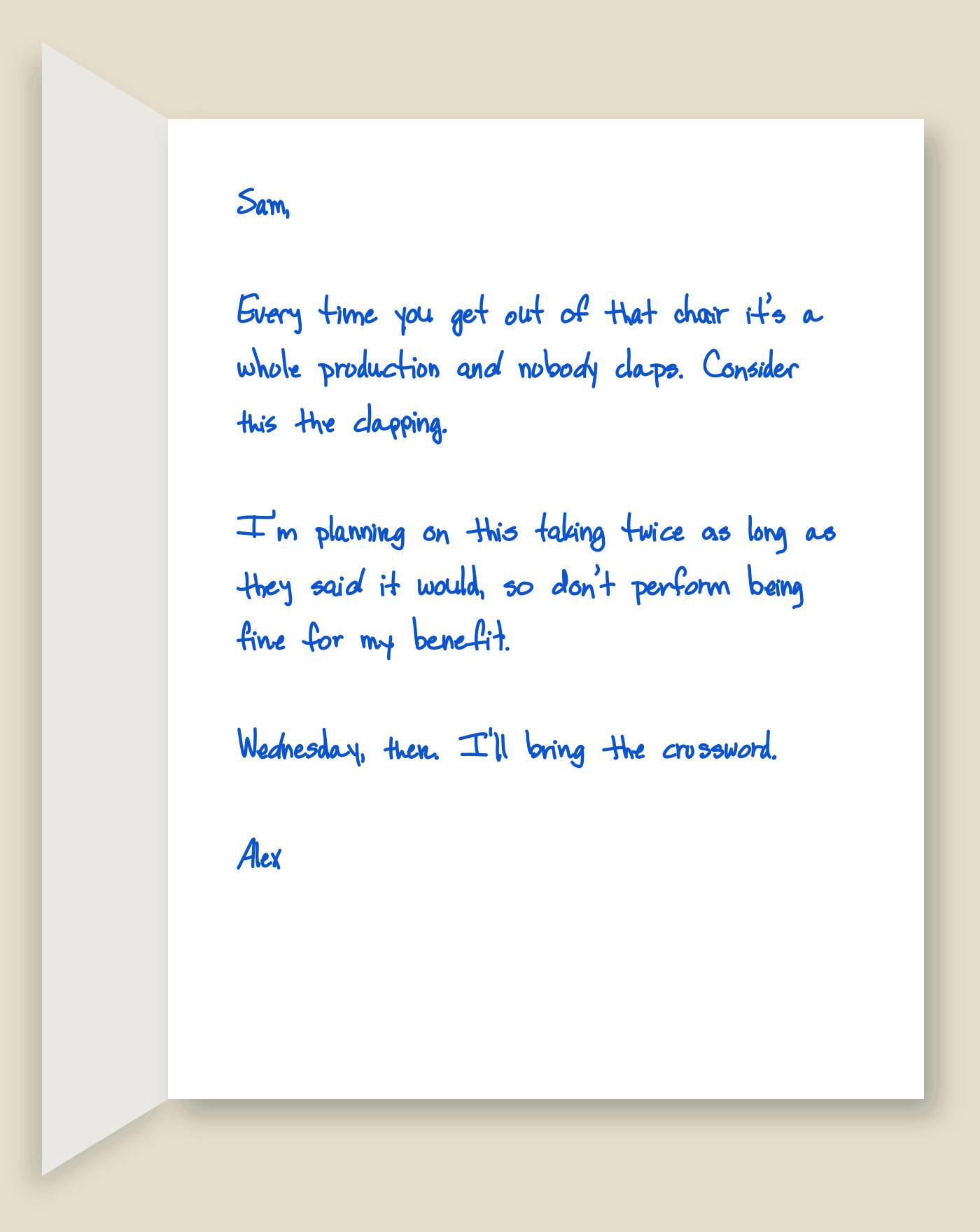
Bored yet? I have a crossword and a free hour Wednesday, if that would be welcome. We can leave all the difficult clues for another day.
For someone still in the hospital
Keep the card easy to receive. Check visiting rules and whether gifts or food are allowed before making plans. Don't encourage someone to ignore a care instruction for the sake of a joke.
I hope you get some quiet between the interruptions today. I wanted you to have a note from outside the hospital that asks nothing of you.
A Wednesday hello from me. No appointment attached, no update required. Just a little ordinary mail.
I'd be glad to visit if it suits you and the ward allows it. I'll check first and keep it short. You don't need to stay awake on my account.
The cat is fed and your mail is stacked unopened where we agreed. I hope it helps to know those small things are taken care of at home.
I hope there's something on the menu you actually enjoy. Sending love from a person who would happily hear your full review.
If anything from home would make the room more comfortable, I can check what the ward allows and bring it at an agreed time. No need to make a list today.
We missed you at trivia. There is no pressure to be back; I just wanted you to know we enjoy having you there. I'll save the best wrong answers for later.
No need to reply. I wanted one thing in that room to be a hello from someone who cares about you.
I hope you have someone who explains what's happening and gives you time to ask questions. Thinking of you in a place that can be busy and unfamiliar.
I sent a little picture for your bedside table. You can put it wherever you like, or keep it in the envelope if the room already feels crowded.
The school pickup we agreed is covered. I've confirmed the arrangements, so you don't need to organize that part from your room. Sending lots of love.
For a sick child
Use words the child understands and a detail they enjoy. Keep jokes gentle, and avoid stories that make doctors or treatment sound frightening. Arrange any visit with their caregiver and care team.
Your dog is being looked after and is ready for all the stories you want to tell. We love you and hope today has something fun in it.
You don't have to feel happy just because a grown-up brought a card. I love you when you're grumpy, too. I hope something makes you smile today.
I can bring your favorite story when a visit is allowed and you're ready. We can read one page or the whole book. You get to choose.
I hope your socks are comfortable. I drew a much sillier pair on the back of this card. See if you can spot all the colors.
I made you a picture for your room. It has a tiny surprise hiding in one corner. There's no hurry to find it, and no homework afterward.
Would you like to hear a joke? What do you call a sleeping dinosaur? A dino-snore. Sending love, and an apology for that joke.
I miss making things with you. When you'd like to, we can choose something small to do together. Until then, here's a card with a big hug inside.
For a teenager
Write to the teenager directly and respect their privacy. Don't talk down to them or assume every conversation needs to be about their health.
You don't owe everyone the full story. I just wanted to say I'm thinking of you. If you'd rather talk about something else, I'm very happy to do that.
I don't know the perfect thing to write. I do have time to listen, and I still want to hear your ordinary news as well as anything you choose to say about your health.
I won't turn every conversation into a serious talk. Send me a video you think I'd like, or leave this unanswered. I wanted you to have a note from me.
I'm sorry your plans have been interrupted. It makes sense if you're annoyed about that. I hope we can find something you still enjoy doing, when you feel up to it.
No cheerful slogan from me. I just hope today is more comfortable and you have a little privacy when you want it. I'm thinking of you.
I'd like to hang out when you're ready, even if that just means watching something for half an hour. We can make the plan small and change it on the day.
For a long-term or chronic illness
For a long-term condition, 'thinking of you' avoids promising a recovery timetable. Keep including the person in ordinary friendship while leaving room for plans to change.
No update required. Do you want the extremely stupid gossip from work? I've been saving it.
You're still the first person I want to tell things to. I hope you know that our friendship has room for your health and for everything else you care about.
I believe what you've told me about how you feel. You don't have to prove it to me or find a new way to explain it every time we talk.
I'd like to keep helping with meals if they are still useful. We can check what you want and choose a day that works, instead of assuming the first weeks were the only difficult ones.
You don't have to be lively company. I'd enjoy a quiet visit if you want one, and I won't mind leaving early if your energy changes.
I won't wait for you to feel better before making room for our friendship. We can find ways to spend time together that work for the day you're actually having.
You're still included in the invitation. You can say no, change your mind, or join for only part of it. I want you to have the choice.
I'm sorry this keeps asking so much of you. You don't have to find a hopeful ending before you tell me about a difficult day.
You can cancel on the morning of. I know plans may need to change, and I won't take it personally. I'd still like to keep making them with you.
If paperwork is piling up, I can help sort it or make copies while you decide what needs doing. You stay in charge of the forms and the information you share.
I'm glad you told me what isn't helpful to hear. I'll remember it. You shouldn't have to teach me the same thing every time we talk.
I wanted to check in without asking whether you're better yet. I'm thinking of you as you are today, and I'd be glad to hear from you whenever you feel like it.
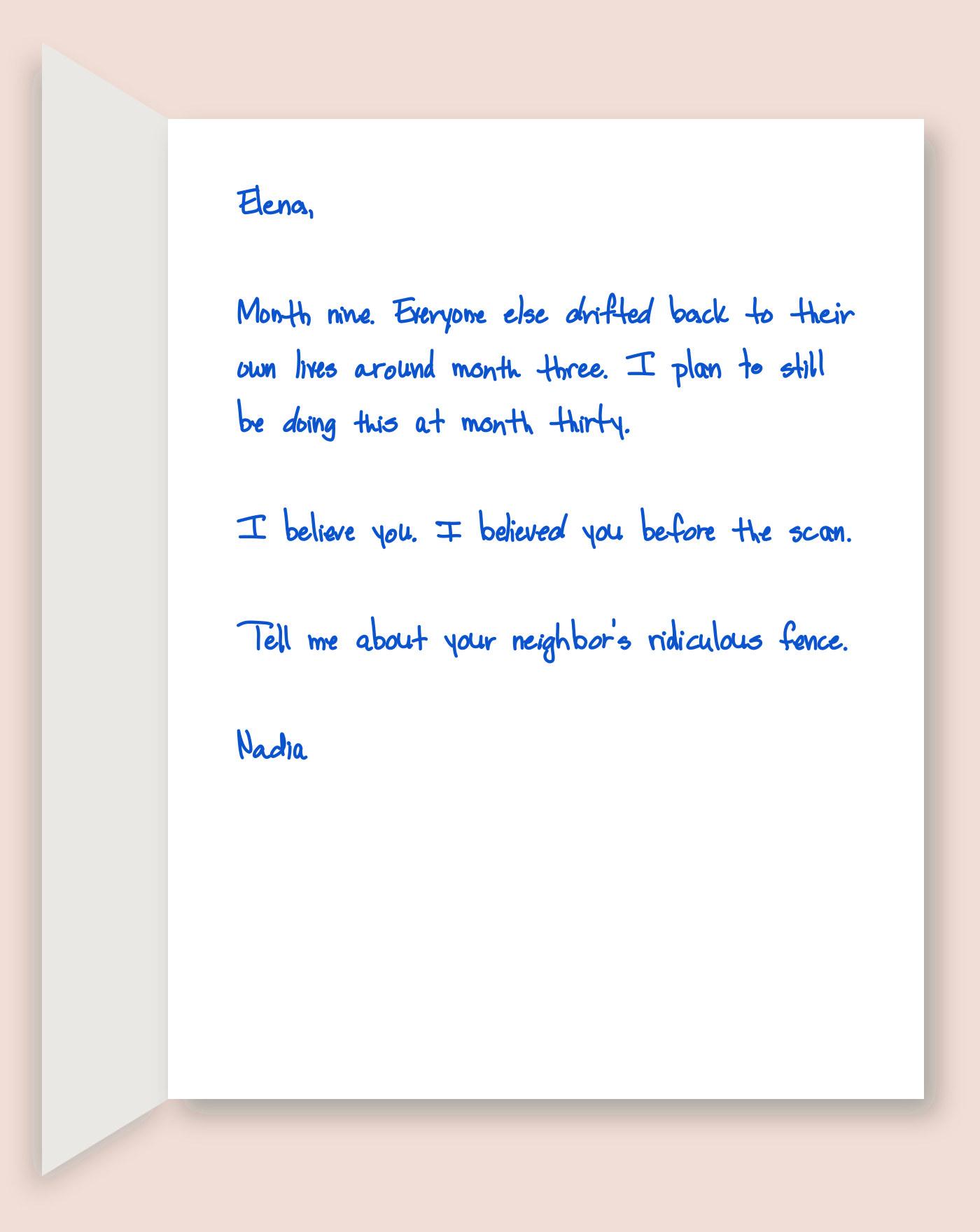
Tell me about your neighbor's ridiculous fence or the appointment you just had. Either is welcome, and we can change the subject halfway through.
If you forget to reply, that's fine. This card isn't a task. I just wanted you to have a reminder that I care about you.
You don't have to give me a list of what you managed today. I'd rather know if you want company, quiet, or a completely unrelated story.
I'm sorry getting heard has been such hard work. I believe you, and I hope your next conversation leaves you feeling listened to.
Your taste in music is still open to debate. If you want an evening with a subject that has nothing to do with appointments, I have a playlist and several objections.
I know you've had to change the way you plan your days. I'd like to understand what makes our plans easier for you, without turning every visit into a discussion of symptoms.
I won't tell you this will pass. I don't know that. What I can do is listen and keep making room for you in my life.
A quiet week doesn't have to mean we've lost touch. I'll send a hello now and then, and you can answer when you want. No explanation needed.
For someone in cancer treatment
Don't compare diagnoses, forecast outcomes, or assume particular side effects. Use their own language for treatment and offer the kind of ordinary company they welcome.
Thinking of you as treatment gets under way. I won't assume what this week feels like. I'd be glad to listen or help with an ordinary task if you want that.
I'm thinking of you on your treatment day. There's no need to send an update; I just wanted you to know you are on my mind.
You don't have to be inspiring for me. You can tell me the ordinary, frustrating version of the day. I'm glad to hear it.
If you'd like a ride to treatment, I can be available Thursday. We can confirm the time and what you'd prefer for the trip. No pressure if you have it arranged.
I'm sorry there are uncomfortable parts of this that I can't take away. If you want to tell me about them, I can listen without suggesting a cure.
I can help with laundry Wednesday if you'd like that done. I'll check before I come and won't expect a visit as well.
You can tell me as much or as little about treatment as you want. I care about you without needing a detailed report.
If the appointments involve a lot of waiting, I can bring a book or a few magazines you actually like. I'll check what's useful before choosing anything.
I've started this card more than once and still don't have perfect words. What I do have is love for you and time to listen when you want me.
I'm thinking of you while you wait for results. I won't fill the waiting with guesses. If a little distraction would help, I have plenty of news about the dog.
Nothing important to report from here. I wanted your mailbox to hold a small hello while you wait for that call. No need to reply.
I'll be near my phone Friday if you feel like talking. You don't have to call as soon as you hear anything; I can wait until you want to share.
I know finishing a round of treatment doesn't tell me how you're feeling. I'd like to keep checking in and helping in ways you still find useful.
I won't assume you feel ready for everything because a treatment date has passed. We can keep our plans small, or leave them for another time.
I'm glad this stage of treatment is finished. You don't have to feel any particular way about that for me. I'd be happy to listen to whatever the day brings up.
Last treatment in this course is done. I'm still thinking of you, and I'd be glad to see you when you want some ordinary company.

For someone struggling with their mental health
Acknowledge what they've shared without diagnosing them. Skip advice about positive thinking or quick fixes, respect their privacy, and ask before visiting or making plans on their behalf.
I don't know the perfect words, but I want you to know I care. You don't have to make this conversation easy for me or explain everything at once.
I'm taking what you've told me seriously. I won't tell you to try harder or compare your day with somebody else's. I'm glad you let me know.
I'd be happy to watch something quietly with you if that sounds good. I'll check before coming over, and we can keep the visit short.
If groceries would take a job off your mind, I can pick up a list Tuesday. I'll agree the details with you first. You don't need to entertain me when I bring them.
You don't have to prove you've done enough today to deserve some care. I just wanted to send you a card and let you know you're on my mind.
The arrangements you asked me to help with are in place. If something changes, we can talk about it. You don't have to manage that part alone.
I'm not keeping a timetable for how you should feel. I enjoy knowing you, and I want our friendship to have room for the days that are hard.
I hope you get a little space from the things that are pressing on you today. There's no advice in this card; just a hello and some care.
I thought a letter might be easier to receive than a call right now. Read it when you want, or put it aside. There is nothing you need to do afterward.
If you'd like something from home, I can check what is allowed and arrange it with you. I won't bring a surprise that makes the day more complicated.
I've shared only what you asked me to share with work. Your privacy matters to me. I hope knowing that takes one worry off your mind.
I know some everyday things are taking a lot of effort. You don't have to hide that from me. I'd be glad to help with something specific if you want to ask.
Would our usual Sunday call be welcome this week? It's fine to skip it or keep it short. I still look forward to hearing from you when it works.
You can change your mind about our plan without worrying that I'll be offended. I'd rather we make it fit how you're feeling that day.
Nothing to answer in this card. Just a reminder that I care about you and hope today has a little comfort in it.
If an errand is getting in the way, I have time Saturday. We can decide together whether help would be useful. You don't have to accept it to make me feel better.
I'm glad you're getting support, and I won't ask you to tell me more about it than you want to. I'd like to stay in touch in a way that feels comfortable for you.
Faith-based get well messages
Use religious wording only when you know it is welcome. The examples here are original personal prayers and wishes, not Bible quotations. Ask before sharing someone's news with a congregation or prayer group.
I'm praying for you, and I won't share your news with a prayer group unless you ask me to. Your privacy matters alongside the care I want to offer.
I remembered you in my prayers this morning. I hope you feel cared for today, in the small practical ways as well as in the words people send.
If you'd welcome a visit from someone at church, I can help arrange it with your permission. There's no obligation; I simply wanted you to know the option is there.
You don't have to find a spiritual lesson in this before we talk. I'm praying for you and am glad to listen to how the day actually feels.
I'm asking God to give you comfort and people who listen well. I'd like to be one of those people whenever you want some company.
I took some quiet time to pray for you today. I hope this note brings a little of the care I was trying to put into those prayers.
My prayer is simple: that you feel held in care today and have help with the parts that are hard. Sending love, with no need to reply.
I won't explain why this happened or promise an outcome. I'm praying for you and would be glad to hear whatever you want to say, including the difficult questions.
We miss seeing you at church, and there is no pressure to be back before you're ready. Sending love and prayers from people who are thinking of you.
Jewish, Muslim and non-specific spiritual messages
Choose words that fit the recipient's own practice. Refuah shleimah and shifa are wishes for healing; don't assume every Jewish or Muslim recipient wants religious wording in a card.
Wishing you a refuah shleimah. I'm thinking of you with care and would be glad to help with a meal or an errand if that would be welcome.
May Allah grant you shifa and ease through this time. I'm keeping you in my duas and sending love, with no need to write back.
Praying for you while you wait for news. You don't have to keep me updated; I just wanted you to know you're remembered.
I'm holding you in my thoughts and wishing you some peace in the middle of a difficult week. I'd be glad to sit with you if you want company.
I lit a candle and thought of you today. It was a quiet moment to remember how much I care about you. Sending love from here.
For the person doing the caring
Send a note addressed to the caregiver, rather than making them a messenger. Offer a practical task you can do; taking over medication or overnight care needs an appropriate, agreed arrangement.
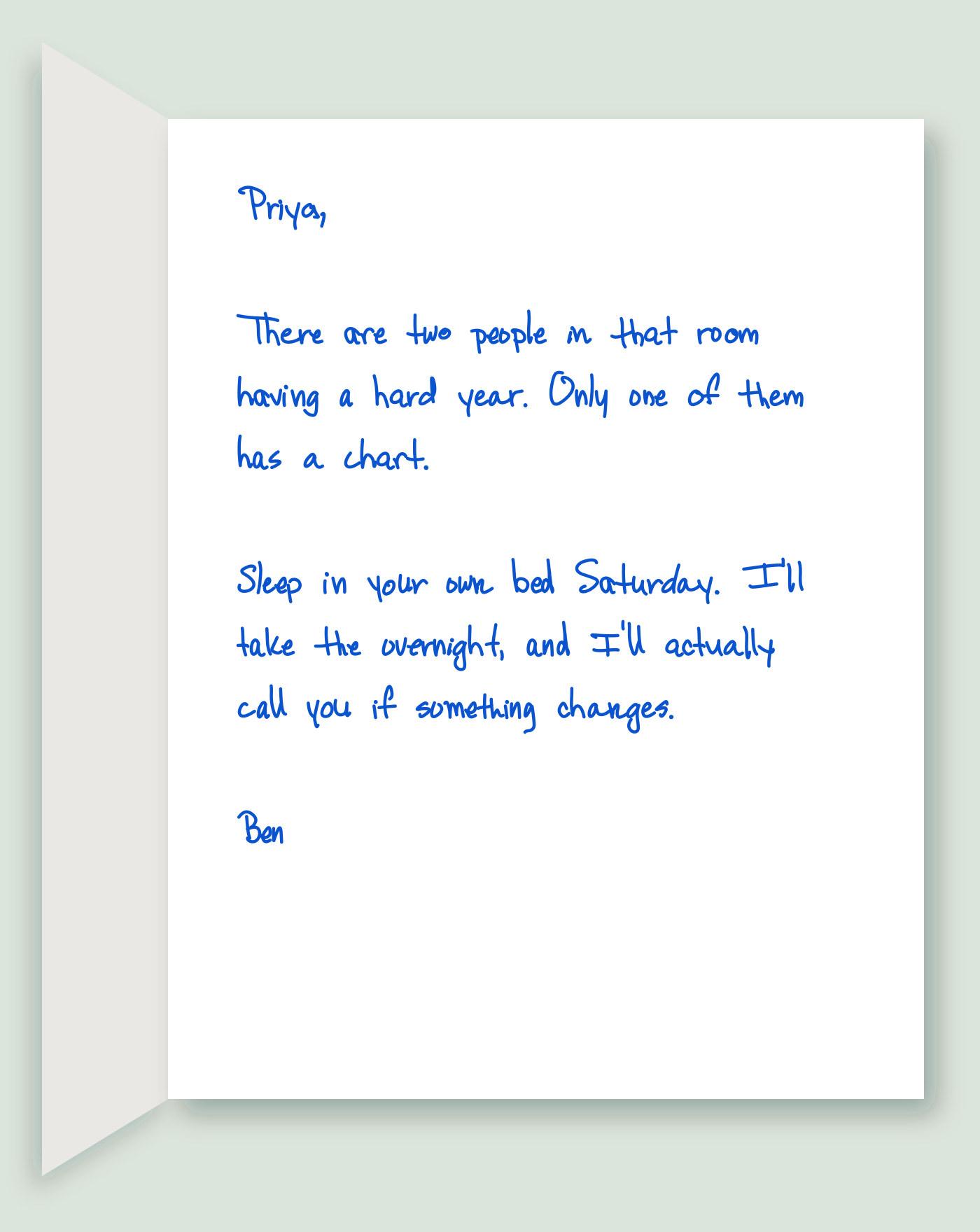
I'd like to help you have a break if there is a safe, agreed way for me to do that. You can decide what would be useful; I won't assume I can take over the care.
I know you have spent a lot of time away from home. If bringing clean clothes or something familiar would help, I can make the trip. I'll check what you want first.
You can tell me about the parts that frustrate you without having to explain how much you love the person you're caring for. I know both can be true.
I'd like to bring you dinner as well as asking about everyone else. Tell me what works for your evening, and I'll check the plan before I cook.
If you'd like company for the trip to the hospital, I can join you Thursday. We can talk on the way or make it a quiet drive.
If you're repeating the same update to lots of people, I can help pass on the exact message you choose. I won't add details or answer questions you haven't agreed to share.
This card is for you. I've noticed how much time and attention you're giving, and I wanted to say that I'm thinking about how you're doing, too.
You've had a lot to learn and keep track of. I won't give you another list of suggestions. I'd be glad to listen or help with a practical job you choose.
The errands we agreed are finished, and I haven't changed anything else at home. I hope that takes a few things off your list for today.
When you have a free afternoon and feel like getting out, I'd love to have lunch with you. We can talk about caring or about something entirely unrelated.
I know the need for support doesn't end after the first week. I'd like to keep checking in, and you can tell me if another kind of help would be more useful.
I'm thinking of the person receiving care and of you, too. You don't have to reply to this card or turn it into an update for everyone else.
For someone you don’t know well
Keep the note warm and let them decide whether to share more. A neighbor, teacher, or professional contact doesn't owe you a health update because you sent a card.
I'm sorry to hear you've been unwell. I wanted to send good wishes and hope you have some comfortable time today.
We've only spoken a few times as neighbors, but I wanted you to know I'm thinking of you. Please don't feel you need to reply.
If a local errand would help, I'm available Saturday afternoon. We can arrange the details if that suits you. Sending good wishes in the meantime.
The class wanted to send a hello. We hope you like the pictures in this card and know we're thinking of you.
My child asked to help choose this card for you. We wanted to send our good wishes, with no need to write back.
The work arrangements we discussed are confirmed. There is no action needed on your side today. Wishing you well.
I heard you've been unwell and wanted to send a note. I hope you have the support and rest you need.
Sending good wishes from your neighbors. We hope today is a little easier and wanted you to know you're in our thoughts.
We don't know each other well, so I won't ask for personal details. I simply wanted to acknowledge what I'd heard and wish you well.
I hope this small gift is useful. We checked what would help before choosing it, and there's no need to send a thank-you. Thinking of you.
Wishing you a comfortable day and kind company when you want it. Please accept my best wishes.
What not to write
These phrases can place an extra burden on the recipient. The source links explain the concerns in more detail. The alternatives are starting points; practical offers still need to be welcome and realistic.
Scroll to compare all columns →
Don’t write | Why | Write this instead |
|---|---|---|
“Let me know if you need anything” | UCLA Health’s Valentina Ogaryan: a diagnosis is often so overwhelming that someone may not know what they need, or cannot express it. Kelly Grosklags, quoted by Living Beyond Breast Cancer: “No one is ever going to call.” | “Would dinner on Thursday help? I’ll check what suits you before I cook.” |
“Stay positive” | City of Hope’s cancer etiquette guidance: “it will only cause frustration and guilt.” | “You don’t have to be cheerful with me.” |
“You’re so brave”, “such a fighter” | MD Anderson: it “may actually make that person feel pressure to display these noble traits when they don’t feel up to it.” The American Cancer Society adds that people told how strong they are “may feel the need to act strong even when they’re sad or exhausted.” | “This is a lot, and you’re allowed to say so.” |
“At least they caught it early” | Ogaryan again, on any sentence starting with “at least”: it “unintentionally invalidates the patient’s current lived experience of the here and now.” | “None of this is fair.” |
“I can imagine how you must feel” | The American Cancer Society, in four words: “because you really can’t.” | “I can’t imagine what this week has been like. I’d listen if you wanted to tell me.” |
“My aunt had the same thing and she’s fine now” | A Memorial Sloan Kettering social worker on comparing diagnoses: “It’s not helpful to compare illnesses.” Macmillan puts it as “cancer is different for everyone.” | Nothing. Delete the sentence. |
“Have you tried [supplement, diet, yoga]?” | CancerCare: “Even after you learn about the cancer diagnosis, you are not an expert.” | An offer of something practical instead. |
“But you look great”, “you don’t look sick” | The Global Autoimmune Institute translates what actually gets heard: “You’re faking it” and “I don’t believe you.” MD Anderson lists “Huh. You don’t look that sick” among things never to say. | “How are you actually doing?” |
“It’s all in your head” | Rogers Behavioral Health: “Mental health challenges are not a matter of willpower, and they often involve biological, emotional, and psychological factors.” | “This is an illness. Trying harder was never the missing piece.” |
“Get well soon”, to someone with a chronic condition | The Mighty asks the fair question: can you say “have a speedy recovery” when “there isn’t a road to recovery yet because there isn’t a cure”? MS Focus suggests a phrase that carries the goodwill without the promise. | “I hope you’re as well as possible.” |
Nothing at all | MD Anderson runs a section headed “Whatever you do, don’t say nothing.” Living Beyond Breast Cancer: saying nothing “can feel like abandonment and be very hurtful.” | A brief note of care, if contact is welcome. No reply needs to be requested. |
Before sending, check that the card doesn't ask them to be positive, answer personal questions, or accept help they haven't agreed to. The note can simply express care.
How to sign a get well card
Use a closing that matches how you usually write to the person. 'With love' can suit family, while 'Warm wishes' works for a colleague. You don't need to invent a second message in the sign-off.
For a partner
With all my love
Love, as always
For a close friend
Lots of love
Thinking of you
From a parent
All my love
A big hug from me
From a sibling
Love from your sibling
From a coworker or your boss
Warm wishes
Best wishes from the team
From someone you barely know
With kind wishes
To a child
A big hug
Lots of love
For a chronic illness
Thinking of you
With love
On a religious card
With love and prayers
Keeping you in my prayers
When to send it, and where
Send the card when you have the words, even if the illness or treatment began a while ago. A later note can simply say you're still thinking of them, without comparing it with the support others have offered.
Check the hospital's own mail instructions before sending to a ward. Confirm the name, address, and any room details they need; ask what happens if the person has been discharged before the card arrives. If you aren't sure it will reach them, use a confirmed home address or give it to an agreed visitor. Check before sending food, flowers, or other gifts.
If you want to keep in touch, make yourself a reminder to send another brief hello. Let the recipient's preferences guide the frequency. They don't have to reply for a note to have been received.
Two neighboring situations have their own rules. If you are writing after a death rather than an illness, none of the above applies and our sympathy card messages guide is the one you want. And if you are the one who was ill and now has a stack of cards to answer, what to write in a thank you card covers that, whenever you have the energy for it.
With Scribble, you choose a card, type your message, and preview one of the available handwriting styles. We write the words with a real pen and mail the card. A single card is $6.99 including US postage. Check the delivery estimate before ordering and use an address where the recipient can receive it. Related source: Scribble
FAQ
What do you write in a get well card?
Say you're thinking of them and wish them some comfort. Add a personal detail or an offer only if it fits your relationship and you can follow through. A few sentences are enough, and you can make it clear that no reply is needed.
What can you say instead of “get well soon”?
'Thinking of you' is a good option when you don't know the details or recovery isn't a clear expectation. You can also write, 'I hope today is a little easier' or 'I'd be glad to keep you company if you want.' Choose wording that fits what they have shared.
What is a good short get well message?
'Thinking of you and hoping today is a little easier' is a simple option. For someone you are close to, 'Sending a hug until I can give you one' can be enough. A short message doesn't need a joke or an offer of help to be useful.
Is it ever too late to send a get well card?
No. You can send a card later in treatment or recovery. Say you've been thinking of them and keep any apology for the delay brief. Avoid implying they should be better by now.
Can you mail a card to someone in the hospital?
Check with the hospital first. Mail rules, addressing details, and handling after discharge vary. If the card may arrive after they leave, a confirmed home address or an agreed visitor may be more practical.
What should you never write in a get well card?
Anything that predicts recovery, compares them to another patient, offers medical advice, comments on how they look, or asks them to stay positive. The American Cancer Society, MD Anderson, UCLA Health, CancerCare and Macmillan all publish versions of that list. Vague offers of help belong on it too.
What do you write to someone before surgery?
Say you'll be thinking of them and acknowledge any worry they've shared. Don't promise the outcome or give preparation instructions. If you're helping with a ride, pets, or updates to relatives, confirm the plan with them first.
How do you write a get well card for a coworker?
Keep the note warm and don't ask for a diagnosis. You can mention a specific work arrangement if it's accurate and agreed, but a simple wish for comfort is enough. Don't promise time off or coverage you aren't able to authorize.
How long should a get well message be?
A sentence or two can work for an acquaintance. For someone close, a fuller note can share ordinary news, offer company, or confirm practical help. Stop when you've said what you mean; there is no need to fill the card.