

Most follow-ups fail because they hand the buyer a chore. "Just checking in on the proposal" means they have to find the proposal, remember what was in it and work out what you want. A good follow-up does that work for them: it says what's new and asks one question they can answer in a line.
This guide is for B2B salespeople, founders who do their own selling, and account managers. The people and companies in the templates are made up. The research is real, and where a famous follow-up statistic turned out to have no source, I say so.
What makes a good sales follow-up email
Six rules cover nearly every follow-up you'll send.
- One clear ask: a date, a name, a yes or no. "Let me know your thoughts" isn't an ask. "Can Luis from the Fresno warehouse join on Thursday?" is.
- Something new every time. An answer to a question they asked, a number they didn't have, a short clip of the feature they cared about, a date that affects them. If you have nothing new, you're not ready to send it.
- Short, but with something in it. Most follow-ups need 50 to 150 words, and a nudge can be shorter if it carries something new. In a Gong study of 304,174 cold follow-up emails, published in 2021, one-line "bubbling this up" notes that only pointed back to an earlier email were 15 times less likely to book a meeting than longer emails.
- A subject line that says what's inside. "Pricing for 12 coolers" gets opened by the person who asked for it. "Following up" could be from anyone.
- Reply in the same thread, so the buyer sees the whole history in one place. Gmail starts a new conversation when the subject line changes, which separates your nudge from the email it's about. Start a new thread only for a new topic, like reopening a deal months later.
- Know when to stop: two emailed nudges and a phone call, then one email that closes the file. Stop at once if they say no or ask you to.
A follow-up plan for every stage of a deal
Each stage has a different job, so each follow-up asks for something different. Here's the whole plan, then a template for each stage.
Scroll the table horizontally if needed.
| Stage | When to send | The goal | The ask |
|---|---|---|---|
| After a discovery call | Same day | Show you listened, and fix what you misheard | Confirm the next meeting and who's in it |
| After a demo | Same day or the next morning | Give your contact something to forward | A meeting with whoever signs |
| After a proposal or quote | Book the review before sending. If you couldn't, two business days later | Find out where the decision stands | Which option is closer? |
| When they go quiet | Two or three business days after your unanswered email, a week later, then call | Make replying take ten seconds | A yes-or-no question or a numbered choice |
| After a trade show or conference | Within two business days of the show closing | Deliver what you promised | One small step: a trial, a sample, a short call |
| After a referral introduction | Within 24 hours | Thank the introducer and set the meeting | 30 minutes, with two times offered |
| After a lost deal | Within a week of the no | Leave on good terms and learn why | One optional question |
| Reopening a cold deal | When something changes for them, or 3 to 6 months later | Give them a new reason to talk | Is this worth 20 minutes now? |
| Closing the file | Two weeks after an unanswered call | Get a clear answer, or end politely | Close the file, or check back in a month you name? |
| After they sign | Within 24 hours | Thank them and say what happens next | A time for the kickoff |
Every template in this post, with [brackets] for your details, is in one Markdown file you can paste into your CRM or sales email tool.
Automate only the nudges and the closing-the-file email. Recaps depend on what was said, so write those yourself from the template. And set any sequence to stop the moment the buyer replies: a nudge that arrives after a yes is worse than none.
Follow-up email after a meeting or discovery call
Send it the same day. It doubles as your thank-you email after the meeting, so one line of thanks is plenty; spend the rest on what you heard. A numbered recap lets the buyer correct you in a sentence, before a misunderstanding ends up in your proposal.
After a discovery call with an operations director
Subject: Notes from Tuesday, and who should join Thursday Dana, Thanks for the hour on Tuesday. Here's what I heard, so you can fix anything I got wrong before Thursday's demo: 1. Fresno is the problem. A full count there eats most of a Saturday, at overtime rates. 2. You're keeping your ERP. Whatever you buy has to read from it. 3. Nothing gets signed before your budget review on March 3. On Thursday I'll show the counting piece only, using a copy of Fresno's bin layout. Could Luis from Fresno join us? He'll spot problems faster than either of us. Marcus
Fictional. Asking for Luis gets the person who knows the problem into the demo, and it shows Dana you were listening when she mentioned him.
Follow-up email after a demo
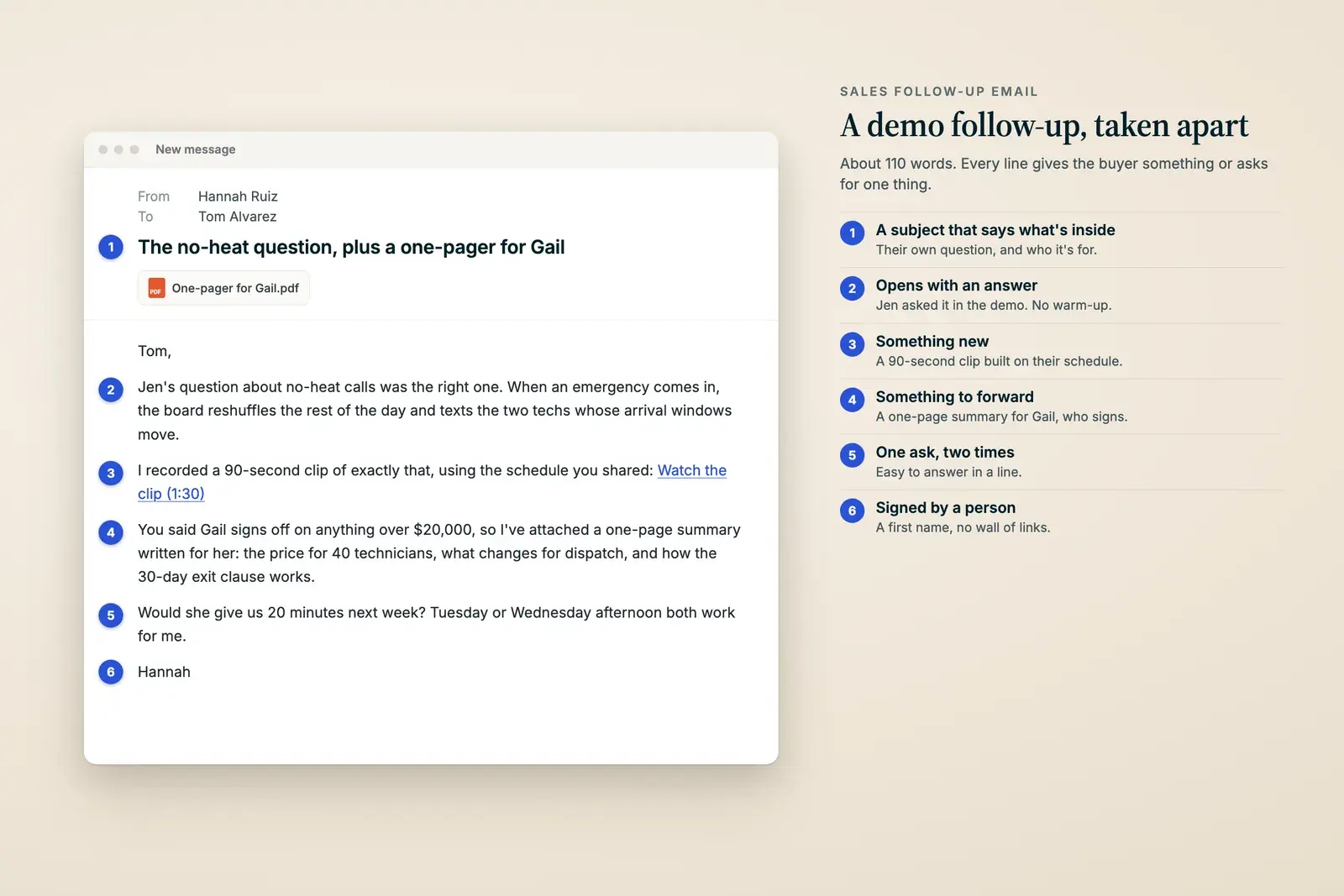
The person who signs often wasn't in the demo. Your contact has to explain it to them, so send something they can forward as is: an answer to the best question from the demo, and a one-page summary written for the approver.
After a demo for an HVAC company's service manager
Subject: The no-heat question, plus a one-pager for Gail Tom, Jen's question about no-heat calls was the right one. When an emergency comes in, the board reshuffles the rest of the day and texts the two techs whose arrival windows move. I recorded a 90-second clip of exactly that, using the schedule you shared: [link] You said Gail signs off on anything over $20,000, so I've attached a one-page summary written for her: the price for 40 technicians, what changes for dispatch, and how the 30-day exit clause works. Would she give us 20 minutes next week? Tuesday or Wednesday afternoon both work for me. Hannah
Fictional. The one-pager answers what approvers ask: what it costs, what changes for their people and how to get out if it doesn't work.
Following up on a proposal or quote
The best proposal follow-up is a meeting you booked before you sent it: "I'll send it Monday. Can we go through it Wednesday at 4?" If you didn't get one, wait two business days, then send something that helps them decide. Answer the question they're probably stuck on, and ask them to pick.
Two business days after a quote to a dental practice
Subject: Harbor IT proposal: the Saturday switchover Lena, One thing I should have put in the proposal: we'd move both offices over on a Saturday, so Monday's 8 a.m. patients won't notice a thing. The imaging software is the only piece we'd test first, on the Friday before. Which of the two options is closer to what you and Dr. Patel want: $2,900 a month with phone support, or $3,400 with a technician on site once a month? Sam Whitfield Harbor IT
Fictional. A choice between two options is easier to answer than "Any questions?", and either answer tells you where you stand.
When a buyer goes quiet: two short nudges
Silence usually means the deal slipped down their list. Keep nudges short, keep them in the same thread so the context is one scroll away, and make each one easier to answer than the last.
Nudge 1: two or three business days later
Subject: Re: Fennel & Fig scheduling pricing Maya, A detail I should have sent with the pricing: if you start on April 1, your managers build the May schedule in the new system. Starting May 1 means one more month of the shared spreadsheet. Is April 1 still the plan? Andre
Fictional. The new fact is a date that matters to her, which gives her a reason to answer.
Nudge 2: about a week after that
Subject: Re: Fennel & Fig scheduling pricing Maya, If the timing has changed, that's fine. Reply with a number and I'll take it from there: 1. Still April 1 2. Later this year 3. We've gone another way 4. Someone else owns this now Andre
Fictional. Numbered answers turn a reply into one keystroke. "Later this year" counts as an answer: note it in the CRM and stop nudging until then.
If both go unanswered, pick up the phone. If the call goes nowhere too, send the closing-the-file email below.
Trade show and conference follow-up email
Send it within two business days of the show closing, while they still remember your booth. Open with where you met and what they told you, and put whatever you promised in this email instead of saying it's on the way.

After a conversation at a trade show booth
Subject: Booth 1412: pricing for the cooler sensors Ben, We talked at booth 1412 on Wednesday about the walk-in cooler alarms that get your managers out of bed at 3 a.m. Here's the pricing I promised for 12 coolers across your four stores: $1,860 for the sensors, then $96 a month. The spec sheet is attached. The part you liked was the text that says which cooler and how warm it is, so whoever's on call can decide whether it can wait until morning. Want me to set up one store on a free 30-day trial before the July heat? Carla Mendes Coldline Sensors
Fictional. The booth number and the 3 a.m. alarms are details no other exhibitor could have written.
Follow-up after a referral introduction
Reply within a day, to everyone on the email. Thank the person who introduced you in one line and move them to BCC, so they can see you answered without getting the rest of the thread. Then make it easy for the new contact to say yes.
Replying to an introduction from a client
Subject: Re: Intro: Nina (Saltbox Studio) and Owen (Ledgerline) Thanks, Grace. Moving you to BCC to spare your inbox. Nina, Grace mentioned you're about to hire a third project manager and aren't sure the margins can carry it. That's the question I help design studios answer before they make the offer. Could we talk for 30 minutes this week? Thursday at 2 or Friday at 10, your time. Owen Park Ledgerline
Fictional. Once the meeting has happened, send Grace a separate thank-you and tell her how it went. People who make introductions like to know they were worth making.
Follow-up email after a lost deal
A lost deal still deserves a follow-up. The buyer will remember how you took the no, and their new vendor may not work out. Thank them for telling you and ask the one question you'd most like answered. Then leave it alone. Skip the discount and skip "let me know if anything changes." They know where to find you.
After a controller picks another payroll provider
Subject: Re: Bayside payroll decision Ines, Thanks for telling me directly, and for explaining the trouble with the boatyard crew's seasonal hours. I'm passing that to our product team. One question, if you're willing: was it mostly price, or the timesheet app? A one-word answer is plenty. Good luck with the switch in January. If it gets bumpy, my cell is 617-555-0148. Felicia
Fictional. Set a CRM reminder for a month or two after their go-live date. If the new system is giving them trouble, that's when you'll hear about it.
How to reopen a deal that went cold months ago
A deal that went quiet months ago needs a reason to come back, and "checking in" isn't one. Good reasons: something changed for them (a new location, a new boss, a new budget year, a job posting for the work your product does), or something changed on your side that answers their old objection. Start a new thread with a new subject, since this is a new conversation.
Reopening a deal after five months
Subject: Your Reno warehouse Rachel, Congratulations on Reno. Last June you put the inventory project on hold until the new building was settled, and your press release says it opens in March. Since then we've added the thing your team asked about: counts from a phone, no scanner gun. If you're planning Reno's setup now, is it worth 20 minutes to see it, or is it still too early? Kenji
Fictional. The press release gives the timing, and the new feature is the one her team asked for.
If your contact has left the company, treat the account as new outreach. These sales prospecting letters work as a first approach to whoever replaced them.
The closing-the-file email (a polite breakup)
When two emails and a call have gone unanswered, stop asking for the meeting and ask for an answer instead. Keep it short and kind, and make "not now" an easy reply. "I guess you're not interested" is a guilt trip, and a fake deadline is worse.
Closing the file after a month of silence
Subject: Re: Halvorsen dashboard pilot Chris, Peak season has probably buried the pilot plan, so I'll stop sending reminders. Should I close the file on this, or check back in January when things slow down? Priya
Fictional. Then do exactly what you said. No reply means you close it, set a reminder for January and send nothing until then.
Thank-you email after they sign
Send it within a day of the signature. Thank them for something specific and introduce the person who takes over. The only ask is the kickoff. Save upsells and referral requests until they've seen results.
After a safety software contract is signed
Subject: Signed. Here's what happens next Joe, Thank you for signing on Friday, and for getting it through before the safety audit. I know that took some convincing on your end. Here's what happens next: Ana Lima runs your setup. She'll have all 14 job sites loaded by the 12th, and she'll call you before anything goes live. Does Tuesday at 9 work for a 30-minute kickoff with Ana? Nadia
Fictional. Getting it signed before the audit was work Joe did inside his own company. Nobody else will thank him for it.
This is also the best moment for a handwritten card, because there's nothing left to sell. How to write a business thank-you note has wording for it, and this first-year client plan covers what comes after the kickoff.
Sales follow-up subject lines that work, and ones to drop
A follow-up subject line has one job: say what's inside, so the right person opens it for the right reason. Most of the time you won't write one, because you're replying in the thread and the original subject stays. When you do need a new one, name the company, the topic or the thing you promised. Every template above shows one.
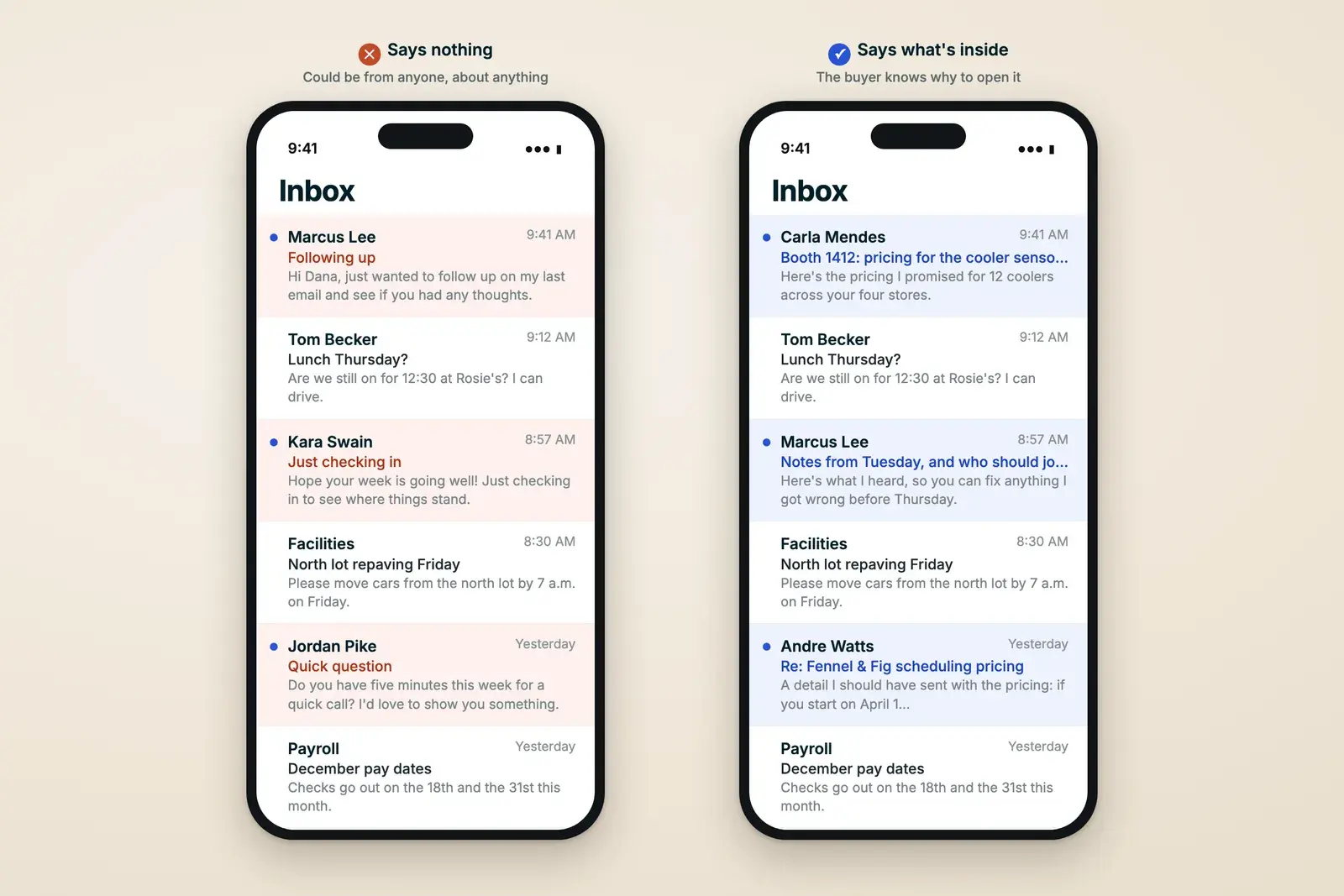
And the ones to drop:
- "Just checking in," "Touching base" and "Following up": they say you want something without saying what.
- "Did you get my last email?": it sounds like a complaint and sends them digging through their inbox.
- "Quick question": vague, and the question rarely is.
- "Re:" on an email that isn't a reply: people spot the trick, and the FTC's CAN-SPAM guide says a commercial email's subject line must accurately reflect the content of the message.
- A fake deadline, like "Pricing expires Friday" when it doesn't. It works once, and after that nobody believes your dates.
How long to wait and how many times to follow up
After a meeting or a demo, follow up the same day. After silence, wait two or three business days before the first nudge. People who answer email tend to answer fast: in a Yahoo Labs and USC study of 16 billion emails, more than 90% of replies came within a day, and half within 47 minutes. Those were people who already wrote to each other regularly, so treat it as a best case. Still, if three days have passed, your email has most likely been buried, and a nudge is fair.
Then widen the gaps: about a week before the second nudge, another week before you call, and two weeks before the closing-the-file email. That's roughly a month from the first unanswered email to the last.
Each touch gets fewer replies than the one before. Gong found reply rates never rose after the first email and fell with every follow-up. The later emails still add up, though. In Belkins' study of 7.5 million cold emails sent in 2025, follow-ups brought in 58.6% of all replies, and just over half of the booked meetings came from the third email or later. Belkins found little to gain after the fifth email and recommends switching to LinkedIn or the phone instead of sending a sixth.
Both studies measure cold outreach to strangers. I couldn't find solid published data on following up with buyers you've already met, so I take two lessons from them and no more: expect each nudge to do less than the last, and don't expect extra emails to fix a silence.
Stop sooner if they say no (reply once, thank them, stop) or ask you to stop. If your follow-ups count as marketing email, CAN-SPAM says you must honor an opt-out within 10 business days. And at volume, remember that an annoyed prospect can press "Report spam." Google asks everyone sending to Gmail to keep spam rates below 0.3%, and recommends staying under 0.1%.
When to call, use LinkedIn or send a handwritten note
Switch channels when two emails in a row go unanswered on a live deal. By the fourth email, the buyer can guess what's in it without opening it.
- Call when a deal has gone quiet after two emails, when the news is bad (the price went up, the start date slipped), or when the email would take ten minutes to write. Leave a short voicemail with the one thing you need, then put it in writing in the thread. Don't make "I just called" the point of that email: in Gong's analysis, mentioning a call made no difference to meetings booked.
- Use LinkedIn when email isn't getting through at all, or the day you meet someone in person. A connection note can be up to 200 characters, and without Premium you can add one to only three requests a month, so save them for people you've met.
- Send a handwritten note after an in-person meeting, on a big deal, when they sign, or after a loss you'd like to win back someday. A card stands out in a way the fifth email doesn't: it's in pen, and it arrives somewhere other than the inbox you've been filling.
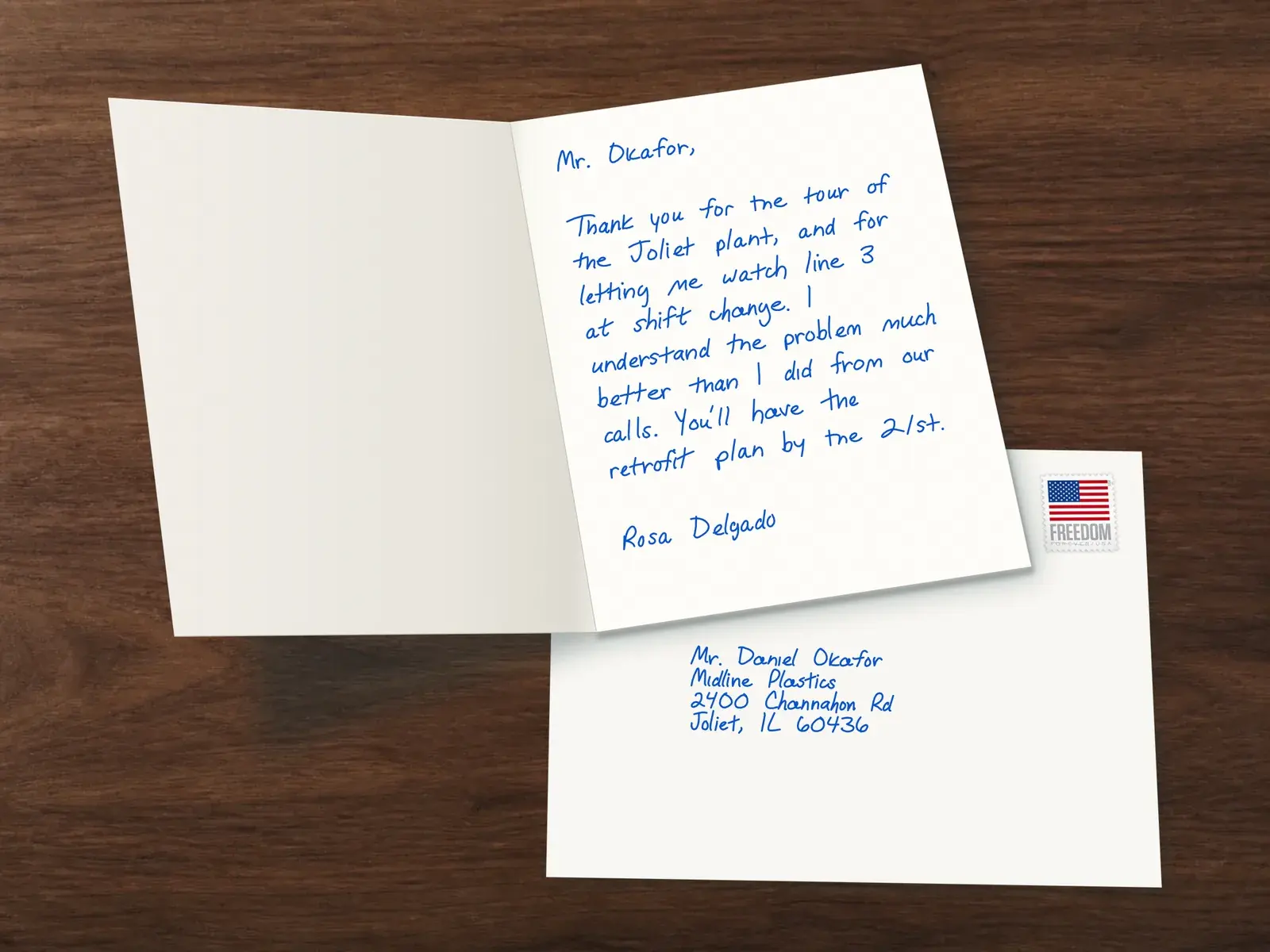
A handwritten note after a plant visit
Mr. Okafor, Thank you for the tour of the Joliet plant, and for letting me watch line 3 at shift change. I understand the problem much better than I did from our calls. You'll have the retrofit plan by the 21st. Rosa Delgado
Fictional, about 220 characters. Send the email recap the same day; the card follows a few days later with the thanks, and no pitch.
Published research on handwritten notes in sales is thin. This guide to handwritten notes in sales covers what it does and doesn't show, and these notes to prospects cover people you haven't met yet. If you'd rather not handwrite and mail them yourself, Scribble Cards can do that part: you type the message, it's written in real ballpoint pen within 1 to 2 business days and mailed with a real stamp, and you can send from HubSpot or Zapier. Order a free sample to see one first.
Frequently asked questions
How long should you wait before following up on a sales email?
After a meeting, follow up the same day. After an unanswered email, wait two or three business days for the first nudge, about a week for the second, then call. People who reply usually do it fast: in a study of 16 billion Yahoo Mail messages, more than 90% of replies came within a day.
How many times should you follow up on a sales email?
For a buyer you've met: two emailed nudges and a call over about a month, then one email that closes the file. For cold prospects, Belkins' data on 7.5 million emails points to three to five emails in total. Stop at once if they say no or ask you to stop.
What should a follow-up email say after no response?
One new fact and a question they can answer in a few words: "A detail I should have sent with the pricing: if you start April 1, your managers build the May schedule in the new system. Is April 1 still the plan?" Skip "just checking in." It makes them do the work of remembering what you wanted.
How do you follow up without being annoying?
Annoying is the same email three times. Bring something new each time, leave a few business days between messages, keep to one ask, and say when you'll stop. Then stop.
Is it OK to send a follow-up email on a Friday?
Yes. In Belkins' analysis of 7.5 million cold emails sent in 2025, Friday's reply rate (0.44%) was close to the best weekdays, Wednesday and Thursday (0.48%), and Friday emails booked meetings at the same rate as Monday, Tuesday and Thursday. What you say matters far more than the day you say it.
What's a good subject line for a follow-up email?
One that says what's inside, like "Pricing for 12 coolers" or "Notes from Tuesday." When you're replying, keep the original subject so the email stays in the same thread. "Following up" and "Quick question" tell the reader nothing.
How do you follow up with a client after a sale?
Thank them within a day and tell them who does what next. Around day 30, ask a specific question, such as "What's been harder than you expected?" After that, stay useful between invoices. This first-year client retention plan has a month-by-month schedule.
Reviewed .