
Keeping a client is a dozen small jobs that nobody schedules: a card in week one, a call on day 30, a renewal meeting three months before the date. Each one is easy to skip, and skipped ones add up until a happy client starts taking a competitor's calls.
This guide is for service businesses and B2B account managers: bookkeepers, agencies, IT and cleaning companies, consultants, anyone whose clients can leave when a contract ends. The people in the examples are made up. The research is real, and each claim links to its source.
What keeping a client is worth
Winning a new client costs more than keeping one you have. In Harvard Business Review, Amy Gallo put it at five to 25 times more, depending on which study you believe and what industry you're in. [1]
Clients also tend to get more profitable the longer they stay. Fred Reichheld of Bain & Company, who created the Net Promoter Score, gave the reasons: returning customers buy more over time, cost less to serve and refer other people. In financial services, he wrote, a 5 percent increase in customer retention produced more than a 25 percent increase in profit. [2][1]
A client's first year at a glance
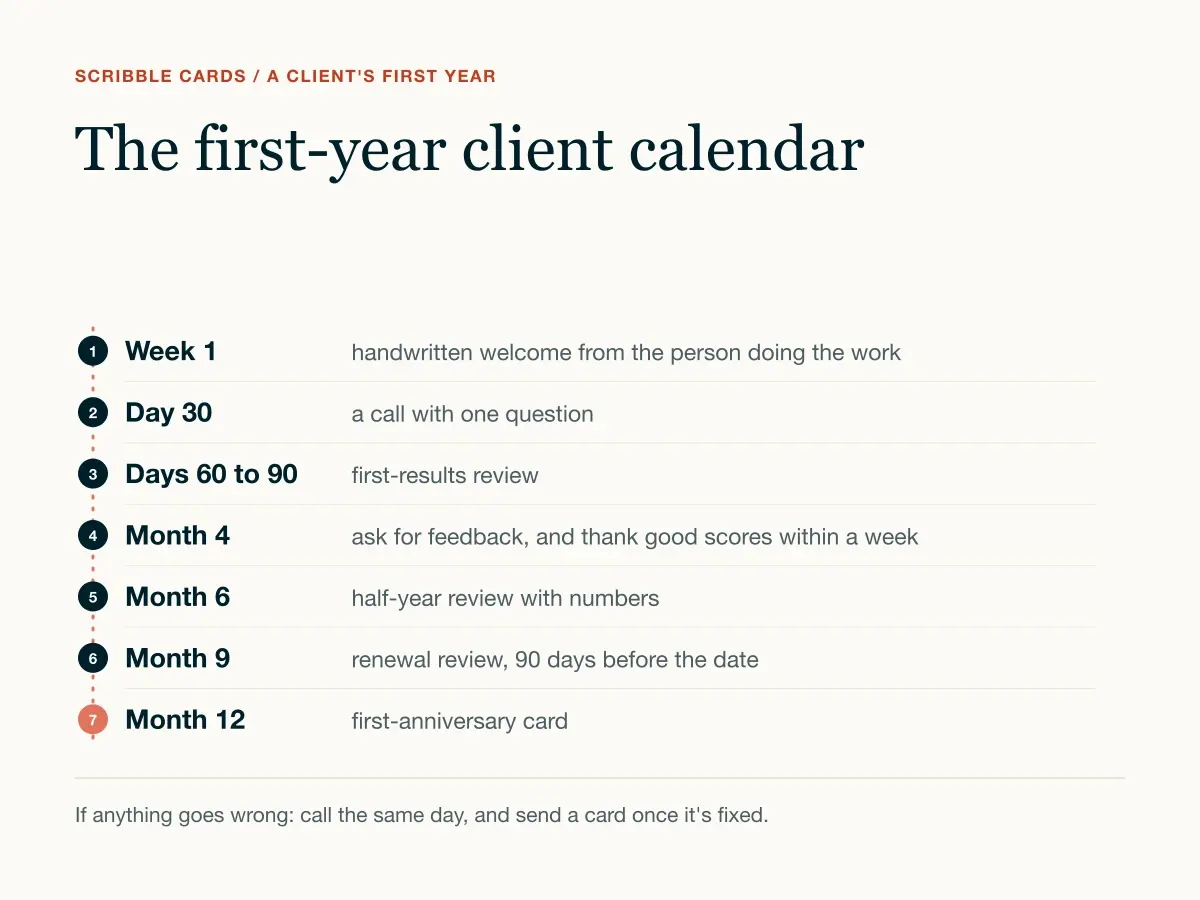
Most of these take ten minutes. Two take real preparation: the first-results review and the renewal review. Those are the meetings where you hear about a problem while there's still time to fix it.
Put every date on the calendar the day the contract is signed. The spreadsheet below has all of them, with an example line for each.
The first 90 days: show them they chose well
New clients spend their first few months quietly checking whether they made a mistake. Every early touch should answer that with evidence: someone knows their name, the first deliverable arrived when you said it would, and problems reach them from you before they find them on their own.
The first 90 days, step by step
Day 1: a welcome email with names and a date
Who does the work, who to call when something breaks, and when the first deliverable lands. Three names and one date do more than a 20-page onboarding deck.
Week 1: a handwritten card from the person doing the work
Not the CEO, and not the salesperson they already met. The person who will be in their inbox every week. Mention one thing from the kickoff so it's clearly about them.
Day 14: point out the first win
The first report filed, the first site visit done. Clients don't always notice finished work, so name it in two lines.
Day 30: call and ask one question
"What's been harder than you expected?" Then stop talking. It brings out the problem they've been too polite to mention.
Days 60 to 90: a first-results review
Thirty minutes on what you agreed at kickoff and what actually happened. Bring numbers. If something slipped, say so before they do.
A week-one card from a bookkeeper
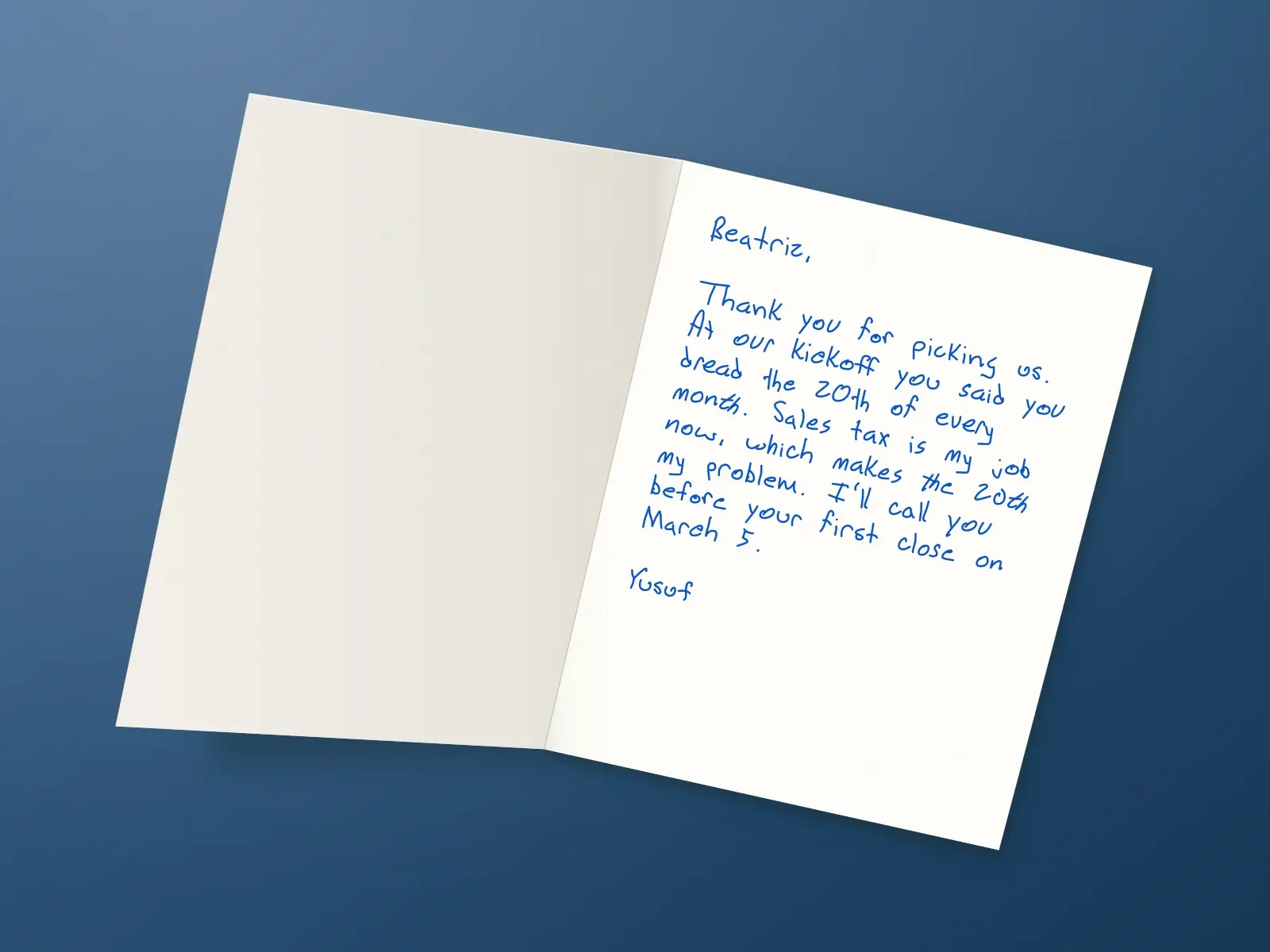
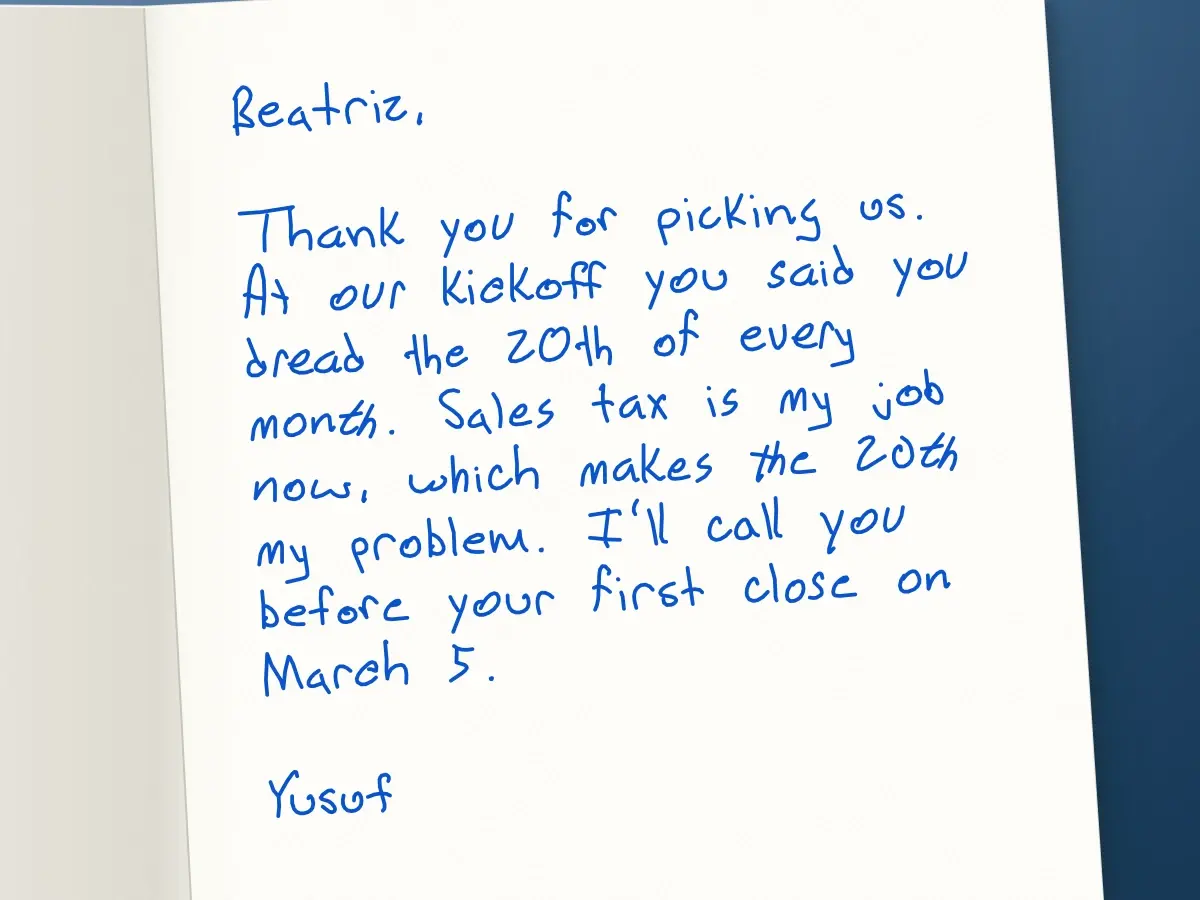
Beatriz, Thank you for picking us. At our kickoff you said you dread the 20th of every month. Sales tax is my job now, which makes the 20th my problem. I'll call you before your first close on March 5. Yusuf
Fictional. The 20th came up at the kickoff call. Use whatever your client said that nobody else would have said.
Save congratulations for real progress. A "great first month" card that arrives while setup is still stuck tells the client nobody is paying attention. If nothing has gone right yet, send the plan for fixing it instead.
Months 4 to 9: stay useful between invoices
- Ask how it's going around month four. Two questions by email are enough: what's working, and what would you change? Answer every reply the day it arrives.
- Thank good feedback within a week, and have someone senior do it. The research on why is in the next section.
- Hold a half-year review with numbers, even if the contract doesn't require one. In B2B this is often a QBR, a quarterly business review.
- Send the holiday card in November. A Thanksgiving card lands in a quieter mailbox than a Christmas card and doesn't have to guess what anyone celebrates.
- Watch for their news: a promotion, a new office, an award, a funding round. A card about their win beats ten emails about your services.
To a client contact who just started a new job
Greta, Congratulations on the new job. Three years of Monday calls, and you never once let a problem wait until Tuesday. Your new team is about to find out what that's like. Vikram
Fictional. No pitch and no "keep us in mind." She knows where to find you.
Thank people for specific things, and leave the coupon out
Two field experiments, eight years apart, point the same way. In a 12-month study at an upscale restaurant group, customers who gave top scores on a satisfaction survey and then got a thank-you email from the company president increased their spending by 51 percent over a control group who got nothing. Adding gift cards or guaranteed reservations did no better than the plain thank-you. An instant automated reply added nothing at all; the email that worked went out within a week. [4][5][3]
In 2022, a randomized field experiment with an online retailer found that a handwritten note raised what customers spent afterward. Adding a giveaway or a discount to the note weakened the effect, and the lift showed up among loyal customers, not new ones. [6]
Neither study looked at B2B contracts, so don't expect the same numbers. The pattern is still worth copying: thank clients you already have, name what they did, send it from a person a few days after the moment, and put nothing for sale in it.
Before and after: thanking a client for good feedback
Before: Thank you for your business. Enjoy 15% off your next project with code THANKS15. After: Mr. Dumont, Your survey said Lourdes "answers before I finish asking." I read it out at Monday's team meeting. She pretended not to hear, then asked me to read it again. Thank you, Daria Wexler
Fictional. The after version names the employee, quotes the client's own words and comes from the owner. It sells nothing.
Renewals: start 90 days before the date
If the first renewal conversation is the invoice, you're relying on luck. Work back from the renewal date instead.
A renewal timeline for annual contracts
120 days out: check the account yourself
Results against the goals they named at kickoff, open issues, slow payments, and who signs now. If the person who hired you has left, you're starting over, so start now.
90 days out: hold a renewal review
Thirty minutes with whoever decides. Show what you delivered in their terms (hours saved, errors caught), ask what they'd change, and agree on next year's goals.
60 days out: call, then send the proposal
Explain any price change on the phone first, with the reason in one sentence. Nobody should discover a price increase on an invoice.
30 days out: paperwork and a plan
Signatures, the start date of the new term, and the first thing you'll do in it.
After they sign: a thank-you card
From the account lead, naming one thing from the year. It ends the year on something warmer than a contract.
If they don't renew, ask why and listen without arguing. Then send a short thank-you for the work you did together. It costs one card and leaves the door open if the replacement disappoints.
When something goes wrong: an apology that keeps the client
In the 2015 Customer Rage Survey, run by Customer Care Measurement & Consulting with Arizona State University's Center for Services Leadership, 75 percent of people who complained about a product or service wanted an apology. Only 28 percent got one. When an apology or another non-money remedy was added to a refund or credit, satisfaction with the response nearly doubled, from 37 to 73 percent. [7]
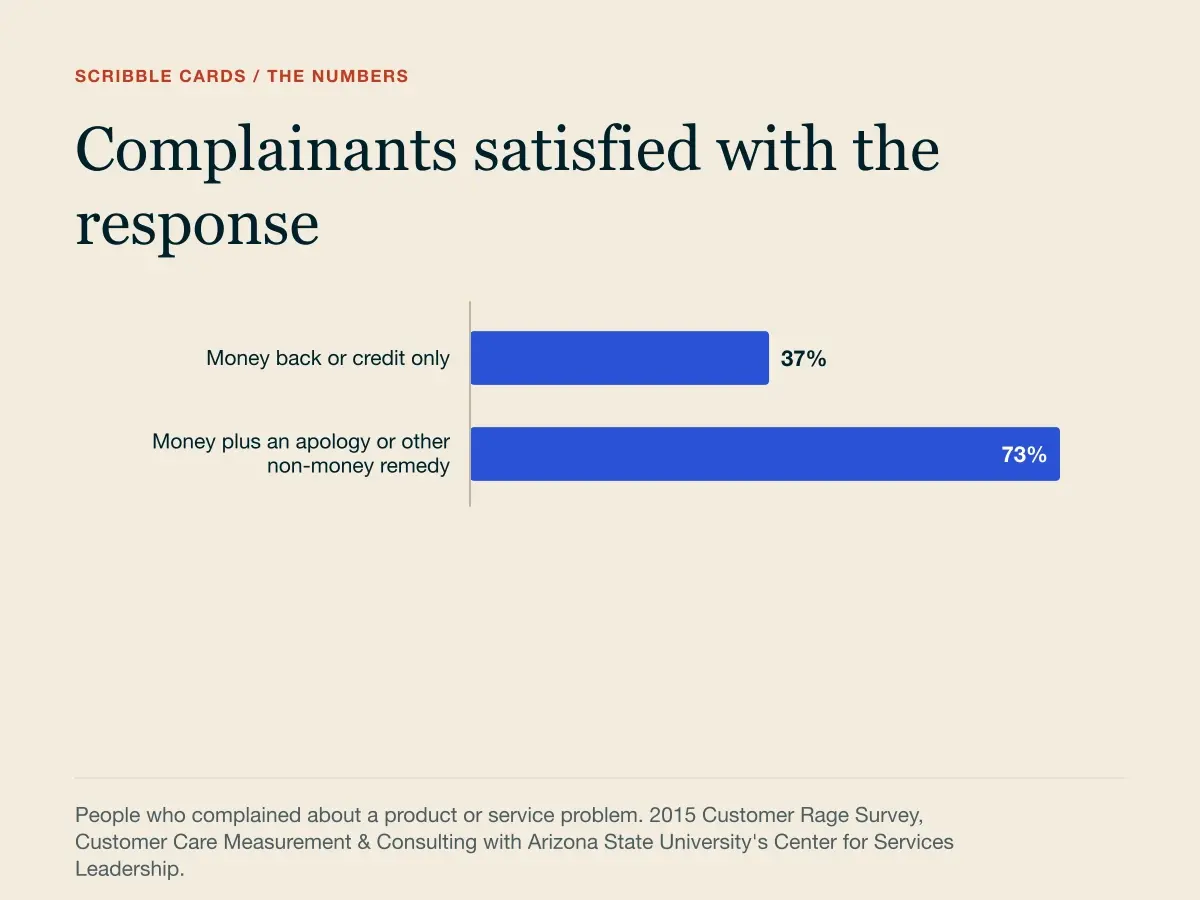
That survey covered consumer complaints, not business contracts, but the lesson costs nothing to apply: never send a credit without an apology attached.
How to apologize to a client
Call the same day
If you can, before they hear it from someone else. Email is for the written follow-up, not the apology.
Say exactly what happened
One specific sentence: "We filed your sales tax return two days late." Not "there was an issue with your account."
Own it
"That's on us." Skip "we apologize for any inconvenience" and skip "if." Don't blame a vendor or the new hire, even when it's true.
Say what's fixed and what's changing
"The penalty is paid, and every return now goes out five days early with a second person checking it." A change they can see is the part they'll remember.
Make it right in proportion
If it cost them money, cover it. If it cost them time, take something off the bill. A coffee gift card for a missed filing deadline reads like a joke.
Send a card once the fix is done
A few days later, handwritten, from the person who owns the mistake. It shows the apology wasn't only damage control.
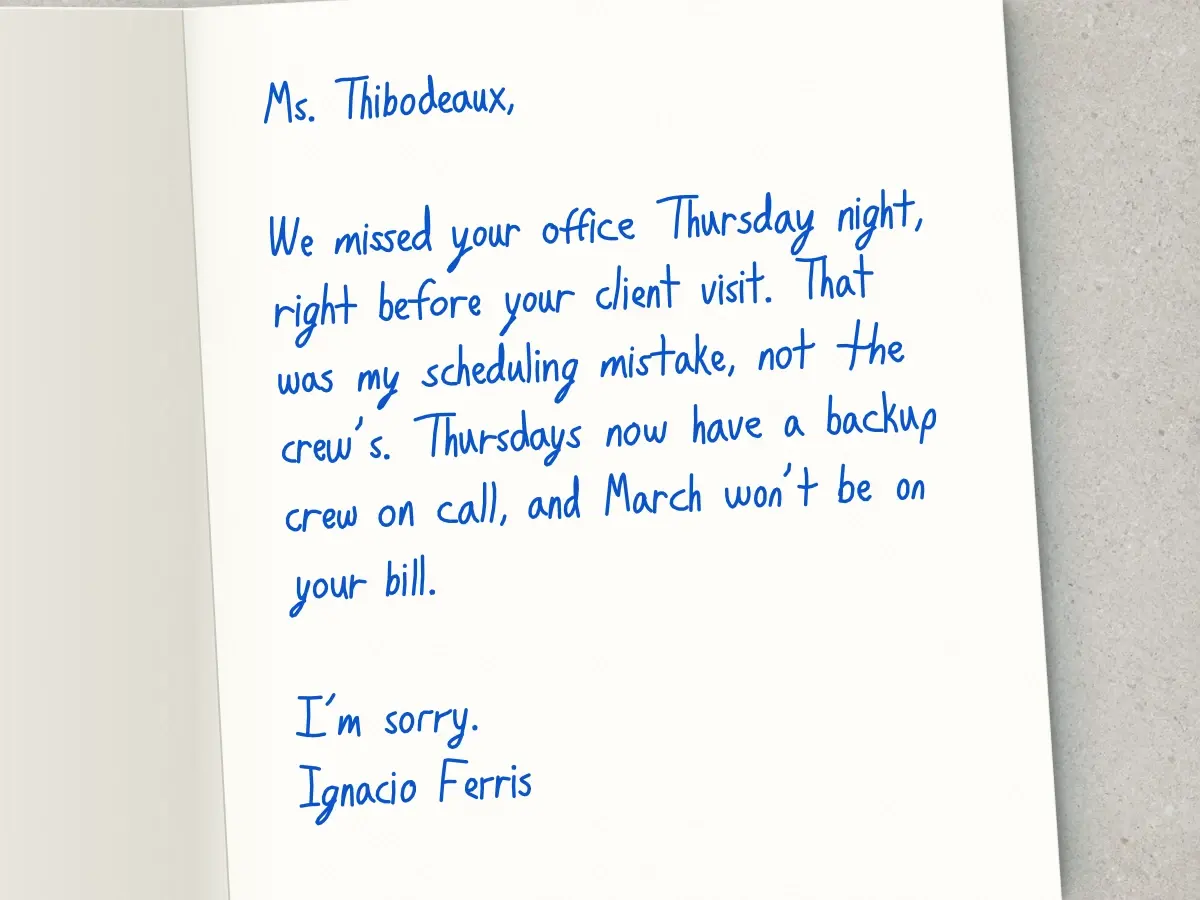
An apology card, mailed after the fix
Ms. Thibodeaux, We missed your office Thursday night, right before your client visit. That was my scheduling mistake, not the crew's. Thursdays now have a backup crew on call, and March won't be on your bill. I'm sorry. Ignacio Ferris
Fictional. It names the night, takes the blame off the crew, says what changed and asks nothing of her.
Milestones worth a card (mostly theirs)
A milestone card works when it's about something the client cares about. Your firm's tenth anniversary is your milestone. Their first year with you, their promotion and the result you helped them reach are theirs.
Scroll the table horizontally if needed.
| Milestone | When to send it | What to write |
|---|---|---|
| One year as a client | To arrive the week of the signing date | Count something real: twelve monthly reports, 40 site visits, the first audit with no findings. |
| Their company's anniversary | Their founding date, often on their website | "Twenty years of keeping Dayton's lights on" beats "congratulations on your milestone." |
| A promotion or new title | The week it's announced | Put the new title on the envelope. If you saw what earned it, say so. |
| A result you helped with | When the numbers come in | Name the number, then give them the credit: "Twelve straight on-time closes. That was your team." |
| A new office or location | Moving week | Send it to the new address and say something about the old one. |
| Five or ten years together | The anniversary month | Say what's changed since you started, including who's still there. |
| Personal news they shared | When it happens | A new baby, a first marathon, a kid's graduation, a new dog: a short card with no business in it. |
Signing anniversaries are easy to run from a list. In Scribble Cards you can upload clients with their start dates once, and each year's card is still written individually in real pen and mailed with a real stamp. Cards are written within 1 to 2 business days and USPS usually takes 2 to 5 more, so set them to go out about a week early.
A first-anniversary template for a client list
{{first_name}}, One year ago this week you handed us your books. Thank you for twelve month-end closes, and for answering my emails faster than I answer yours. Yusuf
{{first_name}} fills in from your list. Every line has to be true for everyone who gets it, so split the list by service if you need to.
Measure it: your retention rate and the warning signs
Client retention rate is the share of the clients you had at the start of a period who are still with you at the end. Leave new clients out of it, or a good sales year hides the ones you lost.
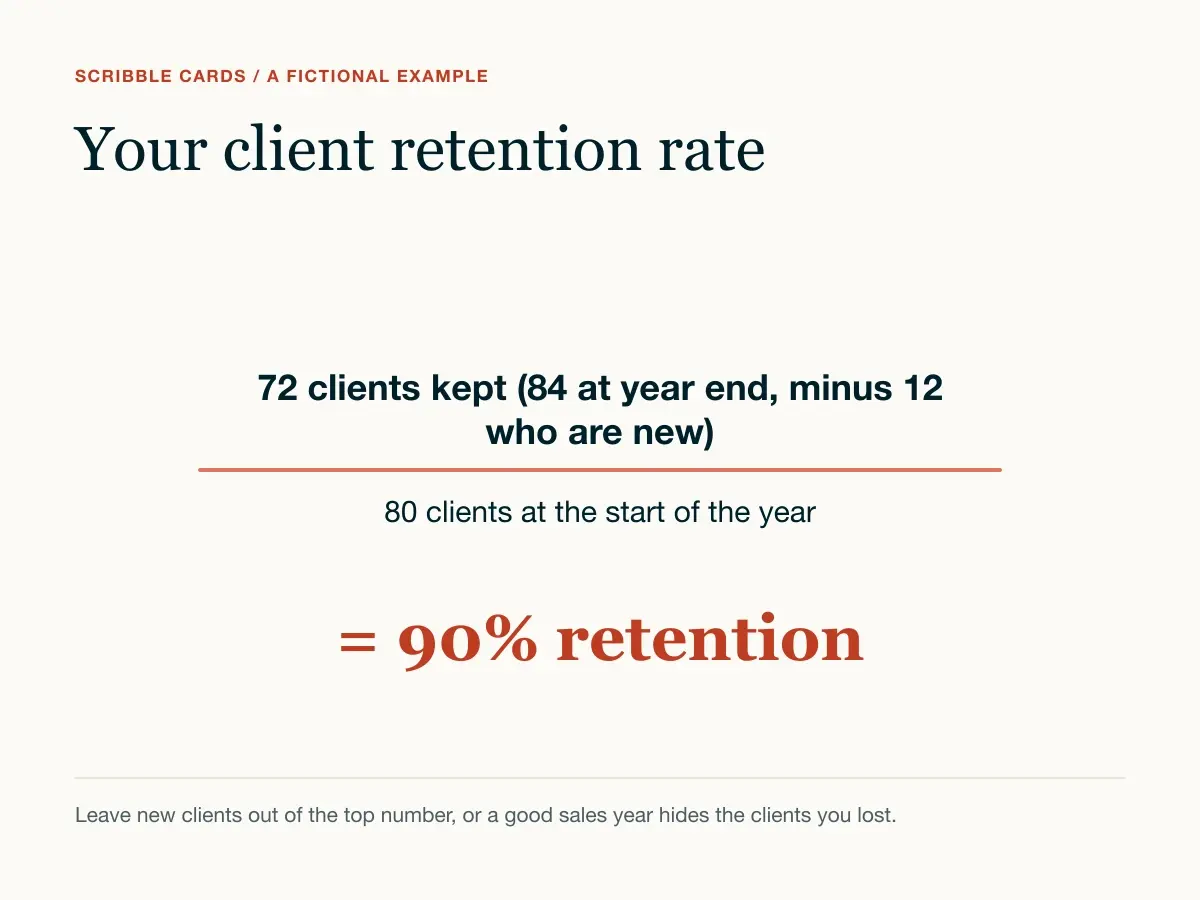
There's no universal good number. A weekly lawn service and a law firm on annual retainers can't be compared. Track your own rate every year, and if you sell recurring contracts, track revenue kept too. A client who stays but cuts the scope in half is half a loss.
Watch for the signs that usually come before the cancellation email:
- Your main contact changes jobs or stops replying.
- Meetings get moved twice in a row.
- Invoices start getting paid late.
- They stop asking you for anything new.
- Someone from finance or procurement starts joining calls.
If you add cards to the mix, don't credit them for every client who stays. Many would have stayed anyway. To know whether cards help, you'd have to hold back a random group for a year and compare renewal rates, and with a few dozen clients the difference is hard to read.
Frequently asked questions
What is a good client retention rate?
There's no reliable benchmark across industries, so the best comparison is your own rate last year. A firm on annual contracts or retainers expects to keep most of its clients from one year to the next. A business that sells one-off projects will show lower numbers by design and should track repeat clients instead. Whatever you track, calculate it the same way every time: clients at the end, minus new clients, divided by clients at the start.
How do you calculate client retention rate?
Take the clients you have at the end of the period, subtract the new ones you added during it, divide by the number you started with and multiply by 100. With 80 clients in January, 12 new ones during the year and 84 in December, that's 84 minus 12, divided by 80: 90 percent.
How often should you contact clients?
For most service clients, something every month, and not all of it email: a report or a quick check-in counts. Add a real conversation every quarter and a handwritten card two or three times a year, for example in the first week, around Thanksgiving and on their anniversary with you.
How do you win back a client who left?
Ask why they left and listen without arguing. A few months later, send a short card with no offer in it that thanks them for the work you did together. If they left over a problem you've since fixed, tell them once, plainly. Then leave it alone.
Do gifts help keep clients?
Less than you'd think. In the restaurant study above, adding gift cards to a thank-you didn't beat the thank-you alone, and the handwritten-note experiment found that discounts weakened the effect. If you do give gifts, the IRS caps the deduction for business gifts at $25 per recipient per year, so check with your accountant before you plan a big holiday budget. [5][6][8]
Sources and methodology
Reviewed .
- The Value of Keeping the Right Customers
Harvard Business Review · Published · Accessed
By Amy Gallo. Source of the five-to-25-times acquisition cost range, and of the 25-to-95-percent profit claim credited to Fred Reichheld, which links to the Bain note below.
- Prescription for cutting costs
Bain & Company · Accessed
By Fred Reichheld, 2001. States that in financial services a 5% increase in customer retention produces more than a 25% increase in profit.
- Managing Post-Purchase Moments of Truth: Leveraging Customer Feedback to Increase Loyalty
Marketing Science Institute · Published · Accessed
Report 14-115 by Clay M. Voorhees, Paul W. Fombelle, Alexis Allen, Sterling A. Bone and Joel Aach. A 12-month field experiment with customers of a hospitality firm.
- Saying 'Thank You' Pays Off
Gatton College of Business and Economics, University of Kentucky · Accessed
Summary of the MSI study by co-author Alexis Allen's college: thank-you recipients increased spending by 51% over a control group, and adding a reward coupon had no effect.
- Thanking customers can reap rewards
Phys.org, reporting Michigan State University research · Published · Accessed
Lead author Clay Voorhees: the thank-you went out within a week of the survey, rewards such as gift cards and guaranteed reservations didn't matter, and an immediate automated response provided no value.
- Do Handwritten Notes Benefit Online Retailers? A Field Experiment
Journal of Interactive Marketing · Published · Accessed
Sanghwa Kim, Jeonghye Choi and Seung Hyun Kim, volume 57, issue 4. Findings taken from the published abstract.
- Holiday spirit turns to rage when customers need service
W. P. Carey School of Business, Arizona State University, via PR Newswire · Published · Accessed
Results of the 2015 Customer Rage Survey by Customer Care Measurement & Consulting and Dialog Direct with ASU's Center for Services Leadership.
- Publication 463 (2025), Travel, Gift, and Car Expenses
Internal Revenue Service · Accessed
Chapter 3, Gifts: the $25 limit per recipient per tax year.