
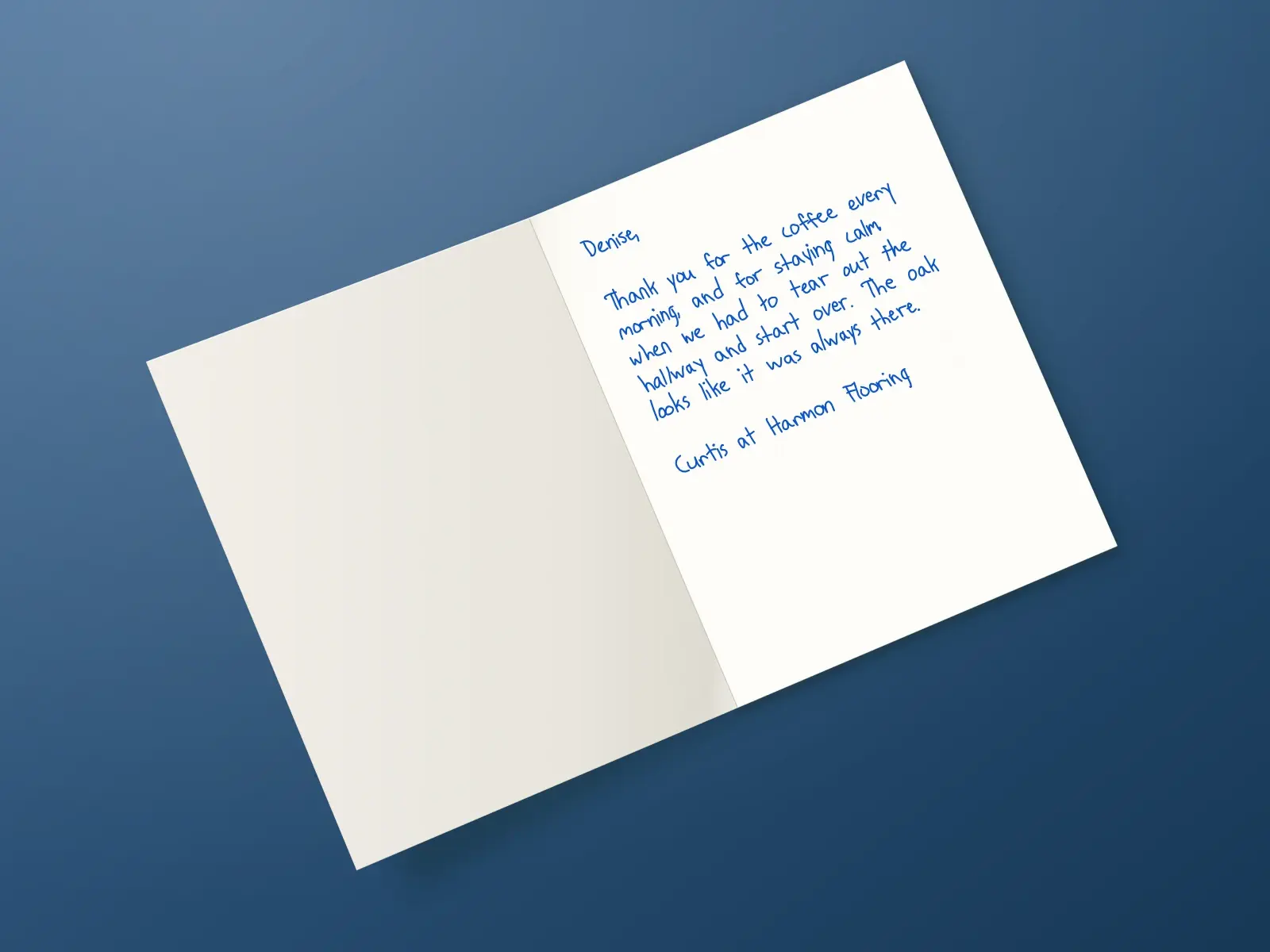
Most business thank-you notes fail the same way: they could have gone to anyone. "Thank you for choosing us for your recent project. We look forward to serving you again" is polite, and it's forgotten before the envelope reaches the recycling bin. Swap in one sentence about what actually happened, like "Thank you for staying calm when we had to tear out the hallway and start over," and the note belongs to one person.
The names and businesses below are invented. Keep the moves and swap in your own details.
The four parts of a good thank-you note
Every note in this guide has the same shape, whether it goes to a client, a new hire or the neighbor who bailed you out. Once you know what you're thanking them for, it takes about five minutes.
Write it in this order
Their name
Use the name you'd say out loud: "Denise," if you call her Denise, "Mr. Pacheco," if you don't. "Dear Valued Client" says the card came off a list.
The thank-you, with the thing named
Thank them for one thing: the referral, the Saturday fix, the first order, the honest feedback. "Thank you for lending us your conference room the week our office flooded" can only go to one person. "Thank you for your support" could go to anyone.
What it changed
One sentence on what happened because of them, like "We kept every client meeting." It's the line people remember, and the one most notes leave out.
Your name
Sign as the person they know. Add the company under it only if they might not place you; a company name alone looks like nobody signed it.
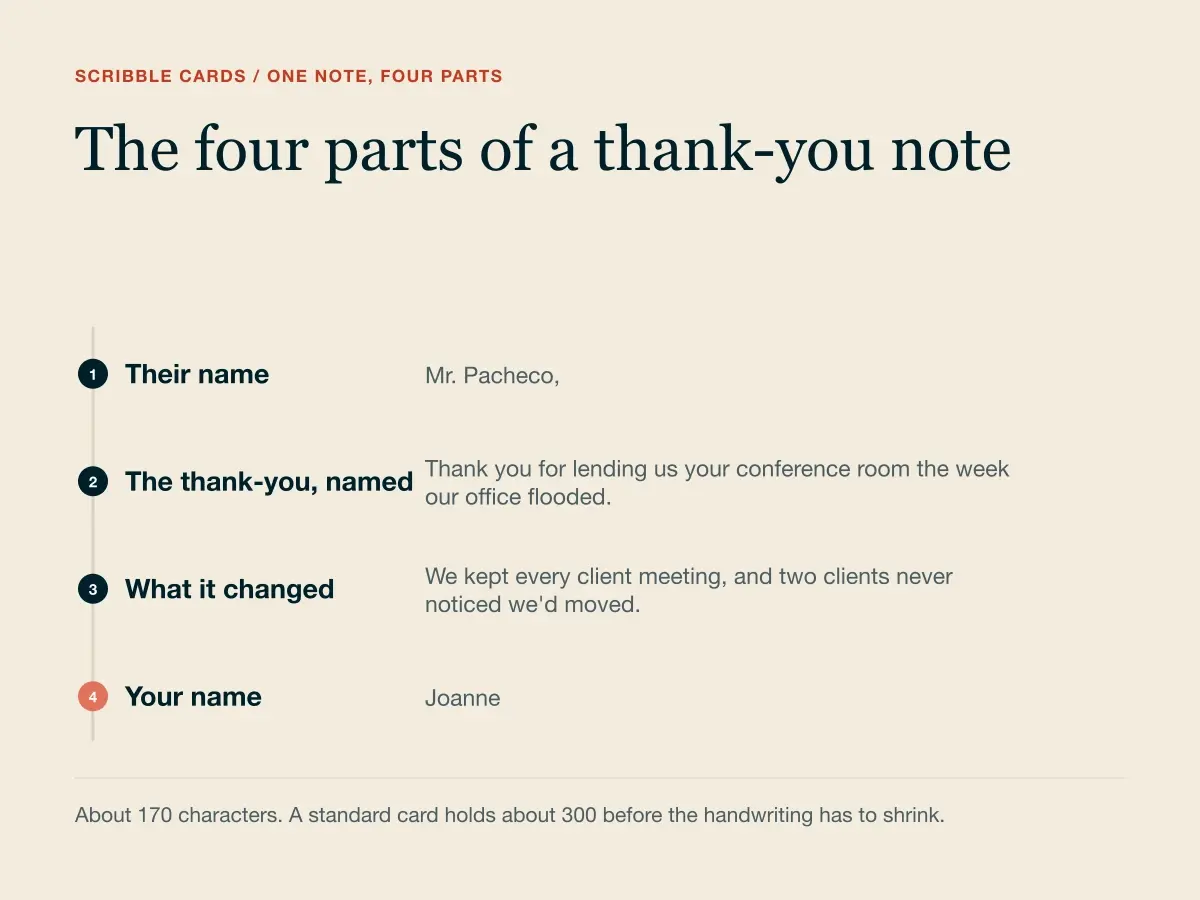
The whole note
Mr. Pacheco, Thank you for lending us your conference room the week our office flooded. We kept every client meeting, and two clients never noticed we'd moved. Joanne
About 170 characters. The joke at the end is optional; the conference room isn't.
Before and after: one client note, fixed
Here's the card a flooring company might send after a job, then the same card rewritten by the installer. Nothing in the first version is wrong. There's just nothing in it that belongs to this customer.
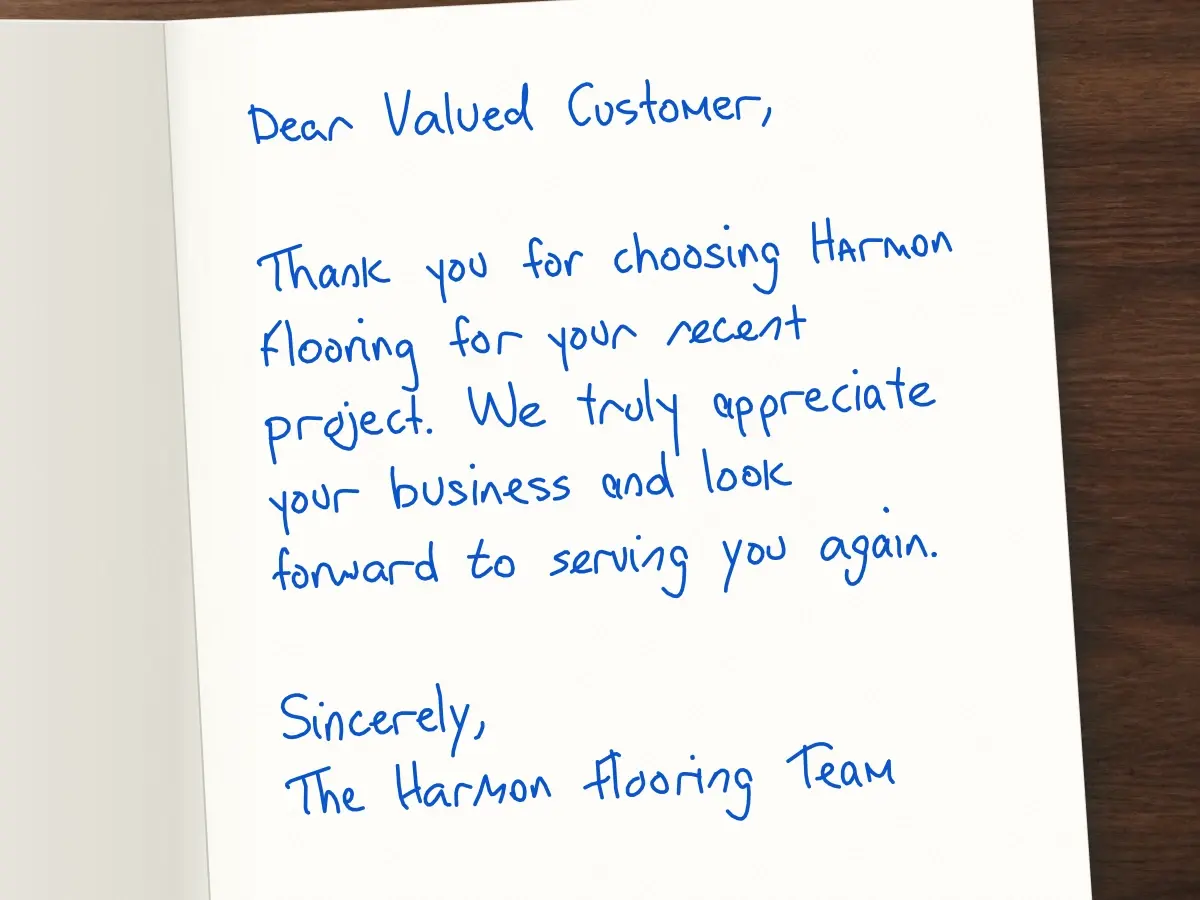
It opens with "Valued Customer" when her name is on the invoice. It thanks her for "your recent project" when everyone involved knows it was four days of oak flooring and a hallway that had to be redone. And it's signed by a team she never met.
After: rewritten by the installer
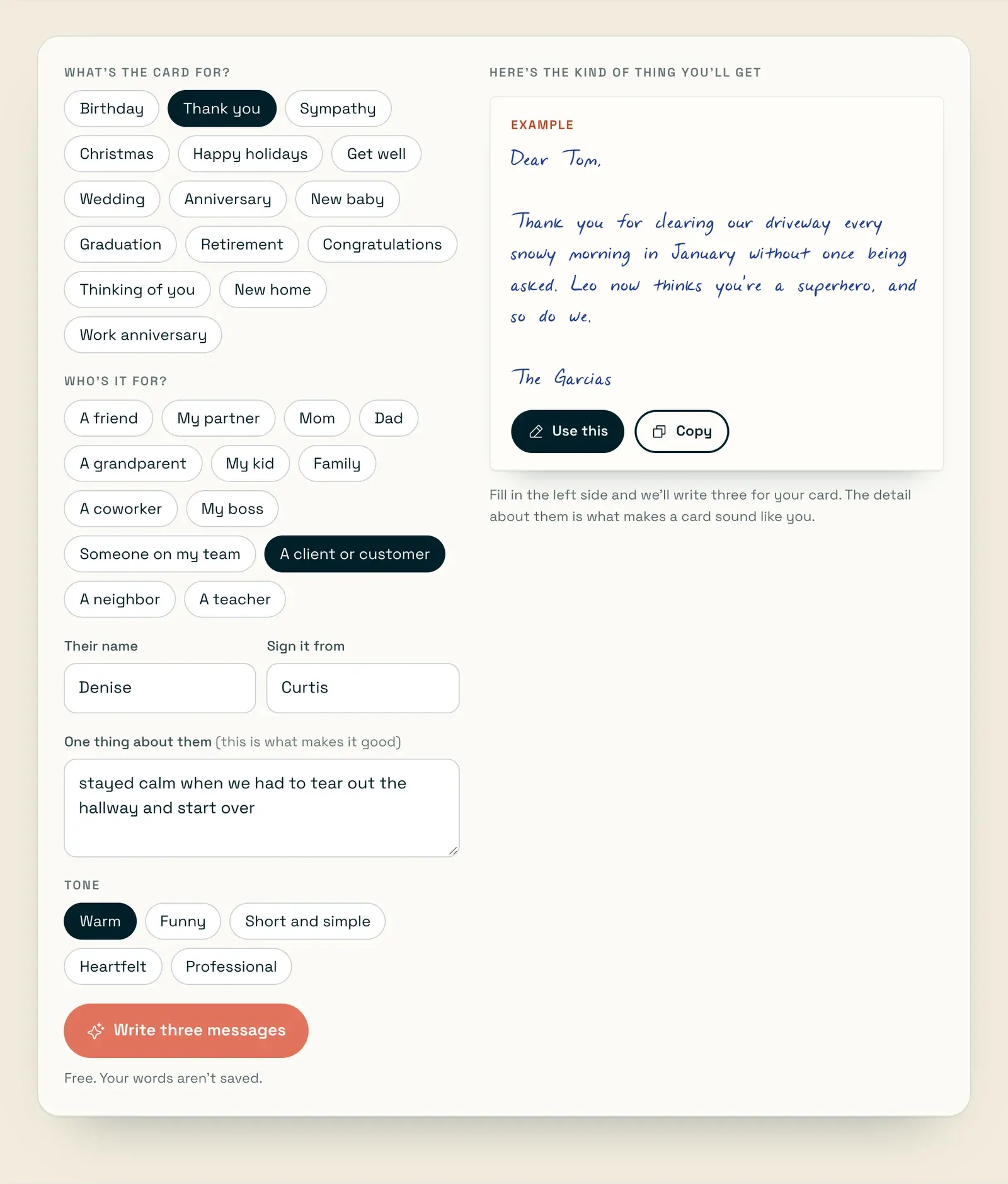
Denise, Thank you for the coffee every morning, and for staying calm when we had to tear out the hallway and start over. The oak looks like it was always there. Curtis at Harmon Flooring
Invented names. Keep the shape: her name, two true details, the result, his signature.
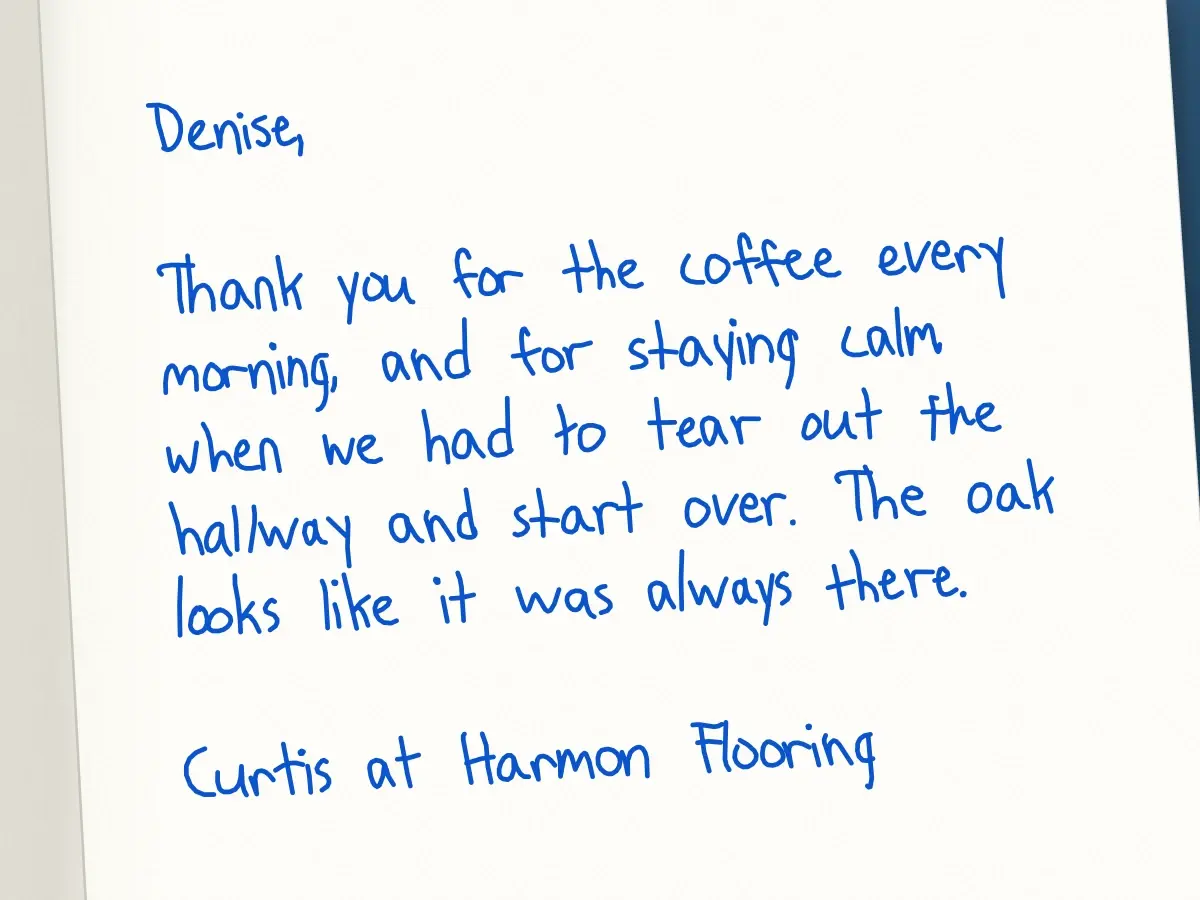
- Her name replaced "Valued Customer."
- Two true details replaced "your recent project": the coffee, and the redo. Owning the redo is a big part of why the card works.
- "The oak looks like it was always there" tells her the mess was worth it.
- The installer signed it. If the owner wants to be on it, the owner signs under Curtis, not instead of him.
- The sales line is gone. "We look forward to serving you again" turns a thank-you into a request for more of her money.
Lines to cut, and what to write instead
Scroll the table horizontally if needed.
| Instead of | Write something like |
|---|---|
| Thank you for your business. | Thank you for trusting us with the Fairview kitchen. |
| We value our partnership. | You answered my 7 a.m. texts all through the spring install. |
| Thanks for all your hard work. | You cleared the Denver backlog in three weeks. |
| Your support means the world to us. | Your review is the reason the Hendersons called us. |
| I hope this note finds you well. | Nothing. Start with the thank-you. |
| Looking forward to working together. | See you at the March kickoff. |
| Sincerely, The Harmon Flooring Team | Curtis |
"Thank you for your business" isn't banned. Keep it if you like it, then add the sentence that says which business: the kitchen, or the order that arrived the day before their trade show.
How to find the one specific thing
This is the step templates skip, and it decides whether the card gets kept. You almost always know a detail. You just have to go looking for it before you write the greeting.
- What was the hardest moment, and how did they handle it? The cracked tile, or the shipment that came in short.
- What did they say that stuck? A quoted line is gold: "You said 'make it work for the dog,' so we did."
- Is there a number? Weeks on the job, years as a client, orders this year, people they sent you.
- What did they do that wasn't their job? A Saturday text answered, a typo caught in the contract.
- What happened because of them? A deadline made, or a new hire who stayed.
- What do you know about their world? The dog on every video call. The kid who just left for college.
If you weren't close to the work, ask someone who was. A manager can give a CEO one sentence about an employee in thirty seconds. For clients, the detail is usually in the CRM notes or the email thread from the week things got hard.
Don't let the wording stall you. In a 2018 study in Psychological Science, people wrote thank-you letters and predicted how the recipients would react. The writers worried about finding the right words; the recipients responded to the warmth of the gesture. They were also more surprised and happier than the writers expected, and less awkward about it than the writers feared. [1][2]
If you're stuck, the free message helper asks who the card is for and one thing about them, then drafts three short messages you can edit.
Thank-you notes to clients and customers
Send one when something specific happened: a project ended, a first order arrived, they renewed, they referred someone, or they were patient while you fixed a mistake. It should come from whoever they actually deal with. If the owner wants to be on it, a second signature under the first is fine.
Leave out the pitch, the discount code and the review request. A coupon turns a thank-you into a flyer, and clients read it that way. If you want a review, ask in a separate email a week later.
To a B2B client after a big rollout
Raj, Thank you for keeping your team off the old system for a whole weekend so we could move everything over. Monday morning, all 46 of them logged in on the first try. That was your planning as much as ours. Tanya
The flat version: "Thank you for your partnership on this important project."
A template for your client list
{{first_name}}, Thank you for your first year with us. {{personal_note}} I'm glad you picked us. Owen
Add a column headed Personal note to your spreadsheet and write one sentence for each client, like "You caught the zoning problem before any of us did." Fill in every row; a blank one leaves a hole in the card.
Thank-you notes to employees
Most people get thanked less than their managers think. Gallup found that people who don't feel adequately recognized are twice as likely to say they'll quit in the next year. [3]
The manager should write it, because the manager saw the work. If the CEO wants to send cards, ask each manager for one sentence about what the person did and put that sentence in the CEO's card.
Name the work and what it made possible, in the words you'd use in a one-on-one. Keep raises and reviews out of it, and mail it to the address they gave HR unless they'd rather get it at work.
From a manager, after a hard month
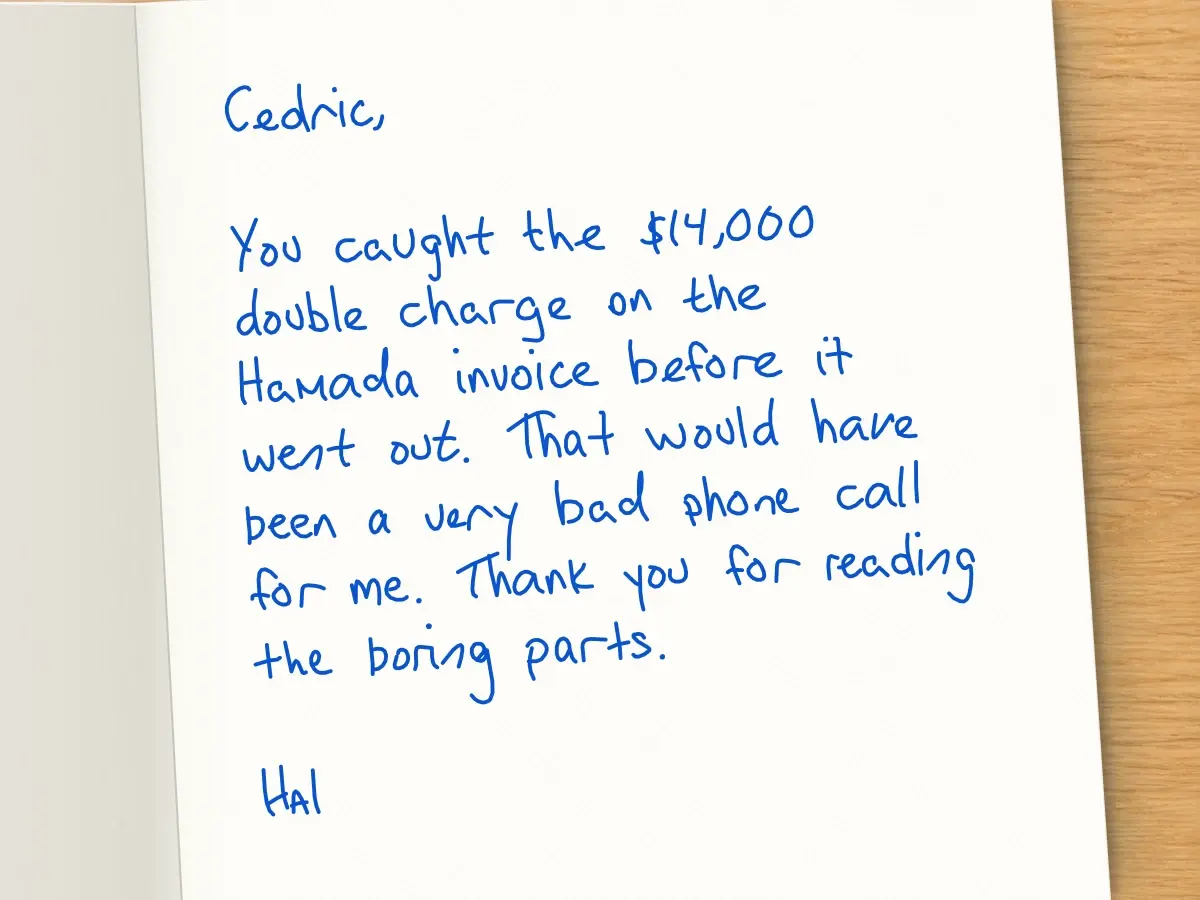
Cedric, You caught the $14,000 double charge on the Hamada invoice before it went out. That would have been a very bad phone call for me. Thank you for reading the boring parts. Hal
The flat version: "Thanks for all your hard work this month. You're a huge asset to the team." Same thanks, nothing he'll remember.
Thank-you notes to partners, vendors and referral sources
These are the people businesses forget: the supplier who rushed an order, the accountant who keeps sending you clients. They get invoices and emails from you all year and almost never a card, which is why one stands out.
For a favor, say what it made possible. For a referral, say who they sent and what happened next, then stop. Skip "keep them coming." It turns their favor into a quota.
To a supplier who saved an event
Gloria, You had 400 shirts printed and on our dock in four days after the first order fell through. Every runner at the 5K got the right size. Thank you. Trent at Ridgeline Running
The flat version: "Thanks for being such a great vendor."
To a referral partner
Danielle, You sent the Ostrowskis our way in March with a two-line email and a warning about their very loud beagle. They closed on Friday. Thank you for thinking of us. Brent
After a meeting, a pitch or a site visit
Speed matters more here than anywhere else. Send a short email the same day and put any follow-up in it. Then decide whether the meeting deserves a card: a first meeting with a big prospect, a site visit someone gave up a morning for, a pitch you lost and learned from.
A mailed card shows up days later, so it can't carry anything urgent. Use it to thank them for one thing they said or did. If you promise a next step, give it a date and keep it.
After a pitch you lost
Ms. Pemberton, Thank you for telling me exactly why we lost, slides included. Most people just stop answering. I've already rewritten the slides. Arjun Mehta
The flat version: "Thank you for the opportunity. We hope to work together in the future."
After a first meeting
Yvette, Thanks for the plant tour on Tuesday, and for showing me the loading dock everyone complains about. I'll have a plan for that dock on your desk by December 4. Walt
When to send it, how long, and whether to handwrite it
Scroll the table horizontally if needed.
| Occasion | Send it | Best format |
|---|---|---|
| Sales meeting or site visit | Email the same day; mail a card within two days | Email, plus a card when the meeting mattered |
| End of a project | Within a week of the handover | Card from whoever ran the job |
| First order | Within a week of delivery | Card for B2B accounts and big orders |
| Referral | When the person they sent signs or buys | Card |
| An employee's hard stretch | Within a week of the deadline | Card from their manager |
| A supplier's favor | As soon as the favor pays off | Card |
| Renewal or client anniversary | Timed to land on or just before the date | Card |
Two to four sentences is plenty, about 300 characters on a standard card. That fits at a comfortable size and forces you down to the part that matters. Apologies can run longer; a thank-you rarely needs to.
Email is fine for routine thanks after a call. For a favor, a milestone or anything you'd call a relationship, mail a card. It lands on a desk instead of in an inbox, and it tends to stay there a while.
If you mail it yourself, a standard card takes one 82-cent Forever stamp. If you'd rather not handwrite 40 of them, Scribble Cards writes each card in real pen, addresses the envelope in pen and puts a real stamp on it. Cards are written within 1 to 2 business days and USPS usually takes another 2 to 5, so give it about a week. [4]
Writing a batch without it sounding like a form
Year-end client cards and anniversary notes usually go to a list. A template can still sound like a person, as long as every sentence in it is true for everyone who gets it.
One template per group
Split the list by relationship
Clients in their first year get one message, ten-year clients another. The handful you know well get their own cards.
Use one or two merge fields
{{first_name}} in the greeting, and maybe {{personal_note}} from a column with one sentence per person. Five fields read like a form.
Test it with the longest name
Keep it under about 300 characters and preview it with the longest name on the list. A line that fits Al may wrap badly for Bartholomew.
Read five finished cards out loud
Pick five rows at random and read each card as the person getting it. If one sounds wrong, move that person to another group.
Sign as a person
"Owen," or "Owen and the team at Harlan Insurance." Never the company alone.
Scribble Cards takes the uploaded list, fills {{first_name}} and any extra column you add, and still writes every card individually in pen, in one of 30 handwriting styles.
Frequently asked questions
What should a business thank-you note say?
Their name, a thank-you for one specific thing, what it changed, and your name, in two to four sentences. "Gloria, you had 400 shirts on our dock in four days, and every runner got the right size. Thank you. Trent" is a complete note. Leave out pitches, coupons and review requests.
How do you start a thank-you note professionally?
With their name and the thank-you itself: "Raj, thank you for keeping your team off the old system all weekend." Skip openers like "I hope this finds you well." For a formal relationship, use Mr., Ms. or Dr. and a last name, then the same direct first line.
How soon should you send a thank-you note after a meeting?
Send a short email the same day, then mail a card within a day or two if it was a first meeting, a site visit or a big decision. A mailed card takes several days to arrive, so keep anything time-sensitive in the email.
Should a business thank-you note be handwritten?
For anything bigger than a quick favor, yes. A card reaches a desk instead of an inbox. Email is fine for routine thanks after a call. Either way, the detail matters more than the format: a handwritten card full of stock phrases still reads like a form.
How do you sign a thank-you note from a company?
With the name of the person they know, plus the company underneath ("Owen, Harlan Insurance") if they might not place you. A second signature is fine if the owner wants to be on it. "The Team" or a company name alone looks like nobody signed it.
How do you write a thank-you note to an employee?
Name what they did and what it made possible, and sign it yourself as their manager. "You caught the $14,000 double charge before it went out" says more than any adjective. Keep raises and reviews out of it.
Sources and methodology
Reviewed .
- People underestimate value of sending letters of appreciation
University of Chicago News · Published · Accessed
Reports Kumar and Epley, "Undervaluing Gratitude," Psychological Science (2018).
- Why we underestimate the power of expressing gratitude
Chicago Booth Review · Published · Accessed
- Employee Recognition: Low Cost, High Impact
Gallup · Published · Accessed
Updated January 12, 2024.
- Notice 123, Price List
U.S. Postal Service · Accessed
First-Class Mail stamped letter, 1 ounce: $0.82.