
A handwritten note is one option for introducing a relevant idea to a prospect. It costs more to produce and deliver than an email, so this guide starts with the audience and message, then explains how to evaluate a small test.
I have been writing about sales and marketing for a long time, and the pattern I keep seeing is this: the tactics that scale infinitely tend to stop working. Email was magic in 2005. Then in 2010. Then in 2015. Today, with AI-generated sequences flooding inboxes at volume, it has become the easiest thing in the world to ignore. The signal-to-noise ratio is terrible.
The answer is not to send better emails. The answer is to do something nobody else bothers to do. A handwritten note is that thing. In 2026, it is practically a superpower.

The Problem With Cold Email in 2026
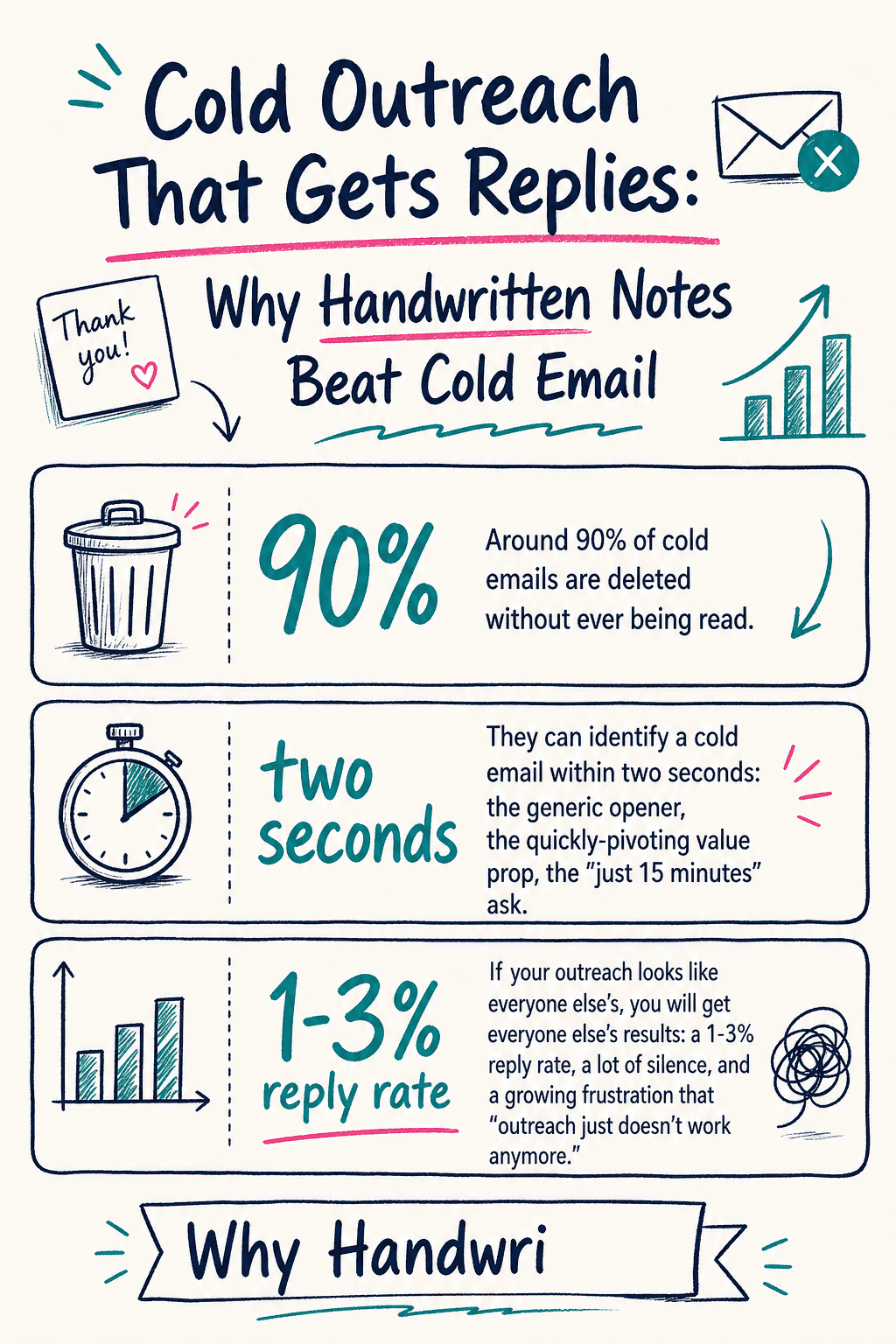
Cold-email replies depend on the audience, data quality, message and definition of a reply. Use your own baseline for qualified conversations; do not compare an unsourced email average with a supplier’s best direct-mail campaign.
An email open is not a reliable count of people who read a message. Privacy tools and automated image loading affect that measure. Track replies and qualified next steps when assessing outreach.
The problem runs deeper than format, though. It is a trust problem. Cold email, by definition, is an interruption from a stranger. When that interruption looks and feels exactly like every other interruption, there is zero reason to engage with it. People respond to things that feel personal, considered, and worthy of their attention. A cookie-cutter email template, however well-written, cannot manufacture that feeling.
Cold outreach needs a relevant reason to contact someone. Before adding another channel, check that the contact is appropriate, the message is specific and the next step is easy to understand.
Why Handwritten Notes Work for Cold Outreach
Physical mail gets opened because it looks different from everything else in the mailbox. When was the last time you threw away a handwritten envelope without opening it? The answer for most people is never. Handwritten mail registers as personal correspondence, not marketing. That means it bypasses every filter - both the spam folder kind and the psychological kind.
A handwritten note costs more per contact than an email, so choose a small audience where a relevant conversation could justify that cost. There is no verified 27% response-rate forecast for a Scribble mailing.
The psychology is straightforward. When a prospect sees that someone took the time to write something by hand, address an envelope, and put it in the mail, their immediate subconscious response is: "This person thinks I am worth their time." That is a powerful starting point for a sales relationship. Effort signals respect. And in an era where most outreach is automated, manual effort is genuinely scarce.
Physical mail gives the recipient something they can keep. That possibility does not establish a recall percentage, an open rate or a future sale for your campaign.
What Good Cold Outreach With a Handwritten Note Looks Like
A good cold outreach note is not a sales pitch crammed onto a card. It is an opening. The goal is not to close a deal in 3-5 sentences - it is to earn the right to a conversation. Here is what that looks like in practice:
Keep it to 3-5 sentences. Any longer and it starts to feel like a letter, not a note. The brevity is part of what makes it feel personal and considered rather than templated.
Lead with something specific about them or their business. This is the single most important rule. A note that could have been sent to anyone will be treated like it was sent to no one. One specific detail - a recent hire, a product launch, a LinkedIn post they wrote - signals that this is not mass outreach.
One clear ask or next step - never more than one. Would you be open to a 15-minute call? Is it worth a conversation? Keep it simple. Multiple asks create friction and dilute the message.
No attachments, no QR codes to microsites, no lengthy value propositions. Save the full pitch for later. The note's job is to open the door, not walk through it.
Follow up by email after allowing for the estimated arrival window. Say that you sent a card rather than assuming it was delivered or read. Test the sequence against your usual outreach.
Cold Outreach Note Wording Examples
Here are five complete examples by scenario. Each is short, specific, and ends with a single clear ask. Adapt the specifics to your own prospect and offer.
For a new prospect at a company you have been targeting
"Hi [Name], I have been following [Company] for a while and really liked what you did with [specific initiative or product launch]. I work with B2B sales teams to help them stand out in a crowded outreach environment, and I think there is something worth talking about. Would you be open to a quick call in the next few weeks? My number is on the back."
After a conference or industry event
"Hi [Name], great to briefly cross paths at [Event Name] last week. I did not get a chance to properly introduce myself - I am [Your Name] at [Company]. After hearing your thoughts on [topic they discussed], I think we might have something worth exploring. I will reach out by email but wanted to send this first."
For a warm lead who went cold
"Hi [Name], I know we chatted a few months back and the timing was not right. I wanted to reach out the old-fashioned way to say I still think there is a real fit here. If things have shifted on your end, I would love to reconnect. No pressure - just wanted you to know we have not forgotten about you."
For a referral intro - someone gave you the name
"Hi [Name], [Mutual Contact] suggested I reach out to you directly. He/she spoke highly of the work you are doing at [Company], and given what we do at [Your Company], I think it is worth a conversation. I will follow up by email this week, but wanted to introduce myself properly first."
For a senior executive you have never met
"Hi [Name], I know your time is limited so I will keep this short. I lead [Your Role] at [Your Company], and we work with companies like [2-3 relevant clients] to [specific outcome]. I think what we are doing could be relevant to [Company] given [specific reason]. Happy to share more if there is interest - my contact details are below."
Combining Handwritten Notes With Your Cold Email Sequence
One sequence to test is a card followed by an email after the estimated arrival window. The email can mention the card and restate the reason for contact. Compare qualified replies with your existing sequence before scaling it.
Multi-touch outreach dramatically outperforms single-channel approaches. A prospect who has received a physical note from you is primed to engage with your email. They have already held something you created in their hands. The email is no longer cold - it is a follow-up from someone they have a vague sense of already. That shift in perception is small but meaningful.
The sequence to run: handwritten note on day 1, email follow-up on day 5 or 6, LinkedIn connection request or message on day 10, second email on day 14 if no response. After that, step back and move the prospect to a nurture list rather than continuing to push. Four touches over two weeks is assertive without being aggressive - and starting with a physical note gives every subsequent touchpoint more credibility.
How Scribble Fits Into Your Cold Outreach Stack
For individual sales reps sending 5-10 notes a week, Scribble handles the production and mailing so you can focus on the message, not the logistics. Write your note, enter the address, and it ships with real pen and real ink. No stuffing envelopes at your kitchen table at 11pm.
For sales teams running outreach at volume, Scribble integrates with CRM workflows so you can trigger handwritten notes automatically at the right moments - new prospect added, deal moved to a certain stage, contract renewal approaching. The notes still look and feel handwritten because they are, using real robotic pen technology. You get the personal touch at scale, which is the combination that makes handwritten notes for sales genuinely powerful rather than just a novelty.
If you are already running sales prospecting letters or experimenting with direct mail personalization, adding a handwritten note layer to your cold outreach sequence is a logical next step. The infrastructure is already there. Scribble just makes it simple to execute.
Choosing the right vendor matters as much as the message. See our full comparison of the best handwritten card services for real pricing and minimums before you commit to one for cold outreach.
Frequently Asked Questions
Does cold outreach still work in 2026?
Yes, but the bar for standing out has risen sharply. Cold outreach works when it is personal, relevant, and delivered through a channel that does not feel automated. Email-only outreach is increasingly difficult to cut through. Adding physical touchpoints like handwritten notes restores the personal dimension that makes outreach effective.
How can handwritten notes fit alongside cold email?
They provide a physical way to introduce yourself, but that does not make them universally more effective than email. Record replies, appointments and cost in your own test. Scribble does not measure whether an envelope was opened.
How long should a cold outreach note be?
3-5 sentences is the sweet spot. Long enough to establish who you are and why you are reaching out, short enough to feel like a personal note rather than a sales letter. The brevity itself communicates respect for the recipient's time.
How do I personalize a cold outreach note at scale?
Start with one specific detail per recipient - something you can pull from LinkedIn, their company news, or a recent interview they gave. Services like Scribble allow you to write note templates with variable fields, so you can include the specific detail at scale without handwriting every word yourself. Even a single personalized sentence changes how the note is received.
Should I send a handwritten note or an email first?
Send the handwritten note first. It sets the tone for the relationship and primes every subsequent digital touchpoint. When your follow-up email references the note you already sent, it immediately stands out from the crowd of cold emails competing for the same inbox. The note is your opening move. The email is your follow-through.
The Bottom Line
Choose one prospect with a clear reason for contact, write a specific note and budget at the price for your actual quantity. A standard Scribble card is $6.99, including handwriting, envelope and US postage. The $2.45 rate requires buying 10,000 prepaid credits in one purchase; smaller purchases use the current volume table.
Cold email has a place in the modern outreach stack. But if it is the only tool you are using, you are playing the same game as everyone else and hoping to win on marginal improvements. A handwritten note is not a marginal improvement. It is a different category of outreach entirely - one that still has room to stand out, because most people have not started doing it yet. That window will not stay open forever.