
A printed postcard can go out for under a dollar, postage included. A card written in real pen, in an envelope addressed in pen with a stamp on it, costs roughly three to eight times as much. Whether it pays depends almost entirely on who's on your list and what one new customer is worth to you.
Below: real prices as of November 2026, what the public response data actually says (less than most blogs claim), and a 400-person pilot that tells you whether handwritten mail pays for your business.
Direct mail formats and what each costs
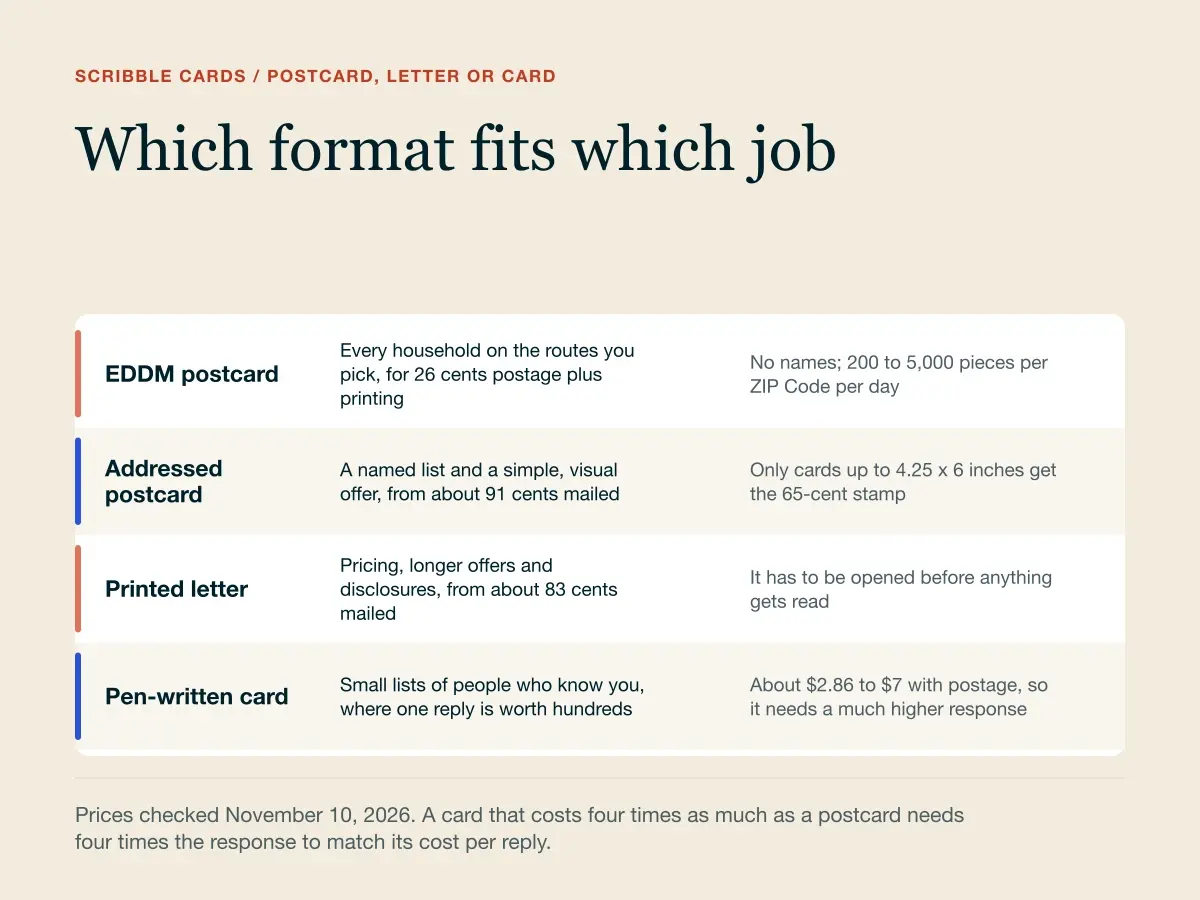
Most small-business direct mail is a postcard to every address on a mail route, a postcard to a list of names, a printed letter, or a card written in pen. Here's what each costs per piece, from USPS price lists and providers' own pricing pages.
Scroll the table horizontally if needed.
| Format | Cost per piece | What to know |
|---|---|---|
| EDDM postcard to every address on a route | 26 cents postage, plus printing | At the Post Office counter: 200 to 5,000 pieces per ZIP Code a day, no permit, no names. |
| Postcard you stamp yourself | 65-cent stamp, plus printing | The postcard stamp covers cards from 3.5 x 5 up to 4.25 x 6 inches. Anything bigger pays the 82-cent letter price. |
| Postcard printed and mailed for you | From about 91 cents | A print-and-mail service's starting price, postage included. |
| Letter printed and mailed for you | From about 83 cents | A print-and-mail service's starting price, postage included. |
| Bulk Marketing Mail letters you prepare | From 39.5 cents postage | At least 200 pieces, presorted, with a permit ($390 to apply) and a $390 annual fee. |
| Card written in pen and mailed for you | A few dollars a card, postage included | Real pen and a real stamp. The price per card drops with volume. |
| Writing them yourself | 82-cent stamp, plus the card | At five minutes a card, 200 cards take almost 17 hours (our estimate). |
The per-piece price isn't the campaign's cost: add design and the hours spent answering replies. And a cheap piece nobody reads is expensive. Watch cost per response, which depends on your list more than your format.
What response rates to expect
Response rate is the share of people mailed who did the one thing you asked, within a window you set in advance. These figures have a source you can check:
Scroll the table horizontally if needed.
| Figure | What it measured |
|---|---|
| 3% or less | Typical actual response to direct mail, as stated by the USPS Office of Inspector General in a 2019 report. |
| 5.1% and 2.9% | Response from house lists (your own customers) and prospect lists in the Data & Marketing Association's 2017 report, as reported by the American Marketing Association. |
| $22.55 and $39.75 | Cost per response for house and prospect lists, from the same AMA article. |
| 112% and 92% | Return on investment marketers reported in the ANA's 2021 survey for letter-size mail to prospect lists and postcards to house lists. Self-reported, from 581 qualified responses. |
You'll see 4.4% and 9% quoted on almost every direct mail blog. Both trace back to ANA reports whose full tables sit behind the ANA's login, and the blogs quoting them disagree about which year they came from. We couldn't verify them, so they aren't here.
The bigger lesson is in the Postal Service's own data. Its Office of Inspector General modeled five years of household mail diaries and found that ad mail from a business the household had dealt with was read 57% of the time, against 26% from businesses they didn't know. Households said they were considering a response to 18% of the mail from businesses they knew, and 3% of the rest. [5]
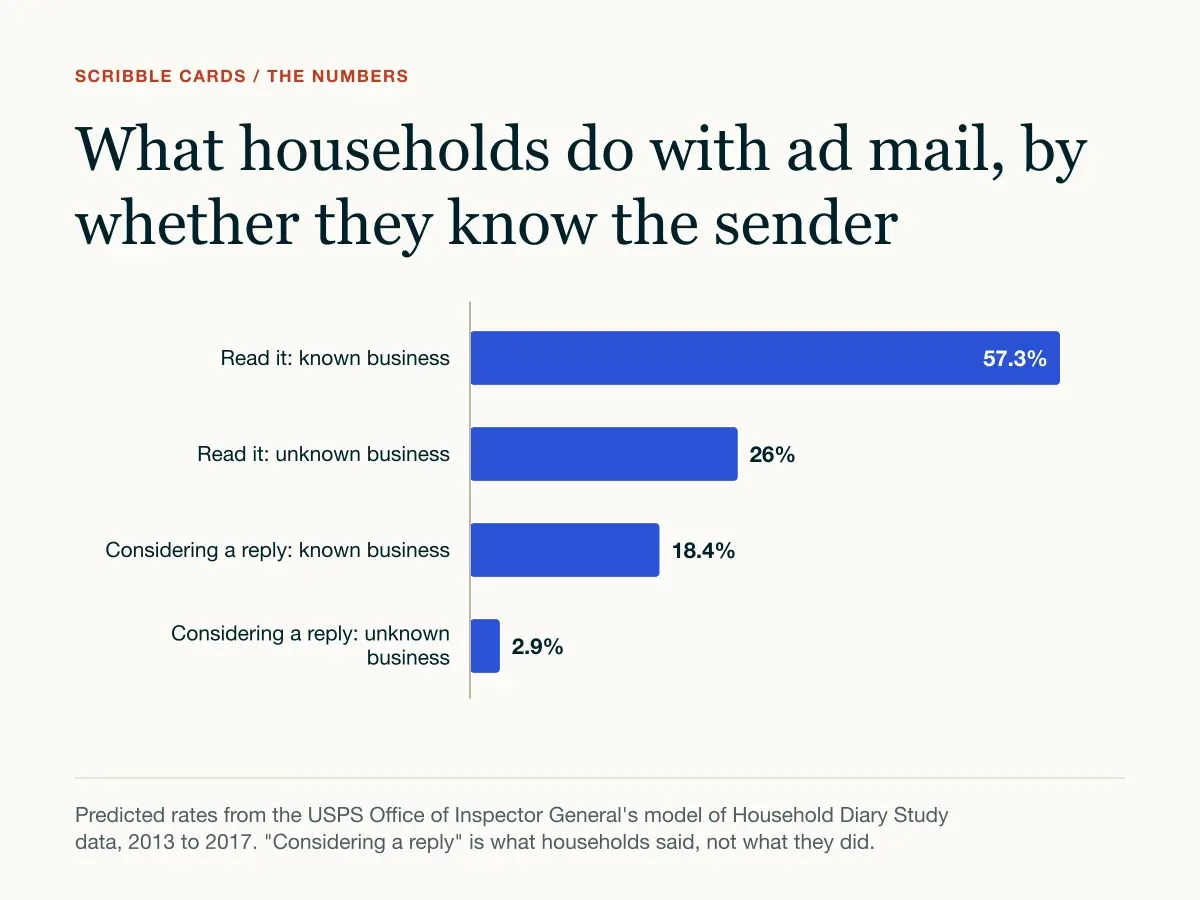
Format mattered less than the relationship. In the same model, postcards were read 57% of the time and letters 44%, probably because there's nothing to open. Mail addressed to someone by name was read 46% of the time, against 39% for mail that wasn't. [5]
Do handwritten cards get a better response?
Probably, on the right list, but nobody has published independent proof. Blogs about handwritten mail quote open rates near 99%, usually with no method attached. We couldn't find an independent, published test of pen-written marketing mail against printed mail.
The closest independent evidence comes from survey research, where people are mailed questionnaires and researchers count who sends them back. A 2002 BMJ review of 292 randomized trials found that personalized letters raised the odds of a reply (an odds ratio of 1.16), and so did stamped return envelopes (1.26) and a follow-up contact (1.44). Those are questionnaires, not sales offers, and the lifts are modest. It's still the same mailbox and the same person deciding whether a piece of mail deserves attention. [8]
So treat handwriting as a bet to test on your own list. The pilot below costs a few hundred dollars and will tell you more than any vendor's case study.
When a handwritten card beats a postcard
Start with one division: the card's cost over the postcard's. That's how many times better the card has to do just to match the postcard's cost per response. At $3.50 against 91 cents, a card needs almost four times the response (our calculation). A card is worth testing when most of these are true:
- The list is small and specific: past clients, customers who've gone quiet, referral partners, event attendees, your top 50 accounts.
- One reply is worth hundreds or thousands of dollars: a listing, a remodel, an annual contract, a major gift.
- There's a real reason to write that fits in two sentences, like two winters since their last furnace service.
- They already know your name. That's where the USPS data says mail gets read.
- Someone will follow up the week the cards land.
Postcards are the better buy when you need every household on a route, when the offer is simple and visual (just sold, or an open house), or when a customer is worth $50 rather than $5,000. Printed letters earn their place when you need room for pricing or legal disclosures.
Real estate postcards or handwritten notes?
Most agents need both, for different people. Postcards suit farming: getting seen month after month on streets where nobody knows you yet. EDDM makes that cheap, at 26 cents of postage a piece plus printing, though the cards go out without names. [2]
Handwritten notes suit the people who already know you: past clients, your sphere, open-house visitors, the neighbors of a listing you just sold. They're the group the USPS diary data says reads its mail, and they can send you business. Give each note one reason and one offer. [5]
To a neighbor of a home you just sold
Rhonda, The blue house two doors down from you closed last week, the fastest sale on Birch Lane this year. If you've ever wondered what yours would bring, I'm happy to run the numbers. No sign in the yard required. Keith Navarro
Invented names. One reason to write, one offer, no pressure.
How to run a 400-person pilot
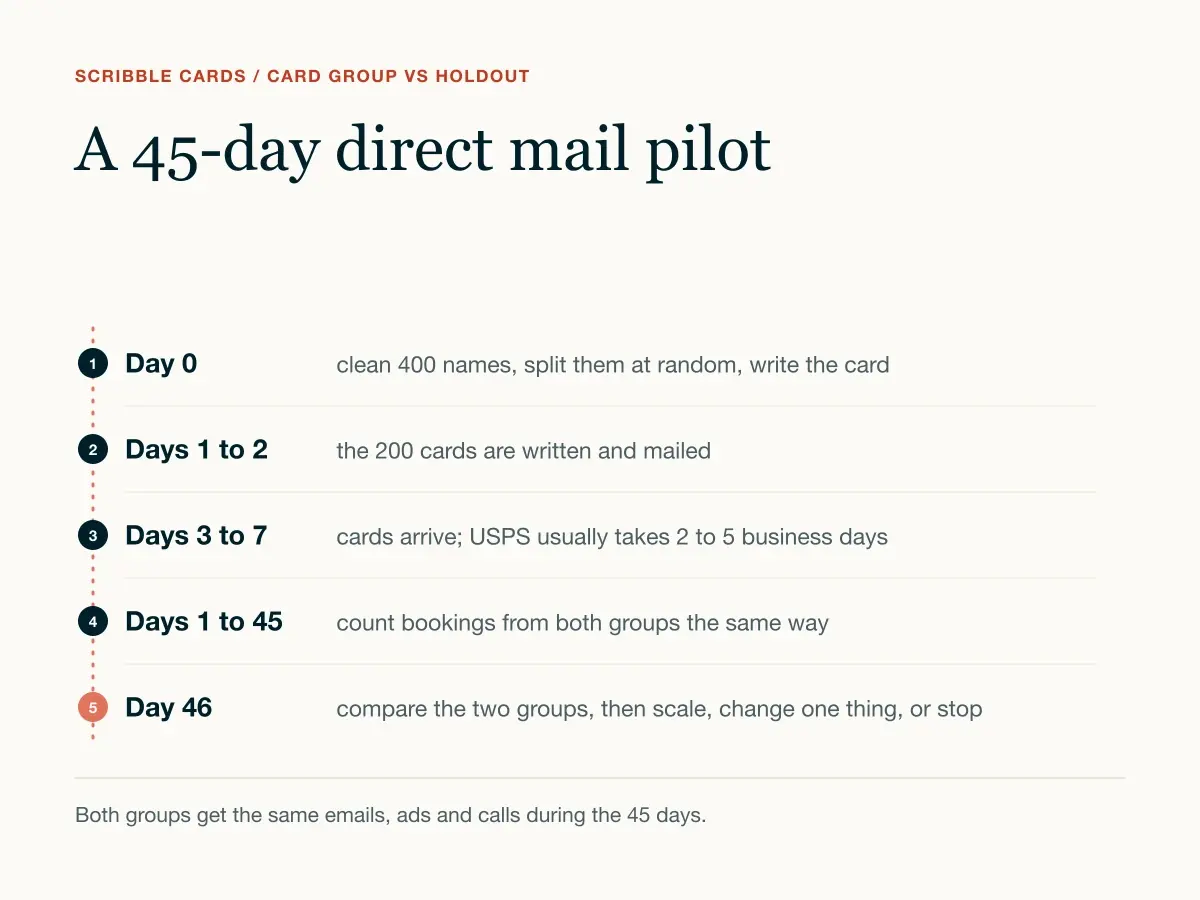
A pilot answers one question: does the card change what people do, compared with not sending it? That takes a group that doesn't get the card. Without one, you'll count every customer who calls after the mailing, including the ones who were going to call anyway.
The pilot, step by step
Pick one list and one action
Say it's 400 past customers who haven't booked a tune-up in more than 18 months. Write the rule down before you mail: "A response is a booked appointment within 45 days of the mail date."
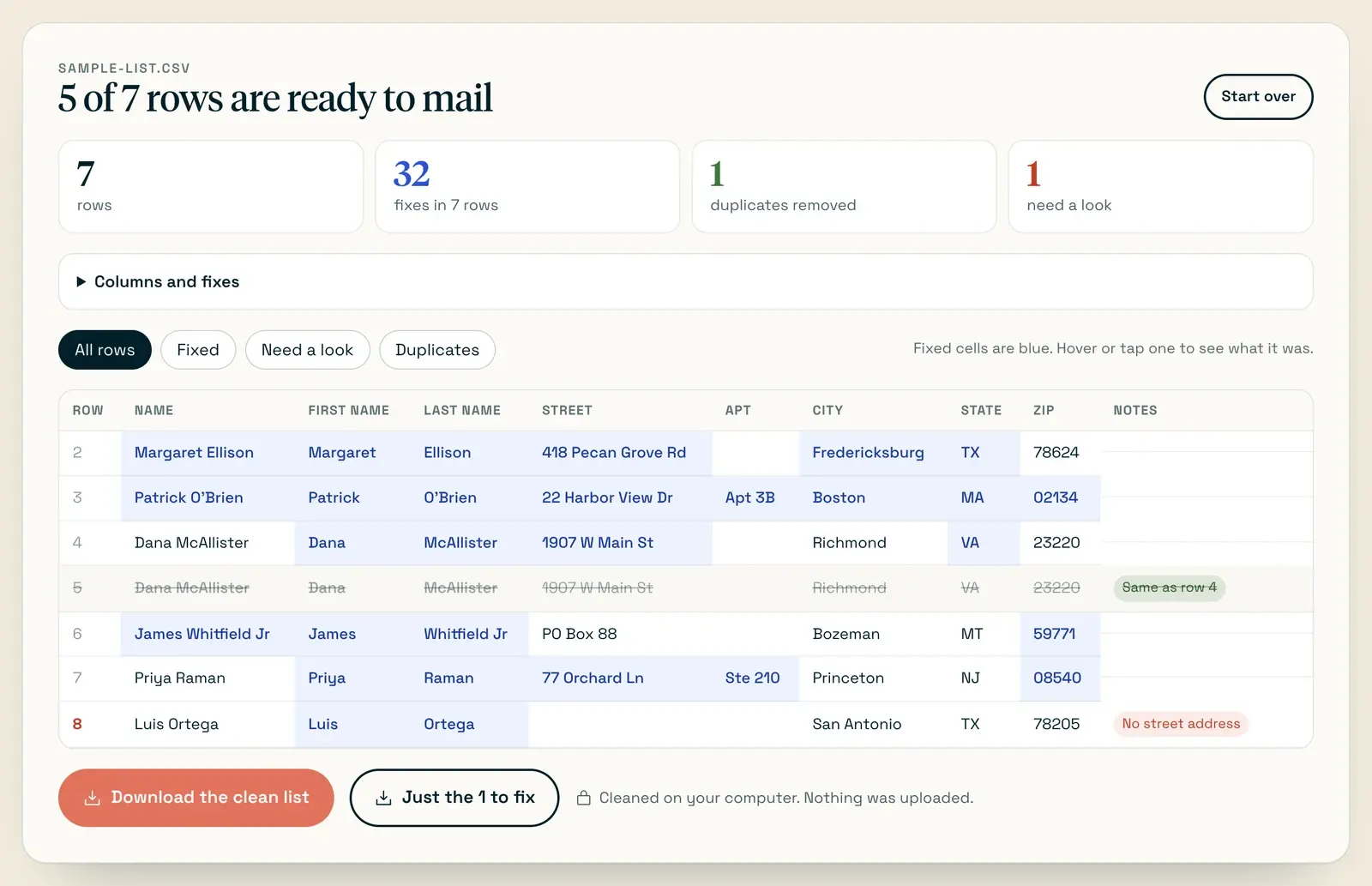
Clean the list, then split it at random
Fix names and ZIP codes and remove duplicates. Then add a column of random numbers, sort by it, and put the top 200 in the card group and the rest in the holdout. Hand-picking means picking the friendly ones.
Write one card for the whole group
Use a reason that's true for all of them, plus {{first_name}} and at most one more merge field.
Mail every card on the same day
Write down the mail date. Scribble Cards writes cards within 1 to 2 business days and USPS usually takes 2 to 5 more, so most land within a week. Put your return address on the cards; undeliverable ones come back to it.
Treat both groups the same otherwise
Both groups get the same emails and ads. If you also phone the card group, say so in your results, because you're testing the card and the call together.
Count responses in both groups
Count everyone who booked in the window, not just people who mention the card or use a code. Most won't. Match bookings to the list by customer ID or address.
Compare and decide
Subtract the holdout's rate from the card group's. That difference is what the card did, and the next section shows how to read it.
Returned cards are free data. First-Class prices include return service, so a First-Class card with a bad address comes back to you. Bulk Marketing Mail isn't returned unless you request it on the mailpiece, which can cost extra. [4]
For the cleanup in step 2, the free mailing list cleaner fixes names, states and ZIP codes and removes duplicates, inside your browser.
Work out break-even before you mail
Say the cards cost an illustrative $4.00 each with postage, so 200 cards is $800. If a tune-up leaves $150 after parts and labor, you need 6 bookings to cover the mailing (800 / 150 = 5.3, rounded up), a 3% response from 200 cards. Those are invented numbers; put in yours.
Direct mail pilot break-even calculator
Put in your real cost per card, what one order or booking leaves you after its own costs, and a response rate you can defend. It shows the total mailing cost and the response rate you'd need to break even.
The starting values are illustrative, not response benchmarks. Change them to your own costs and assumptions. Each converted response counts as one order; repeat orders and longer-term value are excluded.
How this is calculated
Mailing cost = cards × cost per card + setup. Expected orders = cards × assumed response rate × response-to-order rate. Break-even orders = mailing cost ÷ contribution per order, rounded up.
Break-even on the mailing isn't the same as profit from the card. Some of those bookings would have happened anyway, and the holdout group tells you how many.
Read the result honestly
Say the card group books 9 tune-ups (4.5%) and the holdout books 4 (2%). Nine looks like a win against a break-even of six. But at the holdout's rate, about 4 of those 9 would have booked without a card, so the card added 5 bookings: $750 of contribution against an $800 mailing.
And those 5 might be luck. If the cards did nothing at all, you'd still see a gap that size about one time in six (our calculation). Treat a result like this as a reason to run the test again on a bigger list.
Scroll the table horizontally if needed.
| Response without the card | Response you hope the card gets | People in each group |
|---|---|---|
| 2% | 4% | about 1,140 |
| 2% | 6% | about 380 |
| 3% | 9% | about 250 |
| 5% | 10% | about 440 |
| 10% | 15% | about 690 |
Small pilots only see big effects. A 200-card pilot still checks your costs and your follow-up. If the card group does no better than the holdout, change one thing (the list, the reason or the offer) and test again. Change three at once and you won't know which one mattered.
What to write on the card
A direct mail card works when it has a reason to exist today, says one thing about the reader and asks for one small step. Skip brochure language. Nobody writes "industry-leading" in pen.
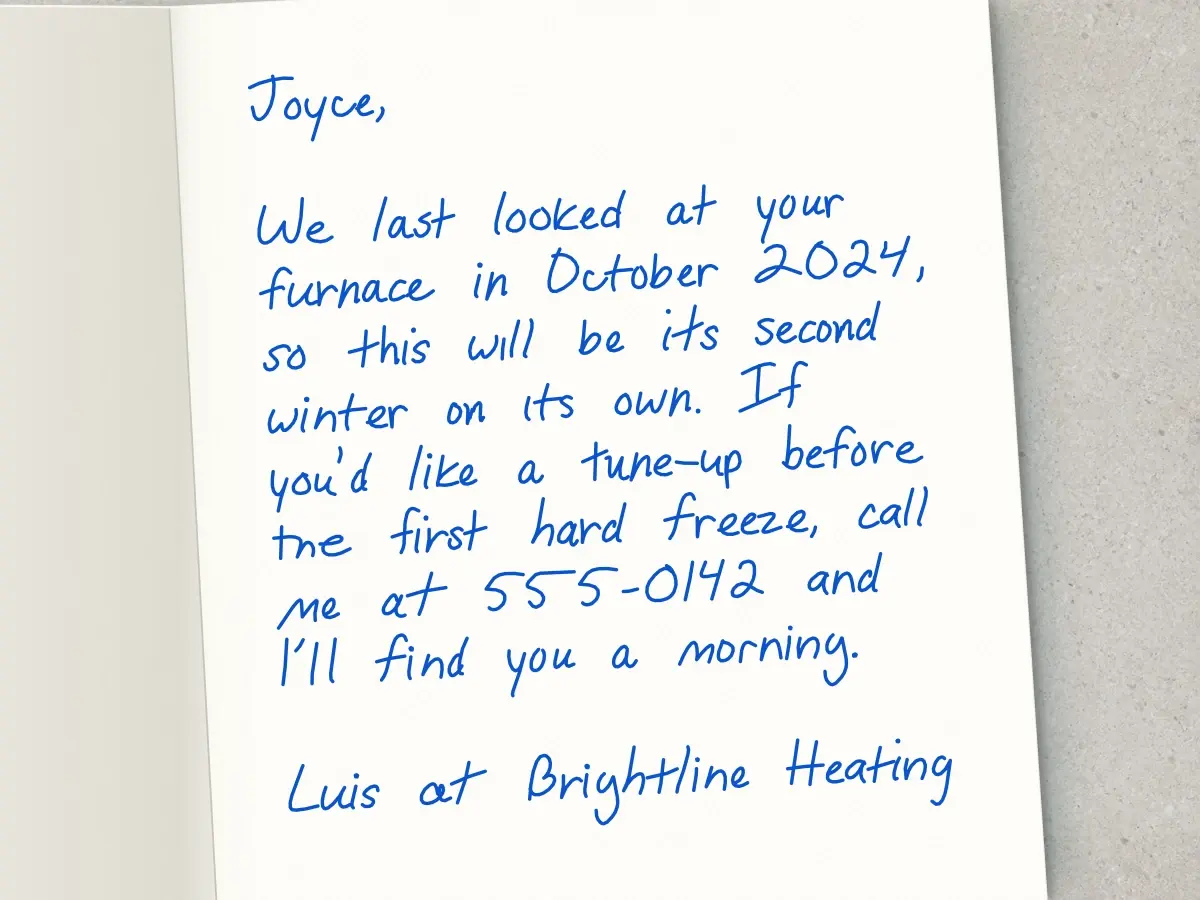
A reactivation card from the pilot
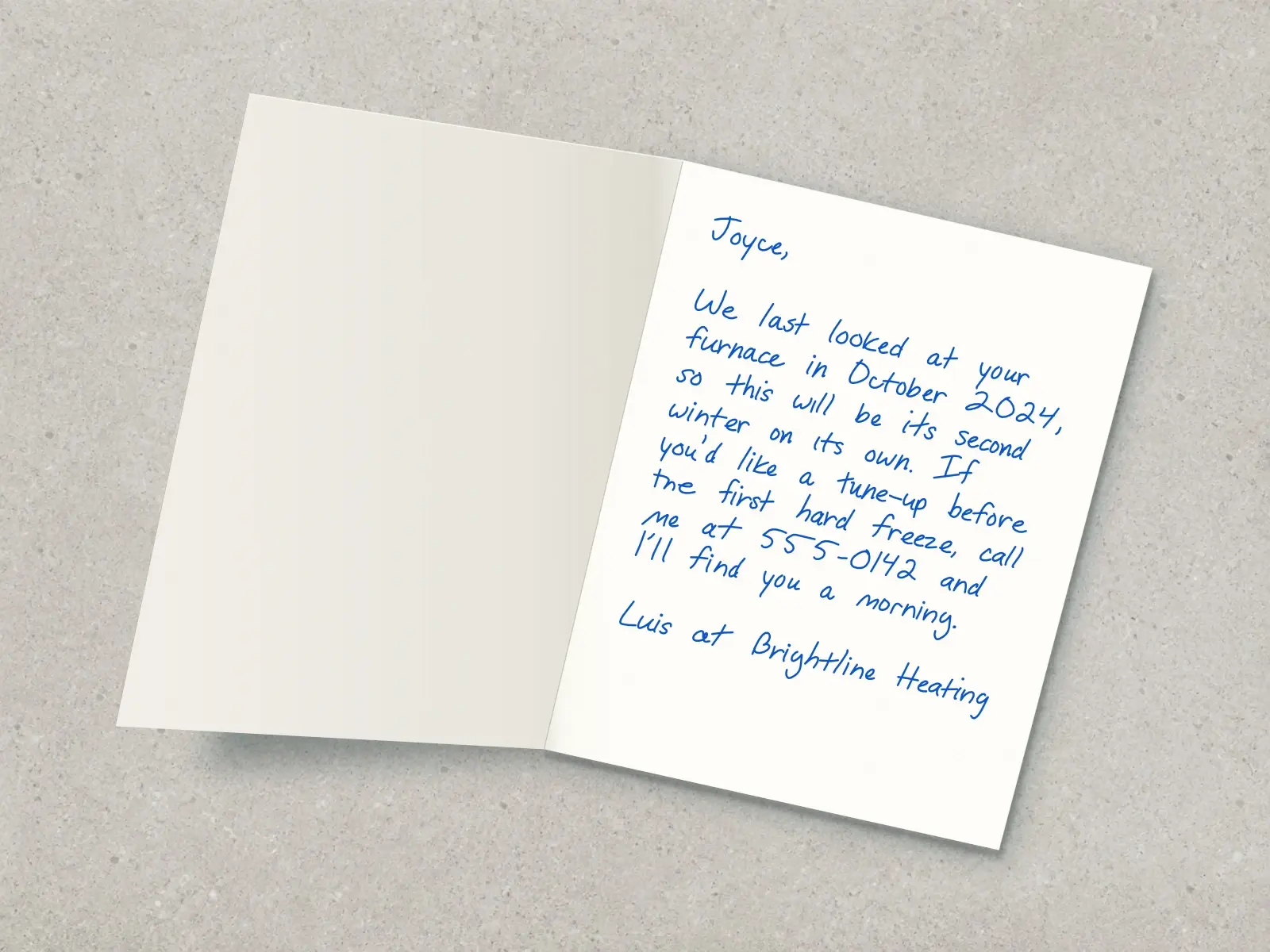
Joyce, We last looked at your furnace in October 2024, so this will be its second winter on its own. If you'd like a tune-up before the first hard freeze, call me at 555-0142 and I'll find you a morning. Luis at Brightline Heating
In the pilot this is one template: {{first_name}} plus a Last service column, written as {{last_service}}. The phone number is fictional.
To a prospect, with a reason to write
Ms. Kowalczyk, I heard your talk on returns at the Columbus logistics meetup. The line about a third of returns arriving with no paperwork stuck with me, because we fix exactly that for two warehouses in Ohio. I'll call the week of December 7. Darnell Price
Why now, one observation about her business, and a date he'll keep.
Choosing a handwritten letter service
"Handwritten" can mean a real pen on the paper or a printer using a handwriting font. Fonts are cheapest and look printed up close. Real pen costs more, and services where a person writes every card usually cost the most and take the longest. Before you pick a service, check:
- Is the message written with a pen? Ask for a sample in the mail and run a fingertip over the writing. A pen leaves a faint groove; a printer doesn't.
- Is the envelope addressed in pen, with a real stamp? A printed label or a permit box gives the game away before the card is opened.
- What does one card cost with postage, at the quantity you'll actually send?
- How long from upload to mailbox, and do they give you an arrival window?
- Can you upload a spreadsheet and use your own columns in the message?
Scribble Cards writes each card and envelope with a real pen and mails it with a real stamp, in one of 30 handwriting styles, to US addresses. You upload a list, use merge fields like {{first_name}}, and get an arrival window rather than an exact date.
Frequently asked questions
What is a good response rate for direct mail?
It depends on the list. The USPS Office of Inspector General puts typical actual response at 3% or less, and the Data & Marketing Association's 2017 report had 5.1% for house lists and 2.9% for prospect lists. A good rate is one that beats your own holdout group by enough to pay for the mail. [5][6]
How much does direct mail cost per piece?
Postage alone runs from 26 cents for EDDM to 82 cents for a stamped letter, and printed postcards or letters mailed by a service start under a dollar. A card written in pen with a real stamp costs more: at Scribble Cards it is $6.99 for one card, down to $2.45 a card in volume. [2][1][9]
Are handwritten letters worth the cost for marketing?
On a small list of people who know you, where one reply is worth hundreds of dollars, they're worth testing. On a cold list where a customer is worth $50, usually not. Divide the card's cost by a postcard's; the card has to beat the postcard's response by that much to win.
Do real estate postcards work?
They're the cheap way to stay visible in a farm area, especially through EDDM at 26 cents of postage a piece. For past clients and your sphere, a handwritten note is the better bet: USPS diary data shows mail from a business people already know gets read about twice as often as mail from strangers. [2][5]
How many pieces do you need for a direct mail test?
Catching a jump from 3% to 9% takes about 250 people in each group, and 5% to 10% takes about 440 (our calculation). A smaller test still checks your costs, list and follow-up, but it can't prove a small lift.
Sources and methodology
Reviewed .
Prices come from USPS Notice 123, USPS program pages and the providers' public pricing pages, checked on November 10, 2026. Group sizes are our calculation, from a standard two-proportion formula at 80% power and 5% two-sided significance. The pilot numbers ($4.00 a card, $150 per booking, 9 and 4 bookings) are invented for illustration.
- Notice 123, Price List
U.S. Postal Service · Accessed
Stamped postcard $0.65; stamped 1-ounce letter $0.82; USPS Marketing Mail automation 5-digit letters from $0.395; Marketing Mail annual fee and permit imprint application fee $390 each.
- Every Door Direct Mail
U.S. Postal Service · Accessed
EDDM Retail: $0.26 a piece, 200 to 5,000 pieces per ZIP Code per day, no permit.
- Publication 25, Designing Letter and Reply Mail: dimensions for postcards
U.S. Postal Service · Accessed
- Making Your Direct Mailpiece Postal Ready
USPS Delivers (U.S. Postal Service) · Accessed
- Advertising Mail: Mail Mix Matters (RARC-WP-19-003)
USPS Office of Inspector General · Published · Accessed
Models Household Diary Study data from 2013 to 2017. Response means a household said it was considering responding.
- How to Use Direct Mail in the Modern Marketing Mix
American Marketing Association · Published · Accessed
Reports figures from the Data & Marketing Association's 2017 Response Rate Report.
- New ANA Study Shows Marketers Still Favor Email For Direct Ads
Association of National Advertisers · Published · Accessed
Response Rate Report 2021: online survey, February to July 2021, 581 qualified responses, self-reported.
- Increasing response rates to postal questionnaires: systematic review
BMJ (via PubMed Central) · Published · Accessed
Edwards and colleagues; 292 randomized trials with 258,315 participants.
- Pricing
Lob · Accessed
Developer plan: postcards from $0.905 and letters from $0.828 a piece, printing and postage included.