
Most companies already recognize people. It just happens by accident. The big project gets a shout-out at the all-hands, the night crew gets nothing, and the bookkeeper who has closed the month on time for eleven years got a pen at year five and hasn't heard much since.
This guide turns that into a system an office manager can run in about an hour a week, with two downloads that do most of the setup: a 2027 recognition calendar and a one-page program.
What a recognition program includes
A recognition program has four layers, and each one catches people the others miss.
Scroll the table horizontally if needed.
| Layer | What it looks like | Who runs it | How often | Cost per person per year |
|---|---|---|---|---|
| Everyday thanks | A manager names one thing a person did and what it changed, out loud or in a note | Every manager | Weekly, plus one written note a month | $0, or $50 if you add spot awards |
| Dated moments | A card on each person's birthday and work anniversary, plus a few company-wide days | HR or the office manager | About four times a year per person | $27 to $43 |
| Peer nominations | Coworkers nominate each other for one specific thing, and a panel of three picks two winners | The panel, with HR | Quarterly | $10 |
| Milestones | A service award and a card from the owner at 5, 10, 15, 20 and 25 years | HR and the owner or CEO | Every five years per person | $25, averaged |
The bottom row is where most programs begin. In WorldatWork's 2019 survey of 445 mostly large employers, 72% gave length-of-service awards, more than any other kind of program, and 89% of those awards had been running for more than five years. But no single program reached most people. Service awards recognized about 23% of employees in a year, and employee of the month or year recognized 4%. [6]
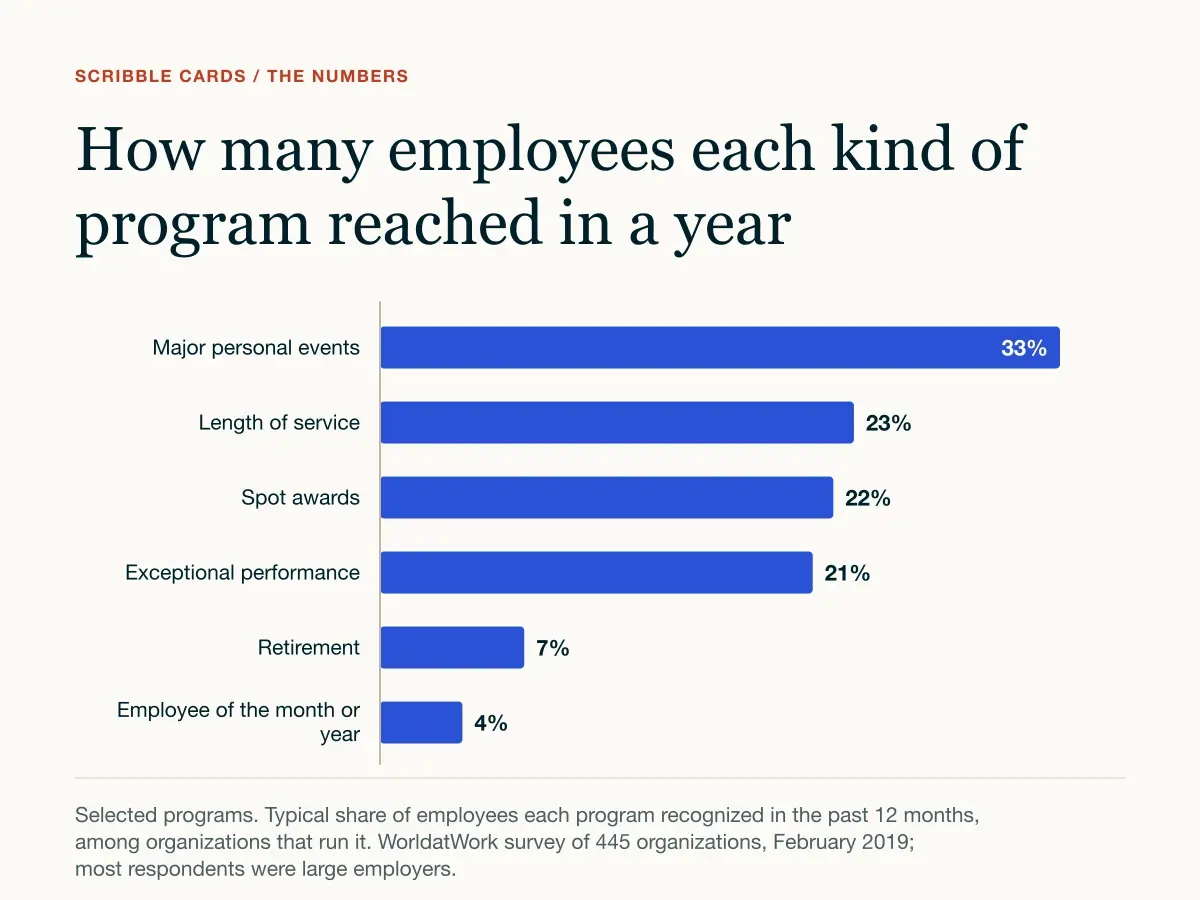
That's why the everyday layer carries the program. It costs nothing and it can reach every person every month, as long as managers actually do it. Most of what follows is about getting them to.
Who recognizes whom
Managers should do most of it. When Gallup asked employees who gave them their most meaningful and memorable recognition, 28% named their manager and 24% named a senior leader or the CEO. The manager's manager came next at 12%, then customers at 10% and peers at 9%. [1]
That 24% should change how you use the owner's time. A note from the top every week stops meaning anything, so save it for a fifth anniversary or the end of a brutal project. Get the detail from the manager before the owner writes a word.
- Managers: one specific piece of work per person every week, said in a one-on-one or a team huddle. Once a month, one of those goes in writing.
- The owner or CEO: signs the milestone cards, and writes a line whenever a customer praises someone by name.
- Peers: nominate each other every quarter. It's the only part of the program that sees what managers miss, like who keeps covering whose Saturday.
- HR or the office manager: owns the list and the dates, orders the cards, and runs the 30-minute quarterly check described below.
Somebody has to thank the managers, too. In a Gallup and Workhuman study of more than 7,500 U.S. employees, people managers said they gave recognition three times as often as they got it from their own bosses. Put every manager on the owner's list twice a year. [4]
Then ask each person how they like to be thanked. Gallup found that only 10% of employees had ever been asked. Two questions on the new-hire form cover it: in front of the team or privately, and is there anything you'd rather we skipped, like your birthday? Keep the answers where managers will look before they call someone up at the all-hands. [3]
What to recognize, and what a good note says
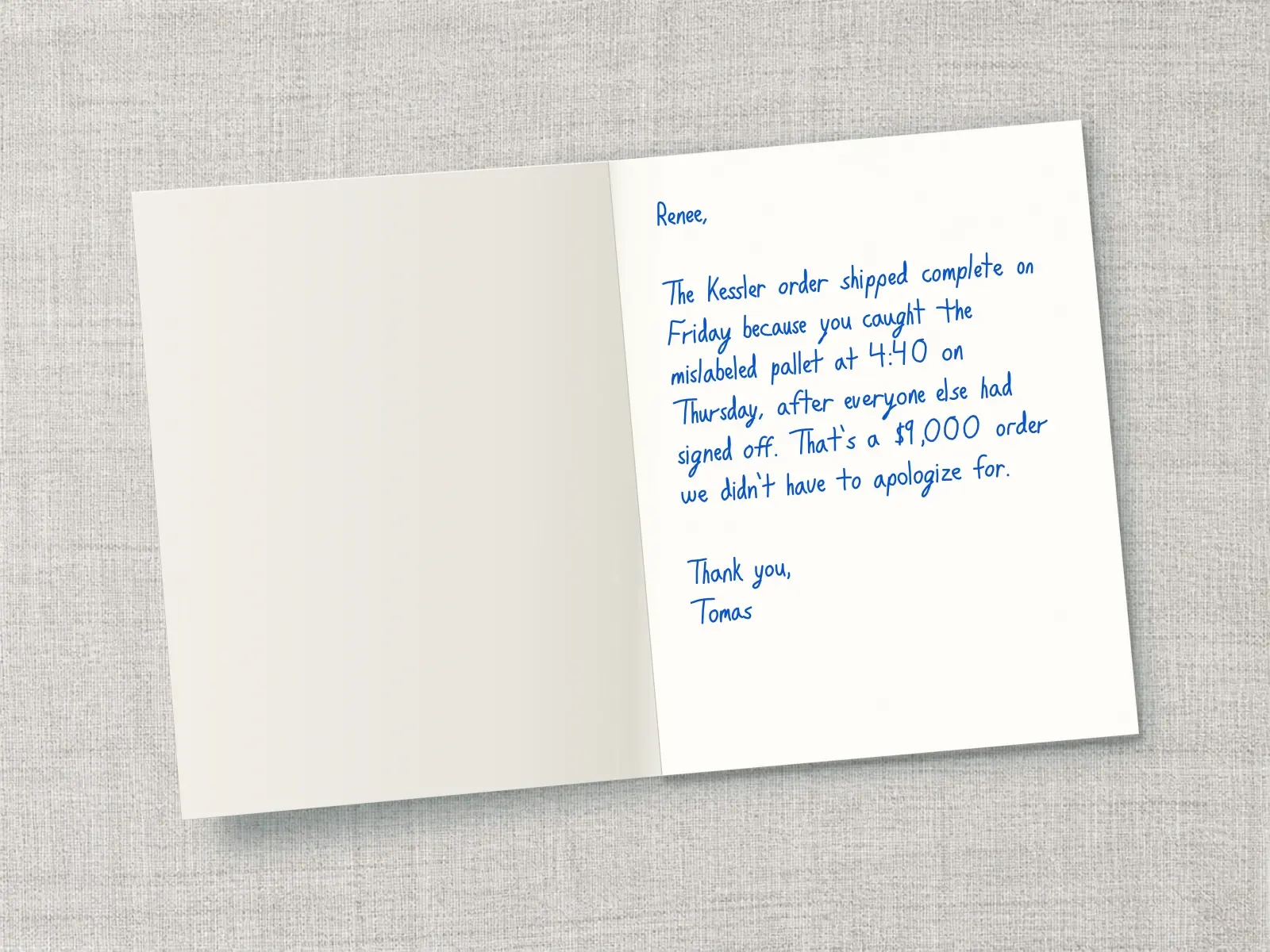
Recognize what people did. "You're so dependable" is a compliment. "You caught the mislabeled pallet before it shipped" is recognition, because it names what the person did and proves somebody saw it. Every note in the program needs two things, what they did and what it changed, signed by the person who saw it happen.
Write down three to five kinds of work you want more of this year, in plain words. A dental office might pick "patients leave calmer than they came in" and "nobody gets a surprise bill." A distributor might pick "orders ship complete" and "new hires trained by their second week." Managers use the list when they're stuck for something to say, and peers use it when they nominate.
Then go looking for the work nobody sees: the vendor accounts someone reconciles every Friday, the overnight restock, the remote bookkeeper two states away, the person who trains every new hire without being asked. In the same Gallup and Workhuman study, only 26% of employees strongly agreed that they get as much recognition as teammates who perform at their level. [4]
One rule for managers: thank people for results. "Thanks for answering emails at midnight" tells the whole team that midnight is part of the job. Thank them for what the late night saved, then fix whatever made it necessary.
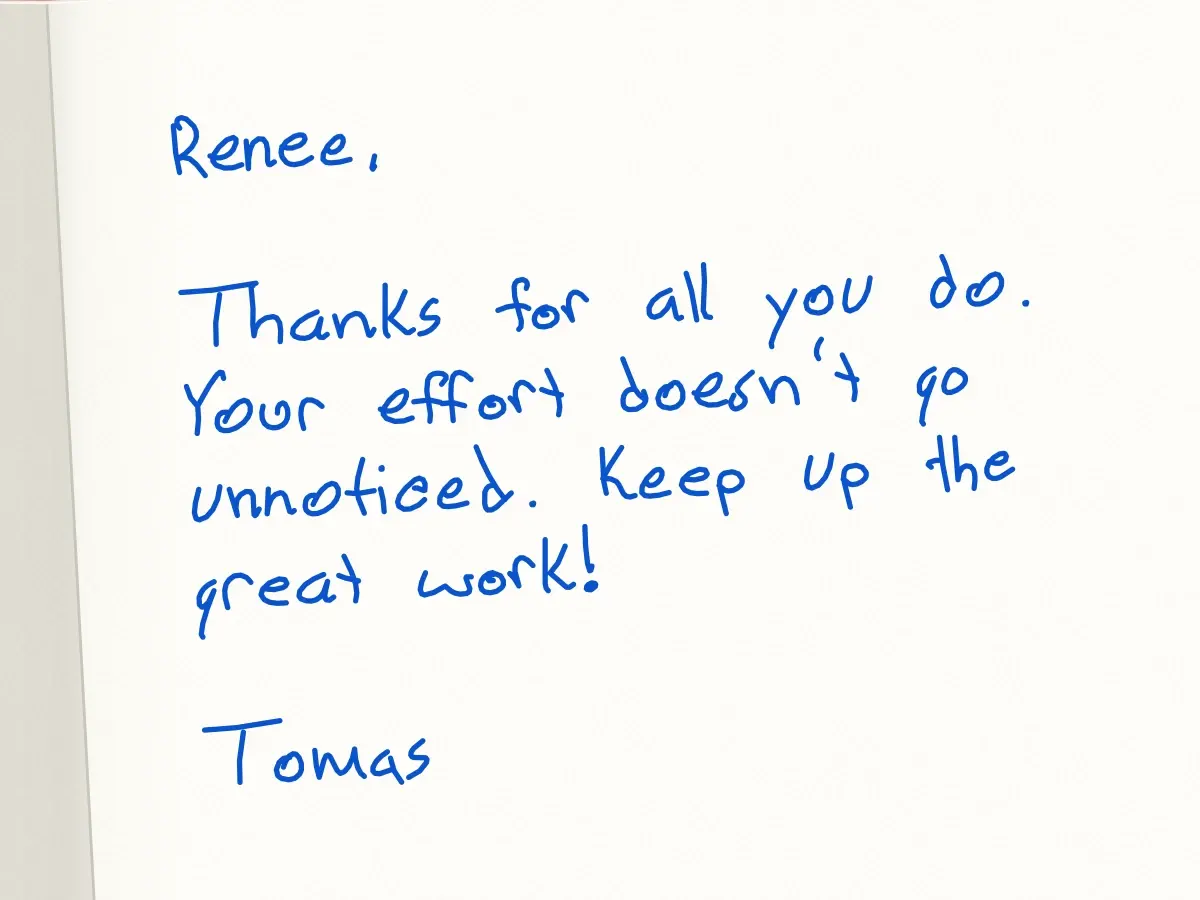
Before: a note that could go to anyone
Renee, Thanks for all you do. Your effort doesn't go unnoticed. Keep up the great work! Tomas
Fictional example. Writing it in pen doesn't rescue it. It still reads like a form.
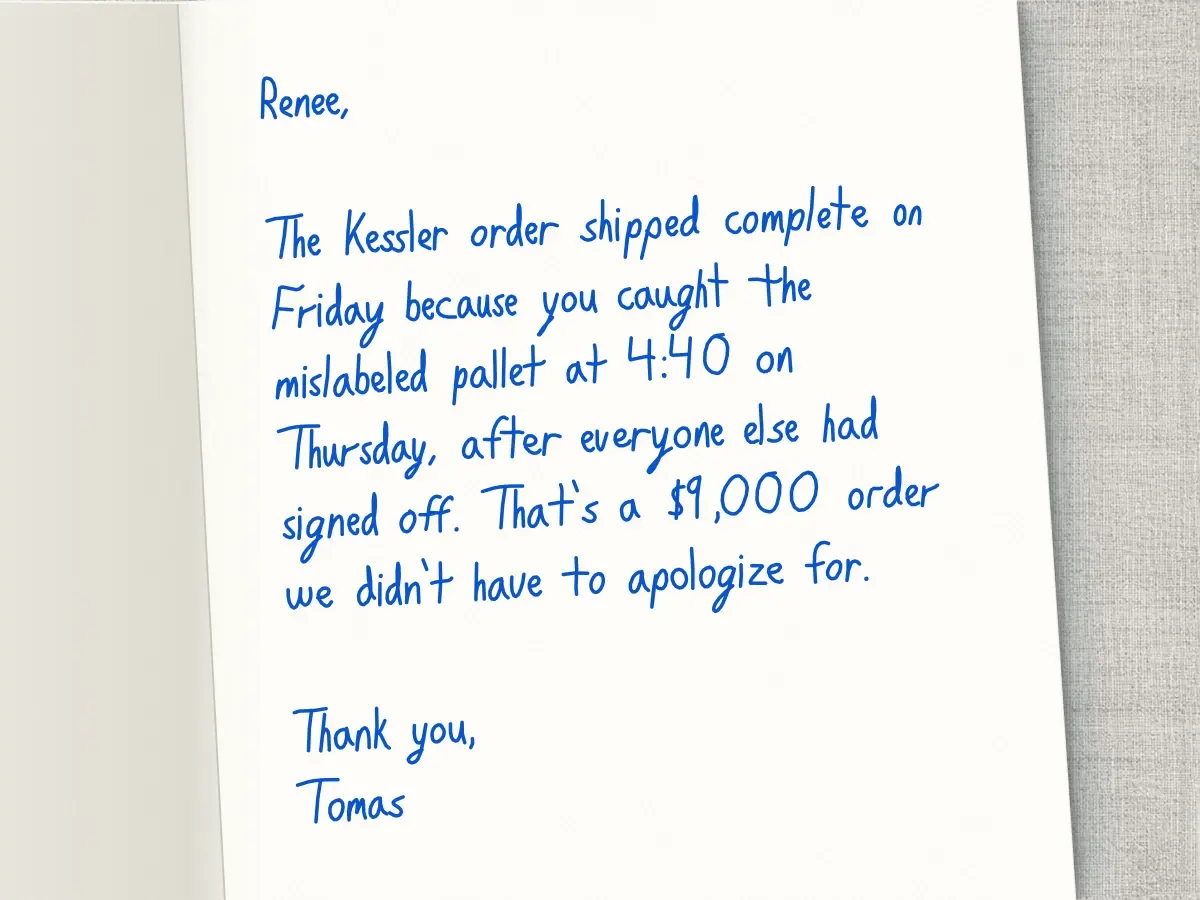
After: the same card, about one thing
Renee, The Kessler order shipped complete on Friday because you caught the mislabeled pallet at 4:40 on Thursday, after everyone else had signed off. That's a $9,000 order we didn't have to apologize for. Thank you, Tomas
Fictional names and order. Copy the shape: the thing she did, what it changed, and his name.
How often, and the 2027 recognition calendar
Gallup recommends recognition every seven days, and it finds only one in three U.S. workers strongly agree they got any in the past week. Weekly sounds like a lot until you see what it is: one specific sentence from a manager, in a one-on-one or a Monday huddle. The calendar takes care of the rest. [1]
- Every week: managers say one specific thing about each person's work. Spoken counts.
- Every month: each manager writes one card or note to someone on the team, about one thing.
- Every quarter: peer nominations close on the last Friday, and HR checks who has gone 90 days without a word.
- Every year: each person's own dates, plus a handful of company-wide days.
Scroll the table horizontally if needed.
| Moment | When it lands | What they get | Who signs |
|---|---|---|---|
| Welcome | At home, before day one | A card that says where to park and who's taking them to lunch | Their manager |
| First 90 days | Day 90 | A note naming one thing they've already figured out | Their manager |
| Birthday | On the day, if they opted in | A card at home | Their manager |
| Work anniversary | Every year on their start date | A card naming one thing from the past year | Their manager |
| Milestone | 5, 10, 15, 20 and 25 years | A card and a service award | The owner, with the manager |
| Life events | When they tell you | A card for a new baby, a wedding or a death in the family | Their manager or the team |
Then add the company-wide days. Employee Appreciation Day is the first Friday in March, which makes it March 5 in 2027. Administrative Professionals Day is the Wednesday of the last full week of April, so April 21. If you employ nurses, Nurses Week runs May 6 to 12 every year. For year-end, pick one card, Thanksgiving on November 25 or a holiday card in December. Two cards a few weeks apart starts to feel like a mail merge. [9][10][11]
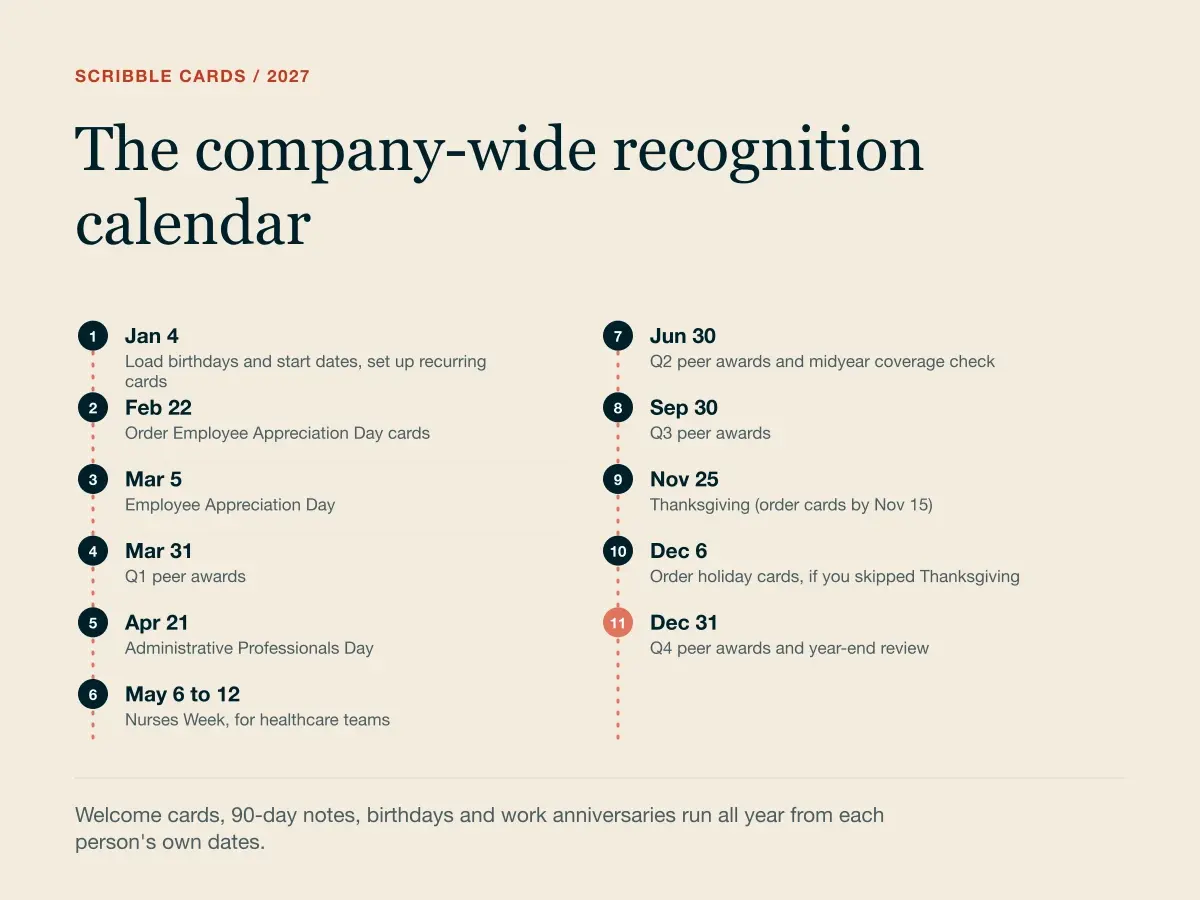
Mailed cards need lead time. With Scribble Cards you upload a list with birthdays and start dates once, the recurring cards are set up, and each one is still written individually in real pen. Writing takes 1 to 2 business days and USPS usually takes 2 to 5, so you get an arrival window, not an exact day. That's why the calendar says to order Employee Appreciation Day cards by Monday, February 22.
What a recognition program costs
Not much, by payroll standards. In WorldatWork's survey, 68% of organizations had a recognition budget, and about half of the budgets they reported came to 0.1% to 0.3% of payroll. [6]
Here's the program in this guide priced for a fictional 40-person company with an average salary of $55,000. These are our own assumptions, so change any line to fit your team.
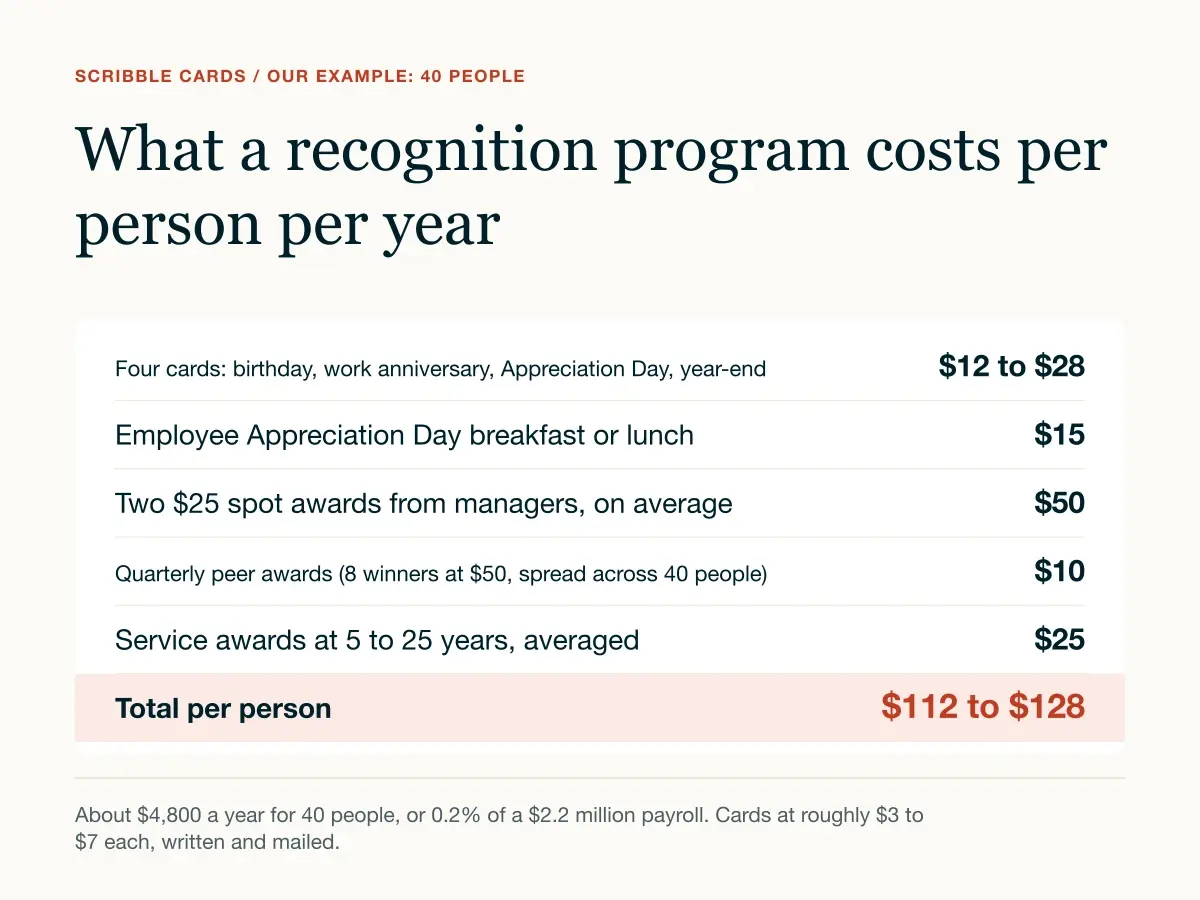
That comes to about $4,800 a year, or 0.2% of a $2.2 million payroll, inside the band where about half of WorldatWork's respondents landed. Spot awards are the biggest line. If money is tight, cut those first and keep the cards and the weekly thanks. Those are the parts that name what someone did. [6]
Launch it in four weeks
Don't skip the training. In the WorldatWork survey, 29% of organizations said they never train managers on recognition at all. Twenty minutes is enough, as long as every manager leaves having written something real. [6]
Four weeks from nothing to a running program
Week 1: collect the dates
Pull start dates from payroll, using the date HR recognizes for anyone who left and came back. Send a short form asking for birthday month and day (optional), how each person likes to be thanked, and where they'd like cards mailed.
Week 2: write the one-pager
Fill in the template below. If it runs past one page, it's too complicated to keep running.
Week 3: brief the managers
Twenty minutes, in person. Show the before and after cards above, hand out the list of work you want more of, and have each manager write one real note before leaving the room.
Week 4: load the calendar and launch
Put every date in a shared calendar or set up recurring cards. Launch on a day people notice, like Employee Appreciation Day or the first payday of a quarter, with a card to every person from their own manager.
How to tell if it's working
Most programs get judged by surveys and activity counts. In the WorldatWork survey, 65% used engagement or satisfaction surveys, 45% counted nominations and 37% tracked usage or participation. Activity counts tell you the program is busy. They don't tell you who it's missing. [6]
Keep a log instead: one line every time someone is recognized for something specific, with the date, the person, who did it and what for. A shared spreadsheet is plenty. Then check five things each quarter.
Scroll the table horizontally if needed.
| Measure | How to get it | What good looks like |
|---|---|---|
| Coverage | From the log: who was recognized for something specific in the last 90 days | 100%. Anyone at zero means a conversation with their manager |
| Gaps by group | Coverage split by team, shift, location and remote | Night shift and remote staff level with everyone else |
| Dates hit | Birthday and anniversary cards that arrived in their window | All of them |
| The survey question | Twice a year, ask "In the last seven days, I have received recognition or praise for doing good work" on a 1 to 5 scale | More 5s each time. Nationally, about one in three workers strongly agree |
| First-year turnover | People who left within 12 months of starting, this year against last | Trending down over two or three years |
A second survey question worth asking: do you get the right amount of recognition for the work you do? Gallup found just 22% of employees say yes. And be careful what you promise leadership. Gallup and Workhuman tracked nearly 3,500 employees from 2022 to 2024, and the well-recognized ones were 45% less likely to have left. That's a strong link, and still only a link, so report turnover as one number among several. [2]
What sinks recognition programs
- Making employee of the month the centerpiece. It recognizes one person and tells everyone else they lost. In WorldatWork's data it reached 4% of employees a year, and once managers start rotating it to be fair, it stops meaning anything.
- Calling up someone who hates the spotlight. Check how they like to be thanked before the all-hands.
- Slipping feedback into a thank-you. "Great job on the launch, and next time loop me in sooner" is a review. Save the second half for the one-on-one.
- Running it out of one person's memory. When the manager who remembers every anniversary leaves, the program leaves too. Put the dates somewhere shared the week you collect them.
Sources [6]
Frequently asked questions
What are the types of employee recognition programs?
Most mix four kinds: everyday thanks from managers, dated moments like work anniversaries, peer-to-peer nominations, and service awards. Some add spot awards or awards for safety and sales. WorldatWork found the average organization runs eight separate programs, far more than a small company needs. [6]
How much should a small business spend on employee recognition?
Our 40-person example comes to about $120 a person a year, roughly 0.2% of payroll. In WorldatWork's survey, about half of recognition budgets were 0.1% to 0.3% of payroll. Start with the weekly thanks and the cards, which cost the least, and add awards once the habit sticks. [6]
Are employee recognition awards taxable?
Usually. The IRS counts cash and gift cards as wages at any amount. Service and safety awards can be tax-free if they're tangible items given in a meaningful presentation, up to $400 per person a year ($1,600 under a qualified written plan). A service award also can't fall in someone's first five years or within five years of their last one. Ask your accountant before you set amounts. [7][8]
How often should employees be recognized?
Gallup recommends every seven days. That doesn't mean a gift every week. It means a manager says one specific thing about each person's work in a one-on-one or a huddle, with written notes and dated moments in between. [1]
Do we need employee recognition software?
Not below a few hundred people. You need a list of names and dates, a log of who was recognized for what, and one person who owns both. Software starts to help with several locations and managers who rarely see each other.
Is employee of the month a good idea?
As a side tradition, maybe. As the core of a program, no. In WorldatWork's survey it reached 4% of employees in a year. A monthly note from each manager to one person on their team reaches far more people for the same effort. [6]
Sources and methodology
Reviewed .
- The Importance of Employee Recognition: Low Cost, High Impact
Gallup · Published · Accessed
Updated January 12, 2024. Source of the most-memorable-recognition shares, the seven-day recommendation and the one-in-three figure.
- Employee Retention Depends on Getting Recognition Right
Gallup · Published · Accessed
Gallup and Workhuman tracked nearly 3,500 employees from 2022 to 2024.
- How to Bridge the Generational Gap in Recognition
Gallup · Published · Accessed
- Are You Playing Favorites With Employee Recognition?
Gallup · Published · Accessed
Gallup and Workhuman study of more than 7,500 U.S. employees.
- Gallup's Q12 Employee Engagement Survey
Gallup · Accessed
- Trends in Employee Recognition (2019)
WorldatWork, underwritten by Maritz Motivation · Accessed
Survey of WorldatWork members fielded February 20 to March 11, 2019; 445 usable responses. Respondents skew toward large North American employers: 6% had fewer than 100 employees. Program reach, budget, training and measurement figures are from this report.
- Publication 15-B (2026), Employer's Tax Guide to Fringe Benefits
Internal Revenue Service · Accessed
Sections on de minimis benefits and achievement awards.
- 26 U.S.C. 274, Disallowance of certain entertainment, etc., expenses (United States Code, 2024 Edition)
U.S. Government Publishing Office · Accessed
Section 274(j)(4)(B) sets the five-year rules for length-of-service awards.
- Employee Appreciation Day
Wikipedia · Accessed
Observed on the first Friday in March; lists March 5, 2027.
- Administrative Professionals' Day
Wikipedia · Accessed
Wednesday of the last full week of April in the United States. The 2027 date, April 21, is our calculation from that rule.
- The History of National Nurses Week
American Nurses Association · Accessed
May 6 to 12 are permanent dates.