
In the Fundraising Effectiveness Project’s full-year 2024 report, 42.9% of the previous year’s donors gave again. Among people who had first donated in 2023, 19.4% returned in 2024. Those figures describe the participating nonprofits; your own retention rate may differ.
A donor may stop giving for several reasons. Bloomerang’s donor communication guidance recommends explaining what a gift made possible and thanking the donor personally. A card can be part of that follow-up; it cannot guarantee another donation.
This guide explains how to plan a handwritten donor acknowledgment and evaluate a small program. The cited retention figures describe other organizations; they do not show that Scribble cards reverse donor churn.
The Nonprofit Donor Retention Problem (By the Numbers)
Before we talk about solutions, let's look at the scale of the problem:
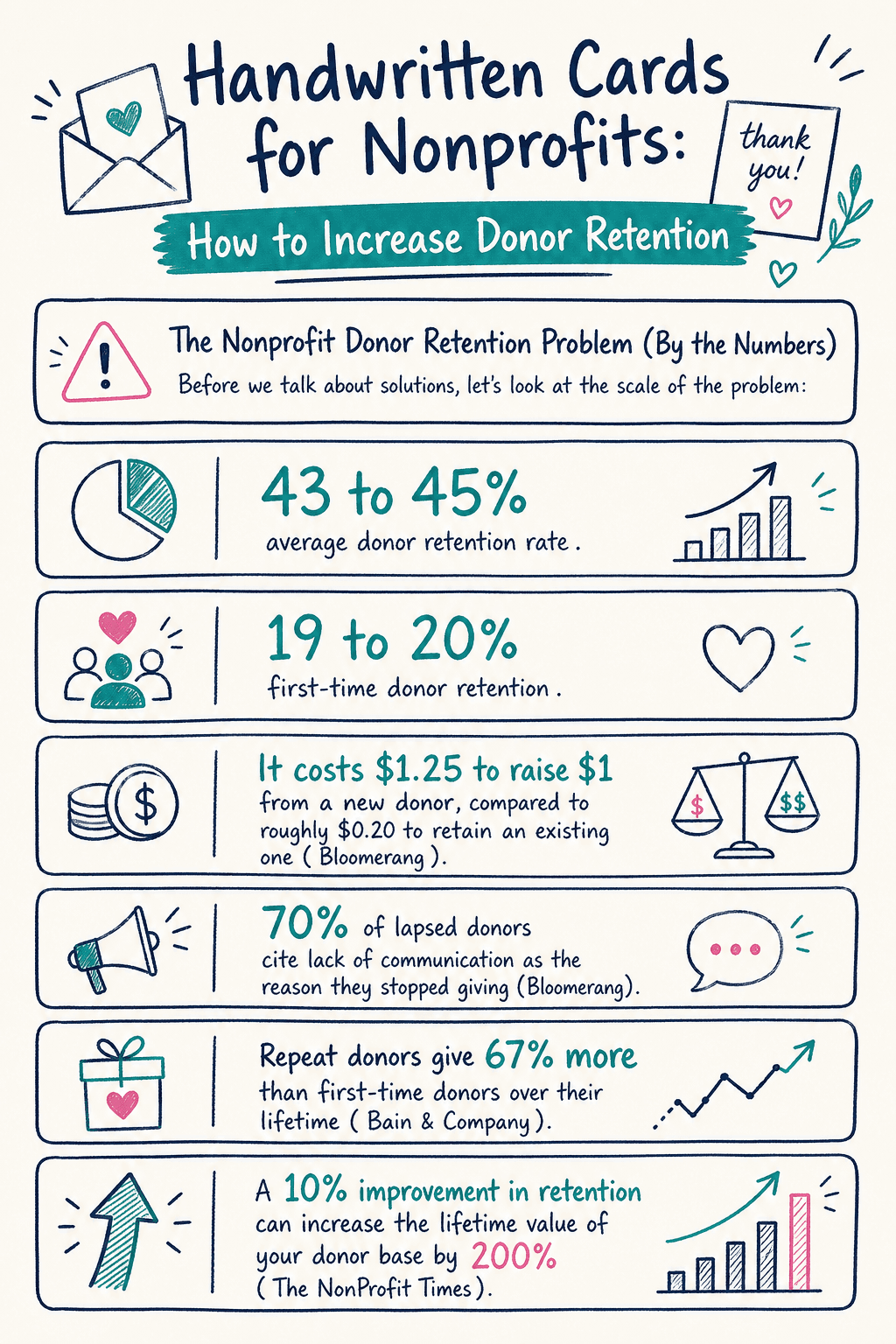
42.9% overall retention in 2024. This was the estimate in the FEP’s full-year 2024 report, rather than a prediction for every nonprofit.
19.4% new-donor retention in 2024. Roughly one in five people who first gave in 2023 gave again in 2024, according to the same FEP report.
Direct-mail costs vary. In Bloomerang’s acquisition-cost guidance, Claire Axelrad gives a range of $1.00–$1.25 per dollar raised for acquisition mail and about $0.20 for a second mailing to those donors. These are mailing examples, not universal costs of acquiring or retaining a donor.
Communication matters. Tell donors what their gift helped achieve and acknowledge their contribution. Bloomerang’s guidance explains how to make those updates useful.
Separate first-time and repeat donors when reviewing results. Their giving histories differ, so combining them can hide which group needs attention.
Retention gains compound. Bloomerang’s worked example compares 41% and 51% retention. It illustrates how keeping more donors can affect long-term giving; it is not a forecast for your nonprofit.
The math is clear: keeping donors is dramatically more cost-effective than finding new ones. Yet most nonprofits spend the majority of their budget on acquisition.
Why Handwritten Cards Work for Donor Retention
Handwritten mail operates on a completely different level than digital communication. Here's what the data shows:
Count replies and repeat gifts when evaluating your donor notes. Scribble does not track whether a recipient opens the envelope.
Response rates depend on the donor list, appeal and definition of a response. Compare donations and net income from similar campaigns before moving your fundraising budget.
Measure repeat gifts directly: compare a thank-you mailing group with a similar group that receives your usual acknowledgment.
132 seconds of attention for physical mail vs 11 seconds for email (see our direct mail statistics roundup).
In USPS and Temple University research, physical advertisements produced stronger emotional responses and lasting memories. That finding does not establish a donation rate for handwritten notes.
The reason is simple: a handwritten card signals genuine, human effort. In an era where donors receive dozens of automated emails per week, a physical note stands out. It tells the donor they matter enough for someone to pick up a pen.
Ways to thank donors
Thank donors with a specific update
When you thank a donor, describe something the gift helped fund. Use a real detail your organization can verify, such as the supplies a classroom received. Avoid crediting one gift with an outcome you cannot attribute to it.
Connect the message to the work
Pair your thank-you with a short update about the project the donor supported. Explain how funds are being used and what progress you can show. A photo or a link to your project report can give the donor more detail.
Keep the message useful
A personal card is one part of donor communication. Keep receipts, project updates and your next request clear, so a thank-you does not have to do every job at once.
How to Build a Handwritten Card Program for Your Nonprofit
Here's the step-by-step process I recommend for nonprofits looking to implement handwritten cards at scale.
Step 1: Identify Your High-Impact Touchpoints
You don't need to send a card for every interaction. Focus on the moments that drive retention:
First donation thank you: Acknowledge the gift promptly and explain what the donor can expect next. Preparing a card within 48 hours is a possible service goal, not a proven retention intervention or a delivery guarantee.
Annual giving anniversary: Acknowledge the one-year mark of their first donation. This reinforces the relationship and primes them for another gift.
Major gift acknowledgment: Any donation above your average gift amount deserves a personal note, not just a tax receipt.
End-of-year gratitude: A December card that thanks them for their impact during the year (with a specific example) is far more effective than a year-end appeal disguised as a thank you.
Lapsed donor re-engagement: A handwritten "we miss you" note to donors who haven't given in 12+ months. No ask, just gratitude for their past support.
Step 2: Write Messages That Feel Personal
The message matters as much as the medium. Generic messages undermine the entire effort.
Fictional example: “Maria, your gift helped fund this spring’s clean-water project. Thank you for supporting the work and the families it serves.” Replace the project detail with a truthful account of how the gift was used; include a quantified impact only when your records support it.
Bad example: "Dear Donor, thank you for your generous contribution. Your support is greatly appreciated."
The difference is specificity. Reference their name, their gift amount (or impact), and a concrete outcome. If you're sending handwritten thank you cards to donors, every card should feel like it was written by someone who knows what their donation accomplished.
Step 3: Choose a Scalable Solution
The biggest challenge for nonprofits isn't knowing that handwritten cards work. It's finding time to send them. Staff and volunteer hours are precious, and hand-writing 500 cards per month isn't realistic.
This is where a handwritten card service makes the difference. At Scribble, we work with nonprofits to send authentic handwritten cards at scale:
Real pen-on-paper writing in 7 distinct handwriting styles
A standard card costs $6.99, including US postage. Larger credit top-ups reduce the per-card price; see the current credit rates before planning your mailing.
Order status in your account, with card progress and arrival windows explained in the docs
Documented API and inbound-hook workflows for donor events, with no general 1,000-card requirement; check the named connector’s availability
No subscription required. Pay per campaign, which fits grant-funded budgets
Personalized messages for each recipient, not one-size-fits-all templates
This gives your organization the warmth and personal impact of handwritten communication without burning hundreds of volunteer hours.
Step 4: Integrate With Your Donor Management System
The most effective handwritten card programs run automatically. Set up triggers in your CRM (Bloomerang, DonorPerfect, Salesforce Nonprofit Cloud, etc.) to send cards at key moments:
New donor: Auto-trigger a welcome/thank you card within 48 hours of first gift
Recurring donor milestone: Send a card after 6 months or 12 months of consecutive giving
Lapsed donor: Trigger a re-engagement card when a donor hasn't given in 90+ days
Major gift: Auto-send a premium thank you for gifts above a threshold you define
Birthday/anniversary: If you capture donor birthdates, a birthday card creates a personal connection unrelated to asking for money
Step 5: Measure the Impact
Track these metrics to justify and optimize your program:
Retention rate: Compare retention among donors who received handwritten cards vs. those who didn't. Run an A/B test for the first 6 months.
Second gift conversion: What percentage of first-time donors who received a card made a second gift?
Average gift amount: Are card recipients giving more on subsequent donations?
QR code engagement: If using QR tracking, how many donors engaged with the linked content?
Cost per repeat donor: Divide the cost of your thank-you program by the number of recipients who give again. Compare similar groups over the same period. This measures campaign cost; it does not prove that a card caused a second gift.
Handwritten Cards vs. Other Nonprofit Stewardship Tactics
Handwritten cards work best as part of a multi-channel stewardship strategy. Here's how they compare to other common approaches:
Email thank you: Useful for immediate acknowledgment and receipt information. Evaluate its role alongside calls or cards; an email open metric does not establish whether a donor read the message.
Phone calls: Personal and effective, but extremely time-intensive. Best reserved for major donors. Calling every $25 donor isn't scalable.
Printed letters: Useful when the message needs more detail, such as a program update. Compare cost and outcome with cards; a handwritten format does not have a verified universal response multiplier. Further reading: direct mail.
Social media shout-outs: Public recognition works for some donors, but many prefer private acknowledgment. Cards are personal and private.
Impact reports: Valuable for demonstrating outcomes, but impersonal. Pair an impact report with a handwritten note for maximum effect.
The smartest approach layers these tactics. Use email for immediate acknowledgment, handwritten cards for personal connection, and impact reports for transparency. For a deeper look at channel comparisons, see our direct mail vs email marketing comparison.
The ROI of Handwritten Cards for Nonprofits
Here is a hypothetical planning example. Use your own costs and results before deciding whether a program is worthwhile.
Suppose you have 1,000 first-time donors and a measured retention rate of 19%. That would mean 190 give again in the period you are measuring.
For this example, assume a $4,000 mailing budget. Check current Scribble credit prices and include your staff costs when building your actual budget.
Illustrative mailing cost: $4,000 for 1,000 cards. This is the budget assumption used in the calculation below.
Assumed result: retention rises from 19% to 29%, so 100 more donors give again. A comparison group is needed to estimate whether the mailing caused that change.
If each retained donor gives an average of $150/year, that's $15,000 in additional annual revenue
Illustrative net return: ($15,000 − $4,000) ÷ $4,000 = 275%, before any costs excluded from the budget. This depends entirely on the assumed additional donations.
The example does not establish an expected return. Run a small test, compare it with a similar group that did not receive the mailing, and use the measured difference to decide whether to expand.
Common Mistakes Nonprofits Make With Donor Thank Yous
Waiting too long: A thank you that arrives 6 weeks after a donation has lost its emotional impact. Aim for 48 hours for first-time donors, one week maximum for all others.
Leading with another ask: A thank you card that includes a donation slip or an appeal undermines the sincerity. Thank first. Ask later.
Being generic: "Dear Supporter" on a handwritten card is worse than not sending one. If you use a handwritten card service, personalize every message with the donor's name and gift impact.
Only thanking major donors: Make the acknowledgment plan work for different gift sizes and recurring gifts. Compare net giving over a defined period before assigning donor lifetime value.
Not tracking results: Without data, you can't prove ROI to your board or optimize your approach. Set up an A/B test from day one.
Frequently Asked Questions
How much do handwritten cards cost for nonprofits?
A standard Scribble card is $6.99, including the handwritten message, envelope and US postage. Credit top-ups reduce the per-card price at larger quantities. Check the current credit table for your planned volume. Any financial return depends on your costs and measured donor response; there is no fixed payback period.
When should a nonprofit send handwritten thank you cards?
The highest-impact moments are: within 48 hours of a first donation, at the donor's one-year giving anniversary, after a major gift, and during year-end stewardship (December). Lapsed donor re-engagement (12+ months inactive) is also highly effective.
Do handwritten cards really improve nonprofit donor retention?
A personal thank-you can be worth testing, but we cannot promise a retention increase. Compare similar groups over the same period and track whether they give again. Use those results to decide whether the cards are worth continuing.
How can a small nonprofit send handwritten cards at scale?
You can prepare a list and message in Scribble, preview the merged text and send cards written with real pens. Documented API or inbound-hook workflows can support recurring events; review recipients, credits and skipped sends. There is no general 1,000-card minimum for those workflows.
What should a nonprofit write in a donor thank you card?
Include the donor's name, reference their specific gift or its impact, express genuine gratitude, and keep it to 3 to 4 sentences. Avoid corporate language. Write like a real person who is genuinely grateful, not like a fundraising department.
The Bottom Line
Use your own donor records to understand who returns and why. A thank-you card can be part of stewardship, but service, donor circumstances and the cause all matter. Start with a program your team can sustain and evaluate.
The organizations that thrive in fundraising aren't the ones with the biggest acquisition budgets. They're the ones that make every donor feel individually valued. A handwritten card does that better than almost anything else.
Planning donor thank-yous? See how sending cards to a list works in Scribble.