

A thank you card gives an account manager a reason to acknowledge something specific: a completed project, a referral, or another year working together. It belongs alongside useful service and regular conversations. A card cannot make up for an unresolved problem.
Start with the clients you already know. Decide what you want to thank them for, who will write the message, and when it should arrive. Then test whether the program is worth continuing.
If you work with donors, the nonprofit thank you card guide covers acknowledgments and repeat-donation measurement.
This guide covers messages, sending, and a practical way to measure repeat business. The research below is useful context, but it does not predict what a card will do for your clients.
Start with a reason to say thank you
Look at the moments your team already records. A referral, a renewal, or the end of a project gives you something concrete to write about.
After a referral, mention the introduction and thank the client by name. Avoid promising that the referral will lead to a sale.
After a project, mention a detail the client will recognize. Ask the account owner to check the message before it goes out.
At renewal, thank the client for choosing to continue. Keep billing details and contract changes in the usual account correspondence.
If someone has raised a complaint, resolve it first. A thank you for their feedback can follow once there is something useful to report.
What gratitude research actually tells us
A small study can tell us something about how a thank you is received without telling us whether a customer will renew.
In research reported by UT Austin in 2018, Amit Kumar and Nicholas Epley asked people to write letters of gratitude and predict the recipients’ reactions. Writers underestimated how positive recipients would feel and overestimated the awkwardness.
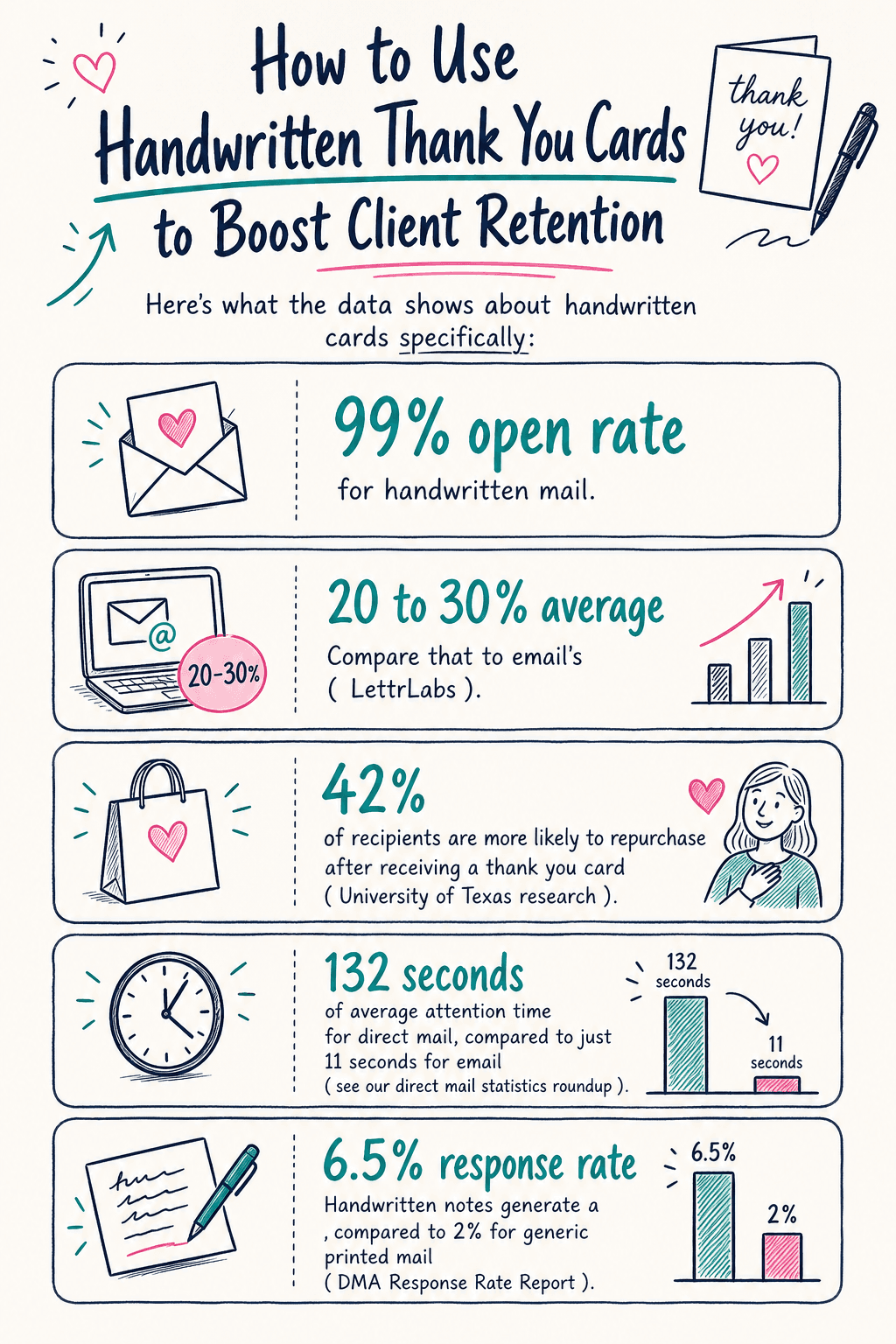
Those experiments concerned expressions of gratitude and recipients’ feelings. They did not establish an open rate for handwritten marketing mail, a repurchase percentage, or a retention forecast for Scribble customers.
For a business, the next question is practical: does a thoughtful card improve an outcome you can measure? Run a comparison with similar clients and find out.
A real example, and how to test your own
It helps to separate an example of a company sending cards from evidence that the cards caused more sales.
Wufoo’s weekly thank you habit
Wufoo wrote in 2016 that its team set aside time each week to write, decorate, and mail personal thank you cards to a handful of users. It is an example of a team making time to thank its customers; it does not measure an effect on retention.
Run a small comparison
Choose one occasion and a group of eligible clients. Randomly assign some to receive a card and some to continue with your usual follow-up. Keep the rest of their treatment the same, and decide in advance when you will compare results.
Choose the outcome before you send
For renewals, compare the share of eligible clients who renew during the same period. For referrals, count qualified introductions. Record the mailing cost and staff time. A small test may not give a clear answer, so keep uncertainty in the result.
Build your thank you card program
Start with one occasion your team can handle consistently. Expand once you have checked the messages, addresses, and results.
1. Choose when to send
Not every interaction needs a card. Focus on the moments that matter most to your clients:
Post-purchase or onboarding: Thank the client for choosing you and name the person they can contact.
After a milestone: Project completion, one-year anniversary, renewal date.
After a referral: When a client sends you new business, acknowledge it immediately.
After feedback: Thank the person for a specific suggestion or explain what you changed in response.
A check-in: Refer to a previous conversation or a shared interest when you have something worth saying.
2. Write the message
A handwritten card with a generic, corporate-sounding message defeats the purpose. Keep it short, specific, and personal.
For example: “Sarah, thank you for trusting us with the launch. Your team’s feedback on the first draft made a real difference. I’m glad we got to work on this together. Speak soon, Alex.”
A message such as “Dear Valued Customer, thank you for your business” leaves out the reason you are writing. Add a detail that belongs to this client.
The difference? Specificity. Mention something real. Use their name. Reference an actual outcome or interaction. If you're sending handwritten notes for sales or retention, the message quality matters as much as the medium.
3. Choose how to send
If several people will send cards, decide who owns the recipient list and who checks the messages. It is easier to maintain one clear process than to chase drafts in separate inboxes.
Scribble uses writing machines that hold real pens. You choose a design and handwriting style, write your message, and preview it before ordering. You can:
Choose from 30 handwriting styles and check how your message fits on the card
Send one card or prepare a mailing for a list of contacts in the same account
Pay $6.99 for a standard card at checkout, including its handwritten message, envelope, and US postage, or use credits at the current volume rates
Buy credits ahead of time and send when you are ready. One credit covers one standard card; credits do not expire
Set up automations for dates or events, or follow the integration guides to connect your own tools
Send without a subscription. Check the selected account space and its credit balance before scheduling a mailing
Allow 3–7 business days for a standard US card: 1–2 for writing and preparation, then 2–5 for delivery. Plan ahead for a birthday or anniversary; delivery dates are estimates.
4. Set up repeat sends carefully
Automations can watch saved dates or events. Choose the contact list and the message, check the credit balance, and review the rule before switching it on. Useful occasions include:
New client onboarding: Trigger a welcome card when a deal closes
Anniversary dates: Send a card on the client's one-year anniversary
Post-purchase: Thank someone after their first order, with enough time for preparation and delivery
Referral received: Add a thank you to the next suitable sending run after you record the introduction
Win-back: Send a card to clients who haven't purchased in 90+ days
Scribble’s scheduled automation rules run daily. Review skipped recipients and address problems rather than assuming every rule creates a card. The automation guide explains how the checks work.
5. Measure the result
Write down the outcome and review date before the first mailing. Useful measures include:
Retention rate: Compare the proportion who renew in the mailed group with the proportion in a similar comparison group
Repeat purchase rate: Are card recipients buying more frequently?
Replies and appointments: Record the responses you can connect to the mailing. A delivered card is not proof that someone read it
Net Promoter Score (NPS): Survey clients periodically to measure sentiment shifts
Gross profit and cost: Compare any estimated additional gross profit with the full mailing cost, including staff time
How cards fit with other follow-up
Thank you cards don't replace your entire retention strategy. They complement it. Here's how they compare to other common tactics:
Email: Use it for time-sensitive updates, links, and conversations that need a reply. A mailed thank you can follow a milestone when there is time for delivery.
Loyalty programs: Rewards give customers an explicit benefit for returning. A thank you card can acknowledge their support, but the two serve different purposes.
Phone calls: A call is better when you need to discuss a problem or make a decision together. A card works when you want to leave a short, personal message.
Gifts: Compare the full cost and the recipient’s company gift rules before choosing a gift. A card is another option, without a promise of the same response.
Use the channel that fits the message. For planning a combined campaign, the direct mail and email guide covers the different jobs they can do.
For an online shop, the e-commerce direct mail guide covers order follow-up and testing repeat purchases.
Where a client thank you can fit
The occasion and relationship matter more than an industry label. Here are a few places to start:
Real estate: Thank a client after closing or acknowledge a referral. The real estate direct mail guide has planning examples; a card does not guarantee a listing or commission.
Financial services: A note after a review can thank the client for their time. Leave account information out of the message and follow your firm’s communication rules.
SaaS and B2B services: An account manager can thank a client after onboarding or a completed project, with their own name on the message.
Professional services: Send a note after an engagement or introduction. Ask the person who knows the client to check that the wording fits the relationship.
Healthcare: Keep a personal thank you separate from clinical correspondence. Do not include sensitive patient information in a marketing card.
Set a budget based on your own costs and client relationships. Include address preparation and message review, not just the card price.
Mistakes to avoid
Before sending, check for these common problems:
Generic messages: Add the recipient’s name and a reason for the thank you. Read a sample aloud to check that it sounds like something you would say.
An unclear owner: Name the person responsible for checking recipients, messages, and scheduled sends.
Wrong timing: Allow 3–7 business days for a standard US card, including preparation and delivery. Order earlier for a fixed occasion and treat the arrival date as an estimate.
An inaccurate preview: Check the actual handwriting, spelling, and layout before ordering. Scribble writes with a real pen; the preview helps you review what will be written.
An unnecessary pitch: A thank you can end with the thank you. Include a next step only if it is useful to the recipient.
Not tracking results: Without measurement, you can't justify the program to leadership or optimize it over time.
If you are comparing services, check current prices and what is included. The handwritten card services guide is a starting point; confirm details with the provider before ordering.
Frequently Asked Questions
How many handwritten thank you cards should I send per month?
Start with the number of relevant occasions your team can review properly. There is no useful universal monthly target. Budget for a small test, decide how you will judge it, and expand only when the process and results support it.
What should I write in a business thank you card?
Keep it to 2 to 4 sentences. Include the client's name, reference something specific (a project, a milestone, a recent conversation), express genuine appreciation, and optionally suggest a next step. Avoid corporate jargon. Write like a human being, not a press release.
Do handwritten thank you cards actually improve retention rates?
A thoughtful thank you may help a client relationship, but there is no verified retention percentage to promise here. Wufoo’s own account describes a weekly sending habit, and the UT Austin study concerns reactions to gratitude. Compare renewals or repeat purchases in your own mailed and comparison groups.
How do I send handwritten cards in bulk without them feeling mass-produced?
Personalize each message with the recipient’s name and a detail you can check. Choose a handwriting style, preview the card, and review a few completed examples before a larger mailing. Scribble’s writing machines use real pens.
What's the ROI of a handwritten thank you card program?
There is no fixed return. Estimate the additional gross profit from your test, subtract all program costs, then divide by those costs. A standard Scribble card is $6.99 including US postage; credit prices vary by top-up size. A difference between groups may be uncertain, especially in a small test.
Start with one mailing
Choose one occasion, write a message your client will recognize, and check the addresses. Review what happened after the mailing before increasing the budget.
For message ideas, see the business thank you card guide. Adapt any example to the person you are writing to.
To prepare your mailing, see how sending to a list works. Choose your card, add your contacts, and check the message before scheduling it.
For a broader look at keeping your clients engaged long-term, see our guide on client retention strategy.