

Most B2B teams treat direct mail as a guessing game. They send a batch of postcards, hope for the best, and wonder why the phone doesn't ring.
A campaign needs a relevant audience, accurate data, a clear message and a measurement plan. These tips describe choices a team can test; they do not report a verified Scribble pipeline case study.
These fifteen tips cover the decisions a B2B team needs to make before a mailing. They are planning advice, not results from a verified set of Scribble campaigns.
Targeting: Reach the Right People
1. Target 100 Right Accounts Over 1,000 Random Ones
The single biggest factor in direct mail success isn't your creative, your offer, or your format. It's your list.
Choose accounts with a specific reason to hear from you. A smaller relevant list can be easier to personalize and review, but list size alone does not determine performance. Further reading: LettrLabs reports.
Before you design a single piece of mail, ask: who exactly are we trying to reach, and do we have verified physical addresses for those specific people?
2. Verify Every Address Before You Send
Bad addresses mean returned mail and wasted budget. This matters even more with B2B because you're often mailing to offices where people change roles and locations frequently.
Check address quality and changes using a suitable current service. For business mail, verify that the contact still works there. Review the cost and data requirements; no fixed percentage of postage savings is guaranteed.
3. Segment by Industry, Role, and Deal Stage
A CFO cares about different things than a VP of Marketing. A prospect in the awareness stage needs different messaging than one who's evaluating vendors.
Segment the audience when it changes what you need to say. Name-only personalization is not a guaranteed lift; review accuracy and compare outcomes for relevant message variants. Further reading: Compu-Mail.
4. Time Your Sends Around Buying Cycles
Timing matters more than most marketers think. If your prospect's fiscal year ends in December, a mail piece arriving in September (when budgets are being planned) will outperform the same piece in February.
Map your target accounts' buying cycles and plan your sends accordingly. For seasonal businesses, align with their peak planning periods. For enterprise accounts, target the 60 to 90 day window before contract renewals.
5. Layer Direct Mail into a Multichannel Sequence
Direct mail works best when it's one touchpoint in a coordinated sequence, not a standalone tactic. The most effective B2B programs combine mail with email and LinkedIn outreach.
Test a coordinated sequence with realistic postal lead time. A card, email and later follow-up may fit your process, but there is no verified universal 118% lift. Record the sequence and keep the comparison group’s other contact consistent. Further reading: direct mail vs email marketing comparison.
Creative: Make Every Piece Count
6. Lead with Value, Not a Sales Pitch
The worst B2B direct mail opens with "We're the leading provider of..." Nobody cares. The best direct mail leads with something genuinely useful to the recipient.
Offer a relevant industry report, a benchmark comparison, a free assessment, or a specific insight about their business. According to Modern Postcard, value-driven CTAs (whitepapers, assessments, consultations) consistently outperform purely promotional offers in B2B.
7. Write to One Person, Not a Company
"Dear Decision Maker" gets thrown away. "Sarah, I noticed your team just expanded the Phoenix office" gets read.
Write your direct mail copy as if you're writing to one specific person. Use their name. Reference something specific about their company or situation. The more it feels like personal correspondence, the higher the response rate. This is true for handwritten notes for sales and printed pieces alike.
8. Go Handwritten for High-Value Targets
For a high-value prospect, consider whether a personal note fits the relationship and the cost. A larger potential contract does not by itself establish that handwritten mail has the highest ROI.
A handwritten envelope gives your message a personal introduction. Test it against your usual mail format with comparable groups, and count replies or sales. An open-rate claim alone cannot tell you whether the campaign paid for itself.
Scribble writes cards with a real pen, addresses the envelopes and mails them for you. Review the current credit prices to budget for your mailing; standard card credits include US postage. Use your own CRM and response data to decide whether a campaign is worth repeating.
9. Use White Space and Clean Design
Make the main point and requested action easy to find. Test the design with someone unfamiliar with the campaign; a supplier design article is not proof of a universal five-second decision window. Further reading: PostGrid's design research.
Stick to one primary message per piece. Use plenty of white space. Limit yourself to two fonts. Make the headline the largest element and the CTA the second largest. Everything else supports those two.
10. Place Your CTA in Multiple Spots
Don't hide your call-to-action at the bottom of the mailer. Put it on the front, repeat it on the back, and offer more than one way to respond (phone, QR code, URL).
Use a CTA that accurately describes the next step. A specific audit or example may be clearer than a generic contact request, but test the wording rather than claiming a guaranteed advantage.
Optimization: Track, Test, Repeat
11. Record Responses and Understand Attribution Limits
"Where did you hear about us?" is not a tracking strategy. Assign unique identifiers to every campaign so you can measure exactly what's working.
Three tracking methods that work:
Campaign URLs: use a page you control and set up your own analytics to count visits and inquiries. A scan or page view alone does not confirm who responded.
Personalized URLs (PURLs): Each recipient gets a unique landing page (e.g., yoursite.com/sarah-jones). Conversion tracking is automatic.
Dedicated phone numbers: Use a unique tracking number per campaign so you can attribute calls to specific mail pieces.
12. A/B Test One Variable at a Time
Split testing direct mail is slower and more expensive than testing email, which makes it even more important to test smart.
Test one variable per send: headline, offer, format, or audience segment. Keep everything else identical. You need a minimum of 200 to 300 pieces per variation to get statistically meaningful results. Common tests that move the needle: handwritten vs. printed, postcard vs. letter, offer A vs. offer B.
13. Plan Follow-Up Around the Estimated Arrival Window
This is the tip most B2B teams ignore, and it's the one that matters most for conversion.
According to Compu-Mail, the average direct mail response time is 18 to 20 days. But the highest-converting campaigns don't wait for the prospect to call. They follow up with a phone call or email within 48 hours of estimated delivery.
The sequence: "Hi Sarah, I sent you a note earlier this week about [topic]. Wanted to make sure it reached you. Do you have 15 minutes this week?" Simple, personal, effective.
14. Choose a Cadence and Review Date
Direct mail is a compounding channel. The first send builds awareness. The second builds recognition. The third builds familiarity. By the sixth send, you're the name they think of when the need arises.
Choose the number of touches from the buying cycle, relevance and budget. Set a stopping rule before sending, and do not use an extreme case-study return as the expected result of a six-month program. Further reading: Uviaus campaign examples.
15. Measure Cost per Deal, Not Cost per Piece
Compare cost per qualified outcome, not just cost per piece. A more expensive format only pays for itself when additional contribution covers the added cost.
Use the same cost and outcome definitions across formats. Include staff time, offer costs and contribution margin; handwritten mail does not automatically win that comparison.
The linked campaign examples can provide creative ideas. They describe individual programs, not a comparable set of profit-based ROI benchmarks. Inspect the original costs, attribution and revenue definitions before repeating any return figure. Further reading: Uviaus campaign examples.
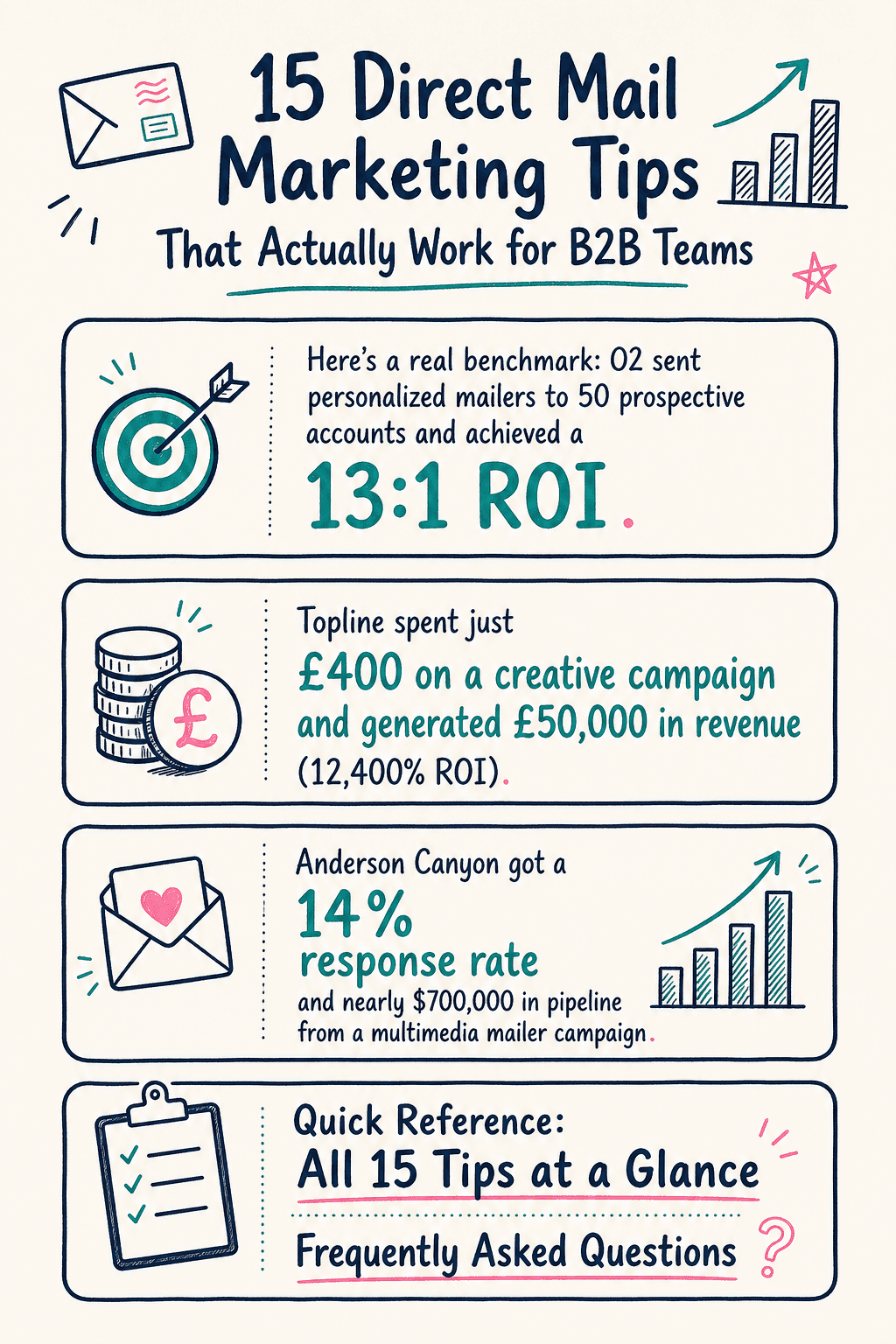
Quick Reference: All 15 Tips at a Glance
Frequently Asked Questions
What is the average response rate for B2B direct mail?
There is no single B2B response rate to apply to every campaign. Define a qualified response and use your own audience history or explicit low, middle and high assumptions for a test.
How much does B2B direct mail cost per piece?
Budget for the full mailing: design, production, postage and any outside tools or list preparation. Scribble standard card credits include US postage; check the current credit prices for the quantity you need. Compare formats using quotes for the same audience and mailing date.
How many times should I mail the same prospect?
Plan only the touches you can justify by relevance and budget. Review complaints, opt-outs, replies and costs along the way. Monthly contact is an option to test, not an ideal cadence for every buyer.
Can I automate B2B direct mail?
Scribble supports documented API and inbound-hook workflows for triggered sends. Check the named connector’s availability and the actual event you can send from your CRM. There is no general 1,000-card minimum for API access.
What's the best format for B2B direct mail?
Choose from the message and budget. Postcards can carry a brief public offer, letters allow more explanation and folded cards can suit a personal note. A box or kit costs more and does not automatically produce the highest response rate.
Put These Tips to Work
The difference between B2B direct mail that works and direct mail that wastes money comes down to discipline: target precisely, personalize genuinely, track everything, and commit to consistency.
Start with a mailing you can afford to learn from. Choose a relevant audience, write a specific message and record replies. Compare the result with your usual outreach before increasing the budget.
If you are new to direct mail, start with the research and planning guide, then compare the real-estate playbook for an industry-specific example. Further reading: Related Scribble guide. Further reading: real estate direct mail playbook.
Ready to start sending? See how sending cards to a list works in Scribble.