Handwritten card services all promise the same thing: genuine handwriting, mailed to real people, without you picking up a pen. But the gap between them is wide.
Some write with a machine holding a pen. Others print a handwriting-style message, or print handwriting you draw on a screen. Compare a physical sample and the complete price at your quantity.
This guide compares ten providers using their published product and pricing information, checked September 16, 2026. We have not run a controlled quality or campaign-performance test across these services. The recommendations below reflect workflow fit, not measured conversion rankings.
Scribble publishes this guide and is one of the services listed. That commercial interest matters. Each provider’s page is linked so you can check current terms, and we recommend comparing physical samples before committing.
TL;DR: The Quick Version
Short on time? Here is the shortlist.
Scribble: One-card sending and prepaid business mailings, with real-pen messages and US postage included.
Handwrite: Real-pen cards for business; confirm the current price and quantity terms before ordering.
Handwrytten: A candidate for teams that need named CRM connections and plan-based sending.
Simply Noted: Prepaid credit packs and subscriptions for automated business sending.
IgnitePOST: Best for ecommerce retention and win-back campaigns.
LettrLabs: Best for local service businesses running direct mail acquisition.
PostPilot: Best for DTC brands running direct mail through Shopify and Klaviyo.
Thankster and Scribeless: Printed handwriting-style options. Compare complete quotes rather than assuming printing is always cheaper.
Felt: An app for drawing a personal message on your phone and having it printed and mailed.
If you are a business that wants the simplest path to genuine handwritten outreach without a bulk minimum or a sales call, start with Scribble.
Real Pen vs. Printed Font: The Difference That Decides Everything
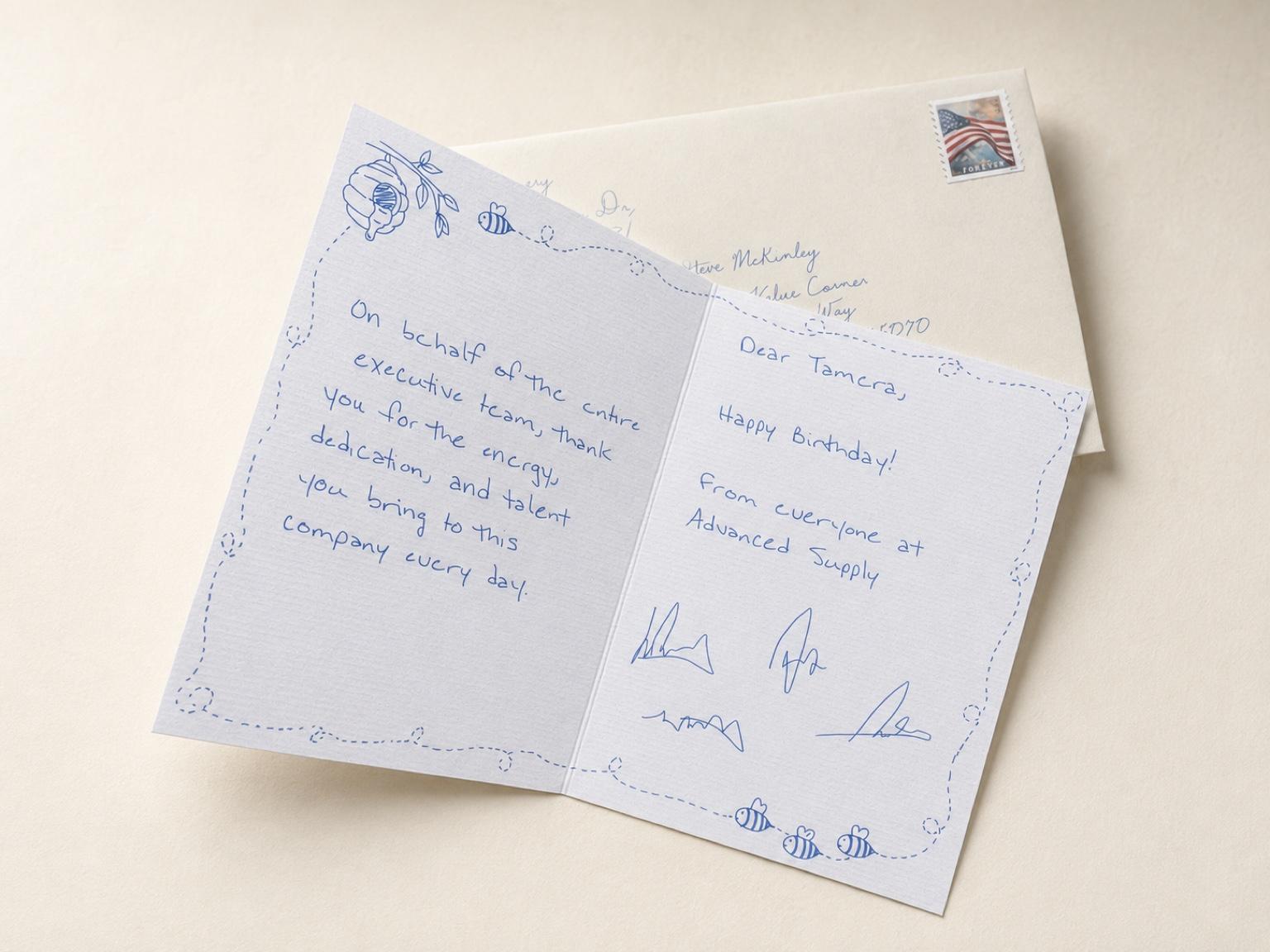
The writing method changes what arrives in the envelope. Inspect ink, paper and a full paragraph in a sample; the method alone does not establish what a recipient will think or whether they will respond.
Robotic pen on paper. A machine guides a pen to write the message. The providers in this group describe robot-written products: Scribble, Handwrite, Handwrytten, Simply Noted, IgnitePOST, LettrLabs and PostPilot. Inspect a physical sample of the exact product you plan to buy.
Printed handwriting-style message. Thankster describes simulated handwriting with character variation and a print-and-mail process. Scribeless says it retired its pen robots in 2019 and uses an algorithm to create handwriting-style output. Ask for a sample to compare the finish.
Prints your own handwriting. Felt captures the handwriting you draw on your phone and prints it. Personal, but still printed rather than penned in ink.
Repeated letters and spacing are worth inspecting in any sample. Look at a full paragraph with your actual wording; a short product photograph can hide layout or legibility problems.
Scribble uses handwriting data and variation software to prepare pen strokes. That does not guarantee that every repeated character is unique. Preview the message and compare it with a physical sample.
Choose the writing method that fits your message and budget. A pen-written card and a printed message can both be evaluated in a campaign test. Our explainer covers how handwritten cards are produced and when they can fit. Further reading: Related Scribble guide.
What to Look For in a Handwritten Card Service
Beyond the pen-versus-font question, these are the factors that separate a genuinely good provider from a mediocre one:
Minimum order. Can you send a single card, or are you locked into 100 or 150 to start? This is the fastest way to rule services in or out.
True cost per card. Watch for a low sticker price that excludes postage, or a headline rate that only kicks in at 10,000 units. The number that matters is the all-in cost at your real volume.
Level of service. This is the one buyers underestimate. Are you handed a login and left to figure it out, or does someone set the whole thing up for you? Some services are pure self-serve software. Others are done-for-you, with an account manager who builds your automation, designs the campaign, and holds your hand through the first send. If you do not have a direct mail person on staff, that support is worth as much as the product.
Card and handwriting selection. Can you upload your own card design, or are you stuck with a thin template gallery? How many handwriting styles are there? A few services, Scribble included, also offer illustrations and doodles you can drop into the card, which matters if brand or personality is part of the point.
Integrations. Does it connect to your CRM, your Shopify store, or your marketing stack? If you are running triggered campaigns, manual ordering does not scale.
Turnaround and coverage. How fast does it mail, and does it ship only within the US or worldwide?
Keep these in mind as we go through the list.
Ten Handwritten Card Services Compared
How to read each entry: one bold "best for" line so you can skim, a short honest breakdown, and a bottom-line verdict. The full side-by-side tables are further down.
1. Scribble: Single Cards and Business Mailings
Best for: businesses that want authentic handwritten outreach without enterprise overhead, plus anyone who just wants to send one great card.
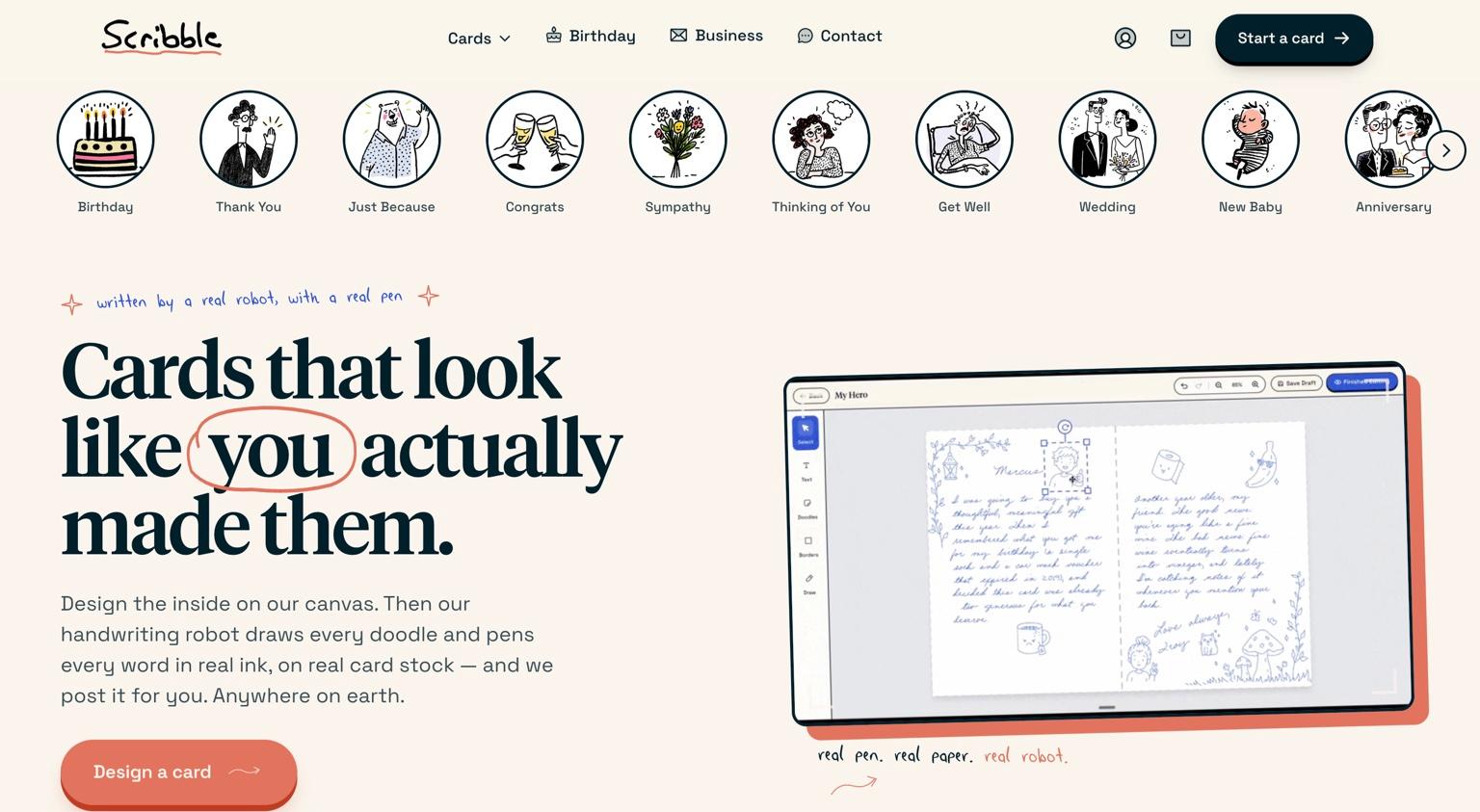
Scribble writes messages with pen-plotter equipment on card stock and mails standard cards within the US. Choose a front design and review the inside message before ordering.
You choose a card design, type the message and select one of 30 current handwriting styles. Preview the layout before ordering.
What makes Scribble stand out is not simply that it uses a pen. Several services here do. It is the combination.
Scribble lets you send one card or prepare a business mailing. Standard US postage is included, and business tools support contacts, campaigns and documented automation workflows. Ask the team about any setup help you need.
For a small test, compare the cash needed to get started as well as the per-card price. Other providers also allow small sends; a campaign platform is not automatically subject to a bulk minimum.
A single Scribble card costs $6.99, including US postage. Prepaid credits lower the price per card: $2.45 requires buying 10,000 credits in one purchase. Here are the rates by credit purchase size: Scribble volume pricing.
Scroll to compare all columns →
Credits bought in one purchase | Price per card (postage included) |
|---|---|
1 to 99 | $6.99 |
100+ | $5.59 |
250+ | $4.89 |
500+ | $4.19 |
1,000+ | $3.50 |
2,500+ | $3.15 |
5,000+ | $2.80 |
10,000 | $2.45 |
Scribble combines personal card ordering with business mailing tools. We put it first because it is our product and fits those uses, not because a comparative test established that it has the largest library or best results.
If you have been meaning to add handwritten outreach to your process but have not found something both authentic and easy, Scribble is where to start.
2. Handwrite: Real-Pen Business Cards
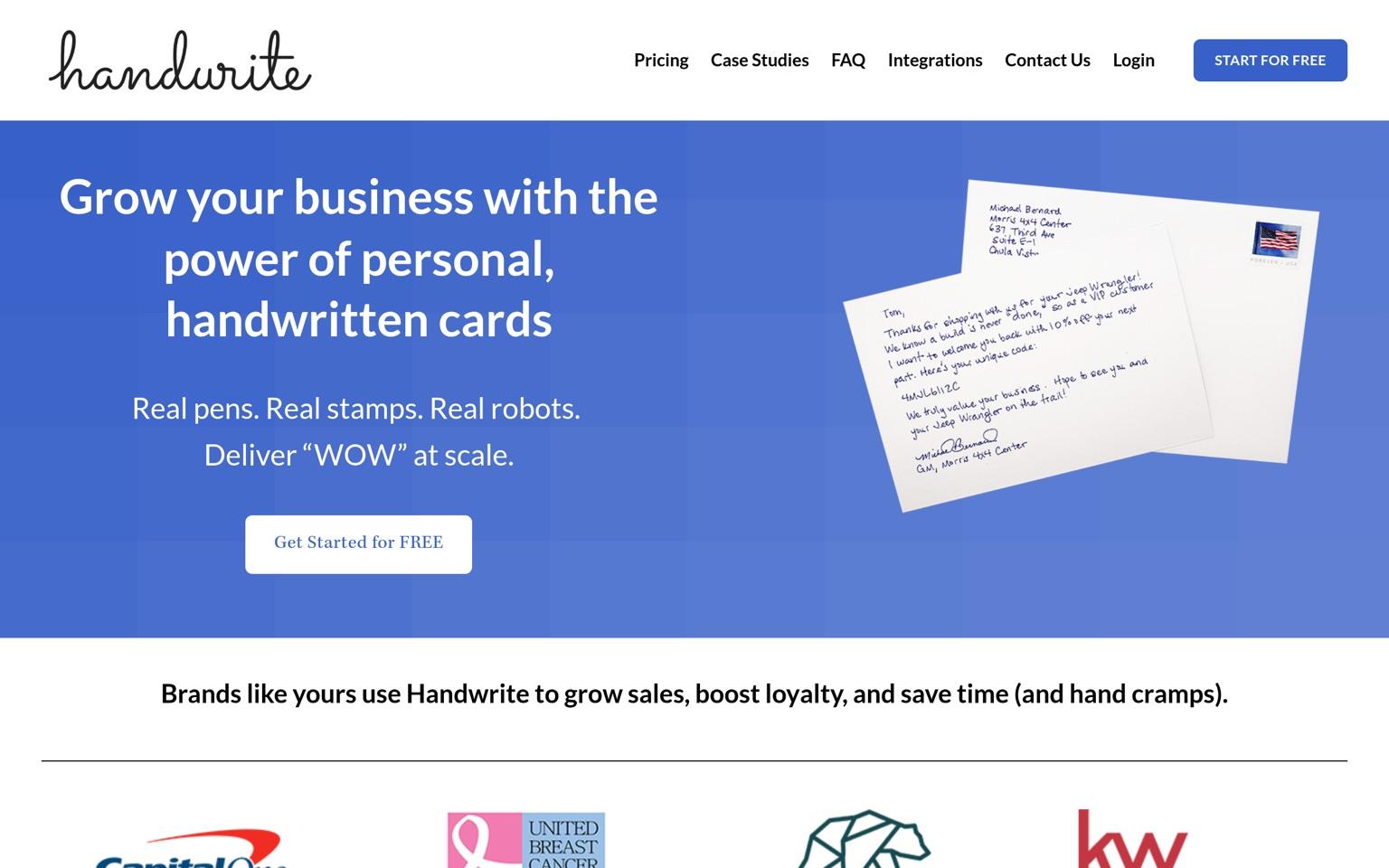
Best for: businesses that want genuine robotic handwriting at a low, transparent price with zero commitment.
Handwrite describes business cards written by robots using real pens and ink. Its current public page does not provide a clear checkout price in the accessible pricing text, so confirm the total, postage and minimum directly. Do not treat an older advertised $2.99 rate as a current quote. Handwrite product page.
Consider Handwrite when comparing real-pen products. Get a current quote and confirm the integration and delivery destination you need.
3. Handwrytten: CRM Connections and Plan-Based Sending
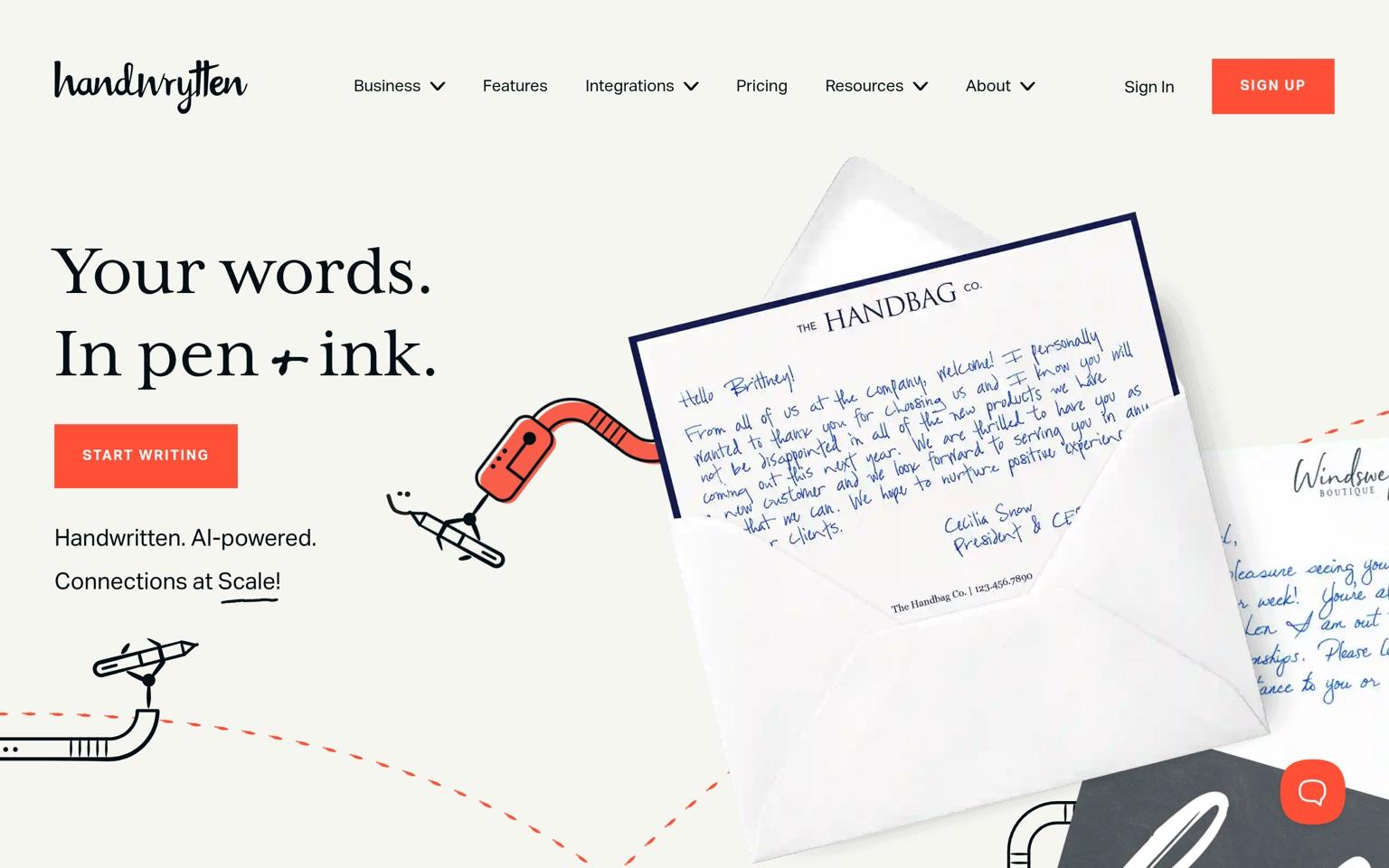
Best for: large sales and marketing teams that need deep native CRM sync and international delivery.
Handwrytten lists connections including Salesforce, HubSpot, Shopify, Zapier, Make and Blackbaud. Verify the specific trigger and plan before relying on a connection.
Handwrytten lists $3.75 retail per card plus postage. With the current $0.82 standard one-ounce letter stamp, that is $4.57 before any other charges. Business plans list lower per-card fees, but also charge a subscription; the nonannual plans are billed every four weeks. Allocate that fee to your actual sends when comparing cost. Handwrytten pricing.
Handwrytten is worth comparing for a CRM-based workflow. A lower per-card fee does not include the plan fee or postage; confirm both before estimating a budget.
4. SimplyNoted: Prepaid and Automated Sending
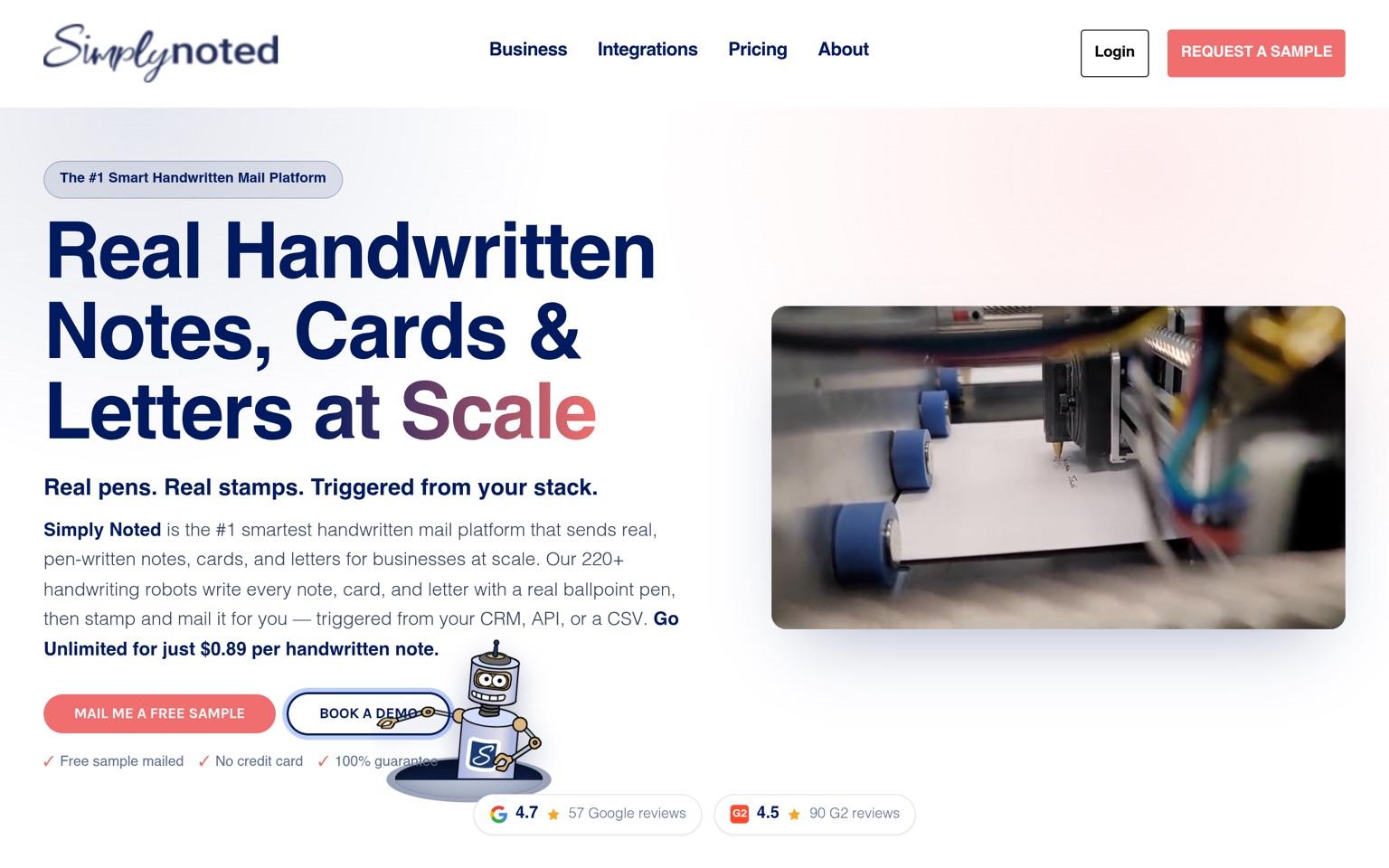
Best for: Shopify and ecommerce brands automating post-purchase cards at scale.
Simply Noted offers real-pen cards, credit packs and automated business sending. Check its current integration options against the event you want to trigger.
Simply Noted’s public calculator lists 100 folded-card credits for $358, or $3.58 each including the displayed $0.82 postage. Subscription pricing has a separate plan fee and per-note terms. Compare the total at your actual use, not a per-note headline alone. Simply Noted plans and calculator.
Compare Simply Noted for a repeat mailing program. The cited prepaid example requires buying 100 credits; confirm terms for any smaller send, subscription or international destination.
5. IgnitePOST: Retention Campaigns and Managed Services
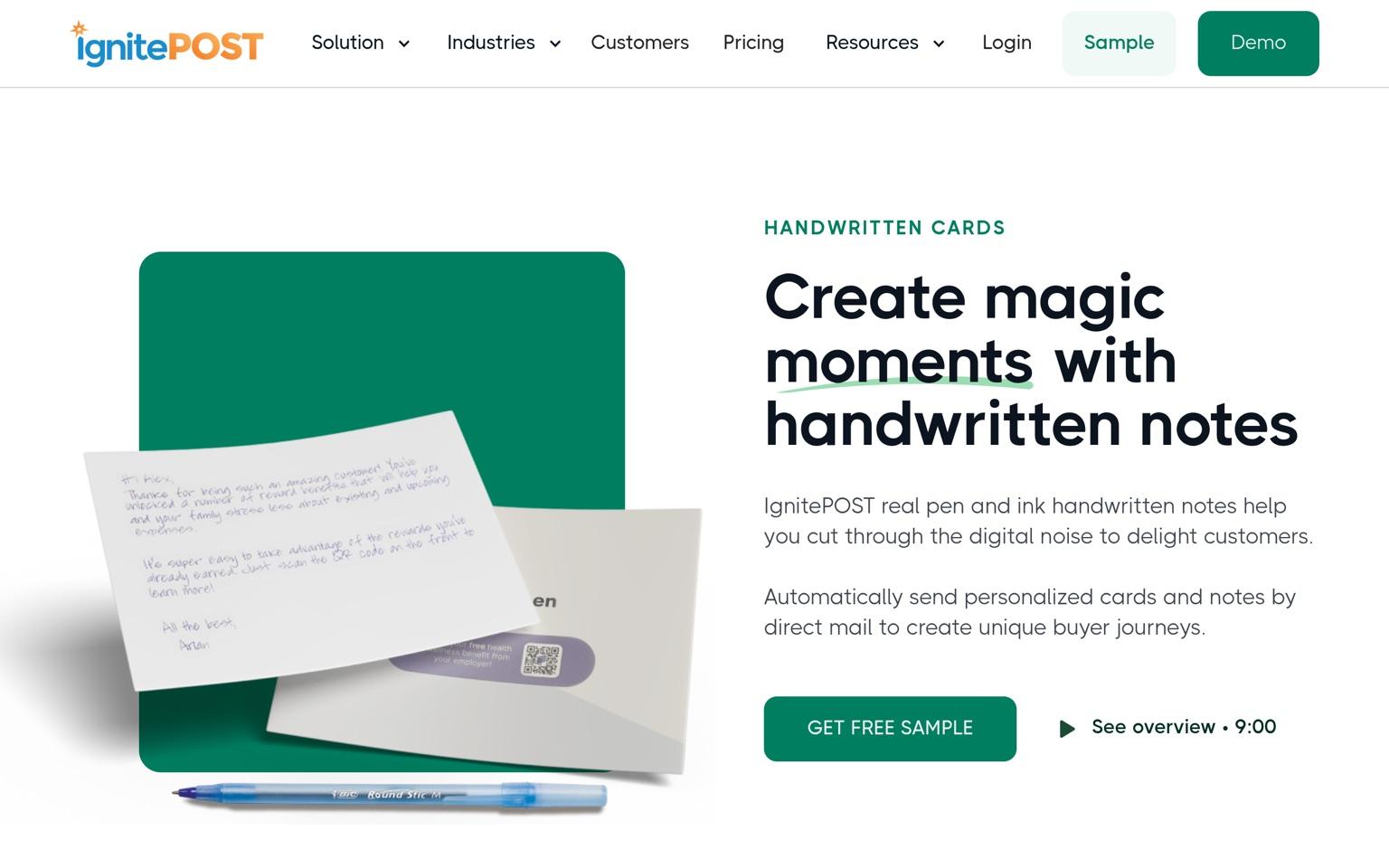
Best for: ecommerce brands running win-back and retention campaigns.
IgnitePOST offers real-pen cards and managed campaign services for retention and reactivation. Check its current connector documentation for your stack. Supplier response-rate claims are not a forecast for your audience.
IgnitePOST describes subscription and prepaid options and says its prepaid prices include postage. Get the current quantity, renewal and unused-credit terms directly; this comparison does not use an unverified low-volume price or volume floor. IgnitePOST pricing.
Consider IgnitePOST if you want help running a retention campaign. Include service fees in the budget and confirm where the cards can be mailed.
6. LettrLabs: Geographic and Triggered Campaigns
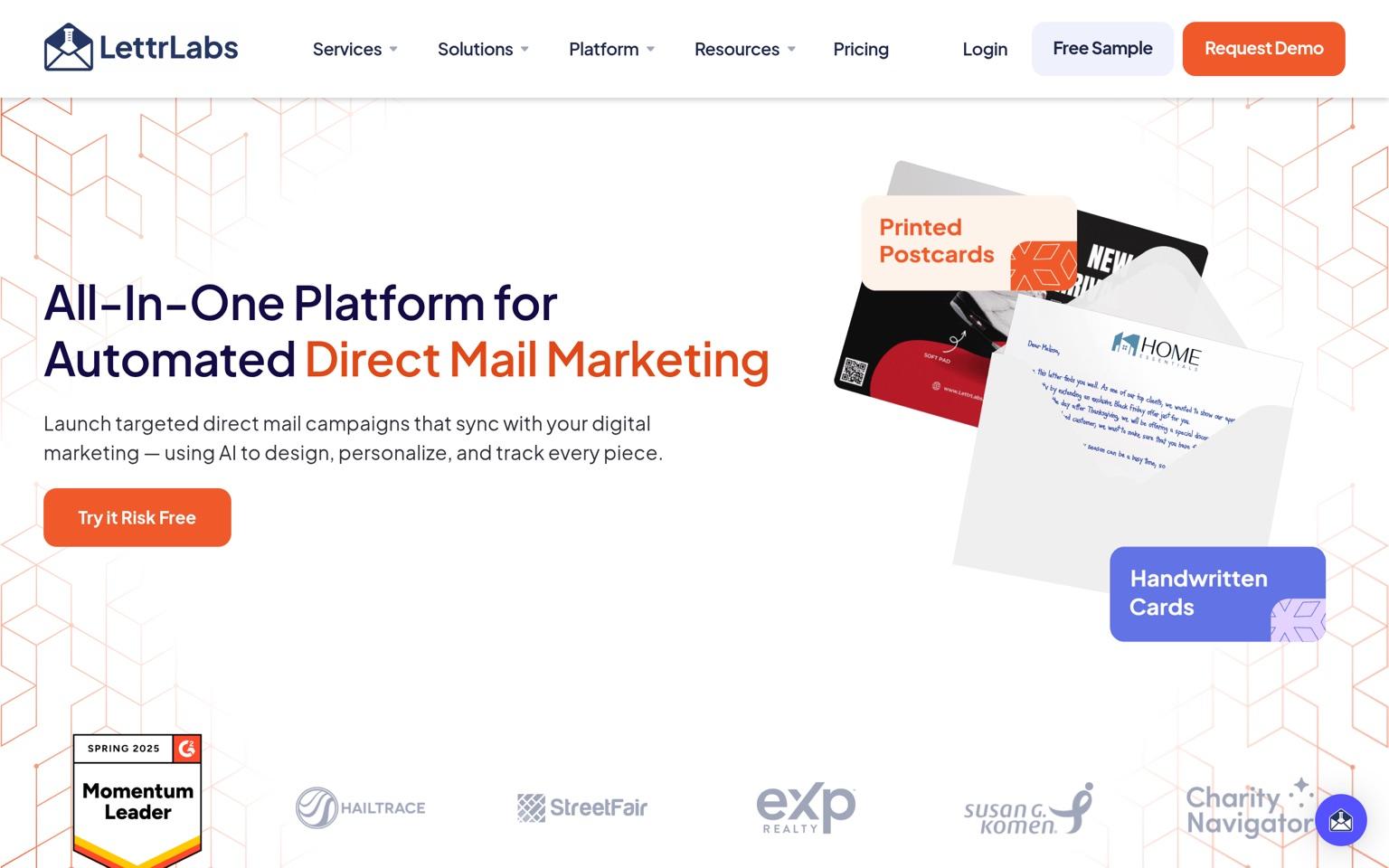
Best for: local service businesses running geographic direct mail to win new customers.
LettrLabs leans into direct mail as an acquisition channel, especially for home services, insurance, and other local businesses. Its robots write with a ballpoint pen, and the platform is built around geographic and CRM-triggered campaigns rather than one-off sends.
A geographic mailing workflow may suit a local service business. Treat vendor case studies as examples to inspect, not standard response-rate benchmarks for your own neighborhood. Further reading: direct mail statistics.
LettrLabs separates platform plans and mail formats. Its pricing page shows different prices for postcards, cards with envelopes and folded cards; optional services can add cost. Request a quote for the exact format, postage, plan term and quantity. A price for a handwritten envelope with a printed letter is not a quote for a fully handwritten folded card. LettrLabs pricing by format.
Consider LettrLabs for a geographic or triggered campaign. Confirm the selected format and complete plan cost before using a headline rate in your budget.
7. PostPilot: E-Commerce Direct Mail
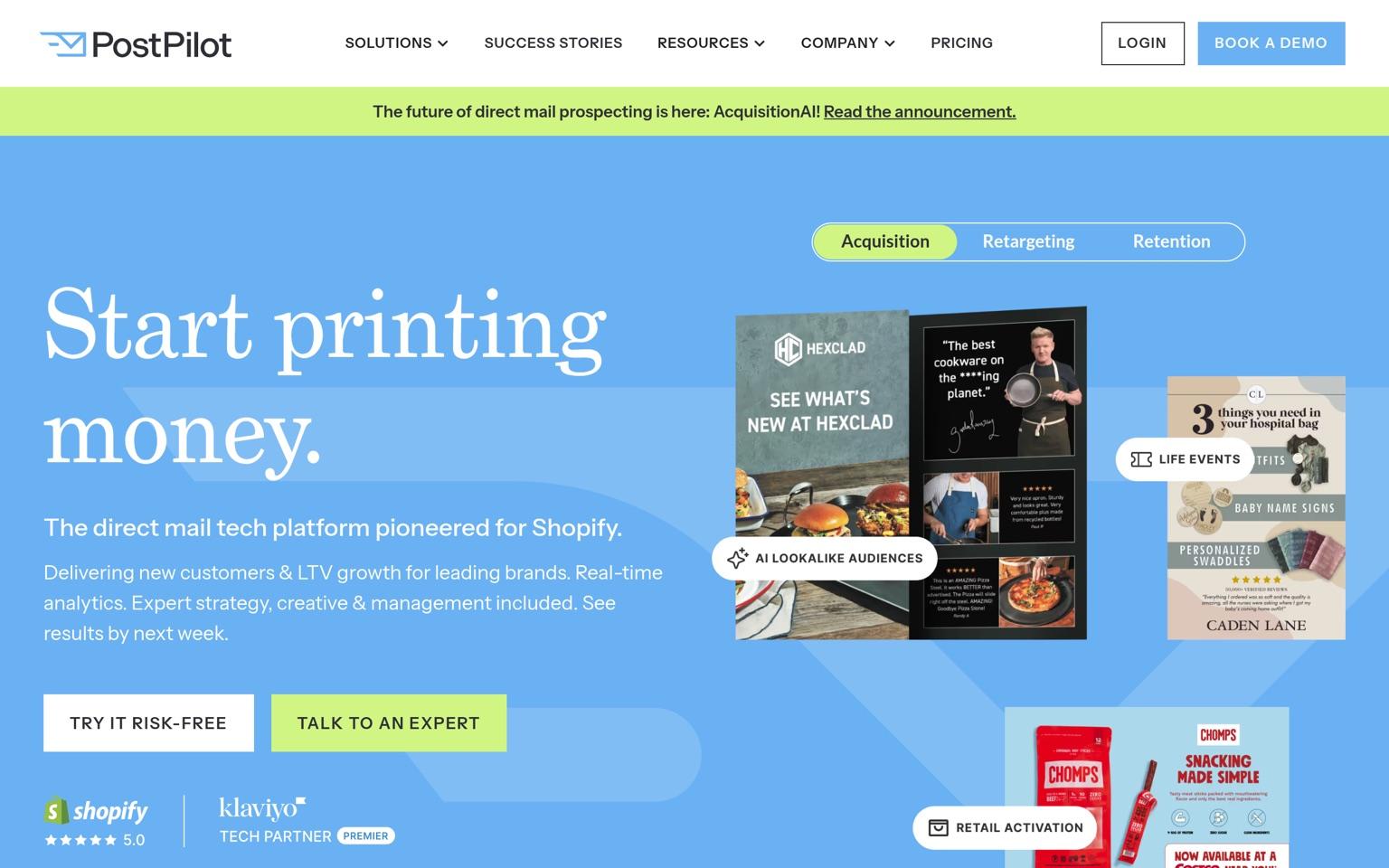
Best for: DTC and ecommerce brands running direct mail through Shopify and Klaviyo.
PostPilot is an e-commerce direct-mail platform with Shopify and Klaviyo workflows and both printed and robot-written formats. Its support documentation describes 4 × 6-inch handwritten cards. Confirm which creative or campaign services your plan includes.
PostPilot’s current Growth pricing lists handwritten cards at $2.99 with postage included, plus a $99 monthly platform fee or a lower annual-plan equivalent. Printed postcards have separate rates. Its pricing FAQ says you can send one card; handwritten pricing is not entirely quote-only. PostPilot pricing.
Compare PostPilot for an e-commerce workflow. Include the platform subscription in the cost of a small test and confirm the selected format’s rate.
8. Thankster: Printed Handwriting and Automation
Best for: high-volume, cost-sensitive mail where a handwritten look is enough.
Thankster describes simulated handwriting with character variation and a print-and-mail process. It offers several mail formats, recurring sends, Zapier, Make, Keap and API workflows. Get a current quote for your format and quantity; this review does not verify a universal minimum or an all-in price. Thankster product and production method.
Thankster is an option for automated printed handwriting-style mail. Order a sample and compare the complete quote with the pen-written alternatives.
9. Scribeless: Printed Handwriting and International Sending
Best for: businesses that need affordable handwritten-look mail shipped worldwide.
Scribeless describes algorithm-generated handwriting-style mail and says it retired its pen robots in 2019. Its pricing page lists GBP prices and separate stamp selections, with facilities in the US, UK and Canada and international sending. Confirm postage and currency at checkout rather than converting a base price into an all-in US-dollar quote. Scribeless product.
Scribeless is worth comparing for international sending and printed handwriting-style output. Confirm destination, postage and the workflow you plan to use.
10. Felt: Print a Message Drawn on Your Phone
Best for: someone who wants to draw a personal message on a phone and have it printed and mailed.
Felt lets you draw a message with a finger or stylus, then prints and mails the card. That preserves your drawn handwriting as print. Check the current app price and options; this review has not verified a business API or automation workflow. Felt product page.
Felt is a candidate for a personal message drawn on a phone. If your need is an automated business mailing, check for that specific capability before choosing it.
Side-by-Side Comparison
Two quick tables so you can compare at a glance. The first is for choosing; the second is for teams that need automation.
At a glance
Scroll to compare all columns →
Service | Best for | Real pen? | From price | Send just 1? |
|---|---|---|---|---|
Scribble | All-round business + personal | Yes | $6.99 for one card; $2.45 with a 10,000-credit purchase. US postage included. | Yes |
Handwrite | Real-pen business cards | Yes | Confirm current quote | Confirm |
Handwrytten | CRM workflows | Yes | $4.57 retail with standard $0.82 postage; plan fees are additional | Yes |
SimplyNoted | Prepaid business sending | Yes | $3.58 each in the cited 100-credit folded-card pack | Confirm other options |
IgnitePOST | E-commerce retention | Yes | Current quote; prepaid postage included | Confirm |
LettrLabs | Geographic campaigns | Yes | Varies by format and platform plan | Confirm |
PostPilot | E-commerce | Yes | $2.99 handwritten on Growth, plus platform subscription | Yes, plan costs apply |
Thankster | Automated printed messages | No, printed | Current format and quantity quote | Confirm |
Scribeless | International sending | No, printed | GBP base price plus selected postage | Confirm |
Felt | Drawing a personal note | Prints your own | Current app price | Confirm |
Prices were checked September 16, 2026. A subscription, credit purchase and per-card usage charge are different costs. Add postage where it is separate, and confirm format, destination, taxes and current terms with the provider.
Service and automation
Scroll to compare all columns →
Service | Method | Key integrations | Support model |
|---|---|---|---|
Scribble | Robot, real pen | API/inbound hooks; HubSpot pilot | Self-serve; ask about setup help |
Handwrite | Robot, real pen | Verify required connection | Confirm support scope |
Handwrytten | Robot, real pen | Salesforce, HubSpot, Shopify, Zapier, API | Self-serve + enterprise |
SimplyNoted | Robot, real pen | Check current integration directory | Self-serve and plan options |
IgnitePOST | Robot, real pen | Verify required connection | Self-serve and managed services |
LettrLabs | Robot, real pen | Verify required connection | Confirm plan and service scope |
PostPilot | Robot-written card | Shopify and Klaviyo workflows | Plan-dependent services |
Thankster | Printed font | Zapier, Make, Keap, API | Self-serve |
Scribeless | Printed handwriting style | Confirm required CRM/API workflow | Confirm service scope |
Felt | Prints your handwriting | Business integration not verified here | App |
Why Handwritten Cards Still Work in 2026
A physical card is another way to contact someone when the message and relationship suit it. Comparing formats requires more than an email-open metric.
Our research guide explains how to read direct-mail studies and compare outcomes. Studies and supplier campaigns use different audiences and definitions; they do not establish that handwritten cards always outperform email. Further reading: direct mail statistics. Further reading: direct mail vs. email marketing.
A recipient may keep a card or discard it. If your goal is renewals or referrals, measure that outcome and include the complete mailing cost.
How to Choose the Right Service for You
If you have read this far and still are not sure, here is the framework I give people.
Start with the quantity you need and ask what you must pay before sending. Scribble allows one standard card at $6.99. Handwrytten offers retail ordering, and PostPilot says it allows a one-card send with its plan pricing. A send minimum and a prepaid-credit purchase are different requirements.
Then match volume and channel. Automating post-purchase cards from Shopify? SimplyNoted, IgnitePOST, or PostPilot. Running cold handwritten outreach to prospects? Scribble and Handwrite handle it, and LettrLabs is purpose-built for geographic acquisition. Nurturing existing clients for retention? Any real-pen service works, and simpler is usually better.
Then decide how much help you need. Confirm who prepares the list, checks the wording, configures the trigger and reviews results. A managed-service fee may be worthwhile, but it belongs in the comparison.
Finally, compare the physical products and complete prices. Printed handwriting-style mail is another option; it is not automatically cheaper at every quantity.
Start with a sample and a mailing you can afford to evaluate. Choose the observation window before sending and expand only if the result and process justify it. The real-estate guide has examples for that audience. Further reading: handwritten notes for real estate.
FAQ
What is the best handwritten card service for small businesses?
For a small business testing one standard US card, Scribble costs $6.99 including postage and does not require a bulk purchase. Other providers may fit your workflow or budget; compare current startup costs and a physical sample before choosing.
Which handwritten card services use real pens?
Scribble, Handwrite, Handwrytten, SimplyNoted, IgnitePOST, LettrLabs, and PostPilot all use robots that hold pens and write in genuine ink. Thankster and Scribeless use printed handwriting-style fonts, and Felt prints your own handwriting.
What is the best automated handwritten card service?
It depends on your stack. Handwrytten has the broadest integrations, IgnitePOST and PostPilot are strong for Shopify and Klaviyo ecommerce, and SimplyNoted is built for Shopify. For a simple automated setup without a minimum, Scribble and Handwrite both offer an API, and Scribble will build the automation for you.
How much does a handwritten card cost?
Prices depend on the format and purchase terms. Scribble is $6.99 for one standard US card, or $2.45 per card with a 10,000-credit purchase. Handwrytten’s $3.75 retail card plus the current $0.82 standard stamp is $4.57; its business plans also charge a subscription. Check current provider terms before ordering.
Can I send just one handwritten card?
Scribble lets you buy and send one standard card. Handwrytten offers retail ordering; PostPilot says its platform permits a one-card send, with the applicable plan costs. Confirm prepaid minimums and the full startup cost for other services.
Do robot-written cards actually look handwritten?
Inspect a full paragraph on a physical sample and preview your own message. Look at legibility, repeated characters, spacing and paper. A production method alone cannot guarantee how every recipient will perceive the result.
Can I integrate a handwritten card service with my CRM?
Several services document CRM, e-commerce or API workflows. Verify the named connector, trigger, plan and support responsibility with the provider; an API is not the same as a native app.
Can I use handwritten cards for cold outreach?
A card can be part of cold outreach when the recipient and reason for contact are appropriate. Budget for a test and count qualified replies. Scribble cannot measure physical envelope opens or promise a return. Further reading: handwritten notes for cold outreach.
Key Takeaways
Scribble supports one-card ordering and business mailings with real-pen messages. One standard card is $6.99 including US postage; the $2.45 rate requires a 10,000-credit purchase.
Handwrite is another real-pen option; request current price and quantity terms.
Handwrytten, SimplyNoted, IgnitePOST, LettrLabs, and PostPilot each own a slice of the automated, high-volume, or CRM-integrated market.
Thankster and Scribeless offer printed handwriting-style output. Compare samples and current complete quotes.
Felt prints a message drawn on a phone. Verify any business workflow you need.
Match the provider to your quantity, workflow and available help, then compare samples. For Scribble, you can request a free business sample before planning a mailing. Further reading: order a single sample from Scribble.
About the author. Jeremy Page writes for Scribble about handwritten cards and business mailing workflows. Scribble is a provider included in this comparison. Further reading: Scribble.