
Giving Tuesday began in 2012 as a single day that asks people to do good. You've probably spent weeks on the appeal. The thank-yous tend to get planned on Wednesday morning, and that's where small teams fall behind: gifts keep coming until midnight, and by Friday nobody is sure who has been thanked.
Below are the one-week schedule, who does what, wording for every channel and kind of donor, and the IRS rules for receipts. The organizations and donors in the examples are invented. The research and the tax rules are real, and each links to its source. For memorial, in-kind and other letters, see donor thank-you letters.
How fast to thank Giving Tuesday donors, and why it matters
Giving Tuesday brings in people who have never given to you before. In the Blackbaud Institute's data, 16 percent of Giving Tuesday donors were making their first gift to that organization, and in 2024, 53 percent of those first-time donors gave between $1 and $50.
Those are the donors charities keep losing. In the Fundraising Effectiveness Project's 2025 annual report, 18.9 percent of people who first gave to an organization in 2024 gave again in 2025, against 59.3 percent of repeat donors. The project's newest report found that only 11.3 percent of donors acquired in 2025 had given again by the end of June 2026. Its advice for this season: "Donors acquired this December should have a plan waiting for them in January."
A quick, personal thank-you is how you keep them. In Penelope Burk's donor research, large majorities said they'd keep giving, and give more over time, if charities thanked them promptly and showed what the money did before asking again. In one of her tests, which she described to In Trust magazine, board members phoned every tenth new donor to a paraplegic association with a thank-you of 45 seconds or less. Those donors gave 39 percent more at the next appeal, and their average gift was still 42 percent higher two years later.
Speed and detail do the work: a named person, the amount, and what the gift will pay for. The FEP suggests treating the first month after a gift as the start of a relationship: a quick acknowledgment, then what the gift made possible, then a more personal follow-up. The plan below covers all of that and asks for nothing.
The one-week Giving Tuesday thank-you plan
Most Giving Tuesday ideas are about the ask. This one starts after the gift. Gifts that arrive after 9 p.m. get their personal email first thing Wednesday.
Scroll the table horizontally if needed.
| When | What | Who sends it | Who gets it |
|---|---|---|---|
| Tuesday, within minutes of each gift | Automatic receipt with the IRS wording | Your donation software | Everyone |
| Tuesday at noon, 5 and 9 p.m.; Wednesday by 10 a.m. for late gifts | Personal email, one version per group | Development lead, signed by the director | Everyone |
| Tuesday, 9 to 10 p.m. | Social post with the total and what it buys | Whoever runs social media | Your followers |
| Wednesday and Thursday | Thank-you call under a minute, no ask | Board members; the director calls the sponsor and fundraisers | Largest gifts, the match sponsor, peer-to-peer fundraisers |
| By Saturday, December 5 | Handwritten card in the mail | Director, board members, volunteers | First-time donors, large gifts, new monthly donors, fundraisers, the sponsor, campaign volunteers |
| December 7 to 11 | One-page report | Director | The match sponsor |
| January 10 to 20 | What the money did, with no ask | Director or program lead | Everyone who gave |
| By January 31 | Year-end statement | Finance | Donors with a single gift of $250 or more |
Do these before Monday night, November 30
Write one template per group
First-time, returning, monthly, matched, large and very small gifts. Every line has to be true for everyone who gets it.
Get real costs
Ask program staff what $5, $25 and $100 buy this month and what a year of $20 a month buys. Ask now for one good photo in January, too.
Test the receipt
Give $5 on your own card and read the receipt on your phone.
Set your large-gift line
Pick the amount that gives your board 20 to 30 calls, not 100. Each board member gets six to eight names with a phone number, the amount, first gift or repeat, and one line about the donor, and logs each call as talked, voicemail or no answer by Thursday at 6 p.m.
Book card night
Buy cards and stamps, and ask four or five volunteers to keep Wednesday evening free.
Draft the social post
Leave a blank for the total.
Name the list puller
One person exports the gifts at noon, 5 and 9 p.m. on Tuesday, sends the emails, sorts Wednesday's list and keeps one sheet of who has been thanked and how.
How to split the thank-you list between staff, board and volunteers
The table above says who does what. The harder part is the list itself, so sort Wednesday morning's export into groups before anyone writes a word. Someone who fits two groups gets the smaller group's message, so a first-time donor who gave $1,000 gets the call.
Say Brookside Food Shelf, an invented pantry with three staff, gets 260 gifts, and Kessler Hardware matched the first $10,000:
- 22 gifts of $250 or more: three board members call seven or eight people each, and the director writes each donor a card.
- 104 first-time donors: card night. At about five minutes a card, that's under nine hours of writing, or five volunteers for two hours.
- 11 new monthly donors: a card from the program lead.
- 123 returning donors and small gifts: the same-day email, then the January update.
- Kessler Hardware, the three supporters who ran fundraising pages and the campaign volunteers: calls and cards from the director.
Before card night, run the export through the mailing list cleaner. Online forms keep names the way people typed them, so "ROBIN HALE" turns up, and the cleaner fixes that and removes duplicate rows. For couples and families, the envelope addressing tool has the right format.
If 104 cards is more evenings than your volunteers have, Scribble Cards can write them in real pen. You upload the spreadsheet and write the message once, with a column holding one line per donor, so each card still says something specific. Envelopes are addressed in pen and mailed with a real stamp, and cards are written within 1 to 2 business days. There's more on running a card program in handwritten cards for nonprofits.
Giving Tuesday thank-you email, social post and call templates
All of these are for Brookside, so you can see how the pieces fit together. The kit has a fill-in version of each.
Automatic receipt email, sent within minutes
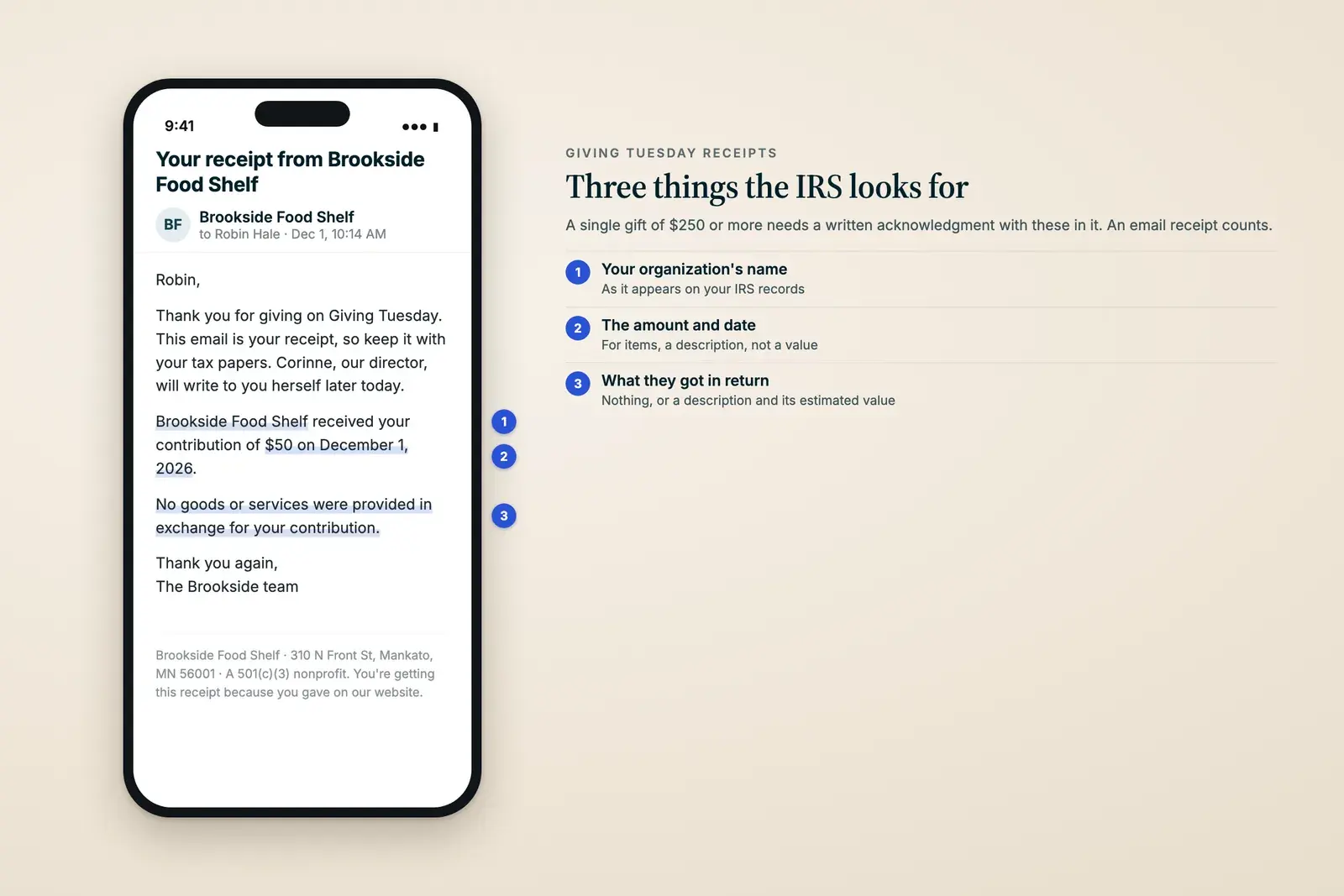
Subject: Your receipt from Brookside Food Shelf Robin, Thank you for giving on Giving Tuesday. This email is your receipt, so keep it with your tax papers. Corinne, our director, will write to you herself later today. Brookside Food Shelf received your contribution of $50 on December 1, 2026. No goods or services were provided in exchange for your contribution.
Invented. The last paragraph follows the IRS sample wording in Publication 1771. Check that your software fills in the name, amount and date.
Personal email the same day, for first-time donors
Subject: Thank you, Robin Robin, Thank you for your first gift to Brookside. Every Saturday we fill 180 grocery boxes, and the gifts that came in today keep milk and eggs in them through February. I'll write again in January to tell you exactly what today paid for. Corinne Mabry Director, Brookside Food Shelf
Invented. Send it from the director's real inbox so a reply reaches a person. The last line tells a new donor when they'll hear from you next.
Subject lines for the same-day email
Thank you, Robin Your gift is already in Saturday's grocery boxes Your $40 counted twice Your fourth Giving Tuesday with us A thank-you, with no ask in it What your December 1 gift bought
Invented. In order: everyone, first-time donors, matched gifts, returning donors, anyone, and the January update. Merge a first name into a subject line only if your form requires one.
Social post on Tuesday night
At 9:40 tonight, gift number 238 came in and pushed our Giving Tuesday past $22,000, counting Kessler Hardware's $10,000 match. That keeps the Saturday grocery boxes full through March. Thank you to everyone who gave, shared a post or talked a friend into it. Final total in the morning. #GivingTuesday
Invented. Name the sponsor only with their OK, and never name donors or amounts without each person's yes.

Board member's thank-you call and voicemail
Hi, is this Mrs. Osei? This is Paul Grady. I'm on the board at Brookside Food Shelf, and I'm calling to thank you for your gift on Tuesday. It's going into the Saturday grocery boxes, starting this week. That's the whole reason I called. Have a good evening. Voicemail: Mrs. Osei, this is Paul Grady from the board at Brookside Food Shelf. I'm calling to thank you for your gift on Tuesday. No need to call back. Have a good night.
Invented. The calls in Burk's test ran 45 seconds or less and asked for nothing, and voicemails seemed to work as well. If the donor wants to talk, let them, and write down what they say about why they gave.
January update, with no ask
Subject: What your December 1 gift bought Dear Robin, On Giving Tuesday, 260 people gave Brookside $13,400, and Kessler Hardware's match brought it to $23,400. Here's where it went: 1,000 Saturday grocery boxes in December and January A second chest freezer, so we could say yes to the turkeys from the church drive Diesel for the delivery van through March One of our Saturday regulars picks up a box for herself and her two grandsons. She asked me to tell whoever paid for the chicken that it was the best part. Thank you, Corinne
Invented. Send it between January 10 and 20, with one photo. If some of the money isn't spent yet, say what's left and what it's for.
Thank-you messages for each kind of Giving Tuesday donor
Most of these are cards, for the groups where a few sentences in pen from the right person are worth the time. Each has one detail only that sender could write, so swap in yours. The organizations are invented. Stuck on a line? The free card message helper drafts three from one fact about the donor.
First-time donor, who found you through a post
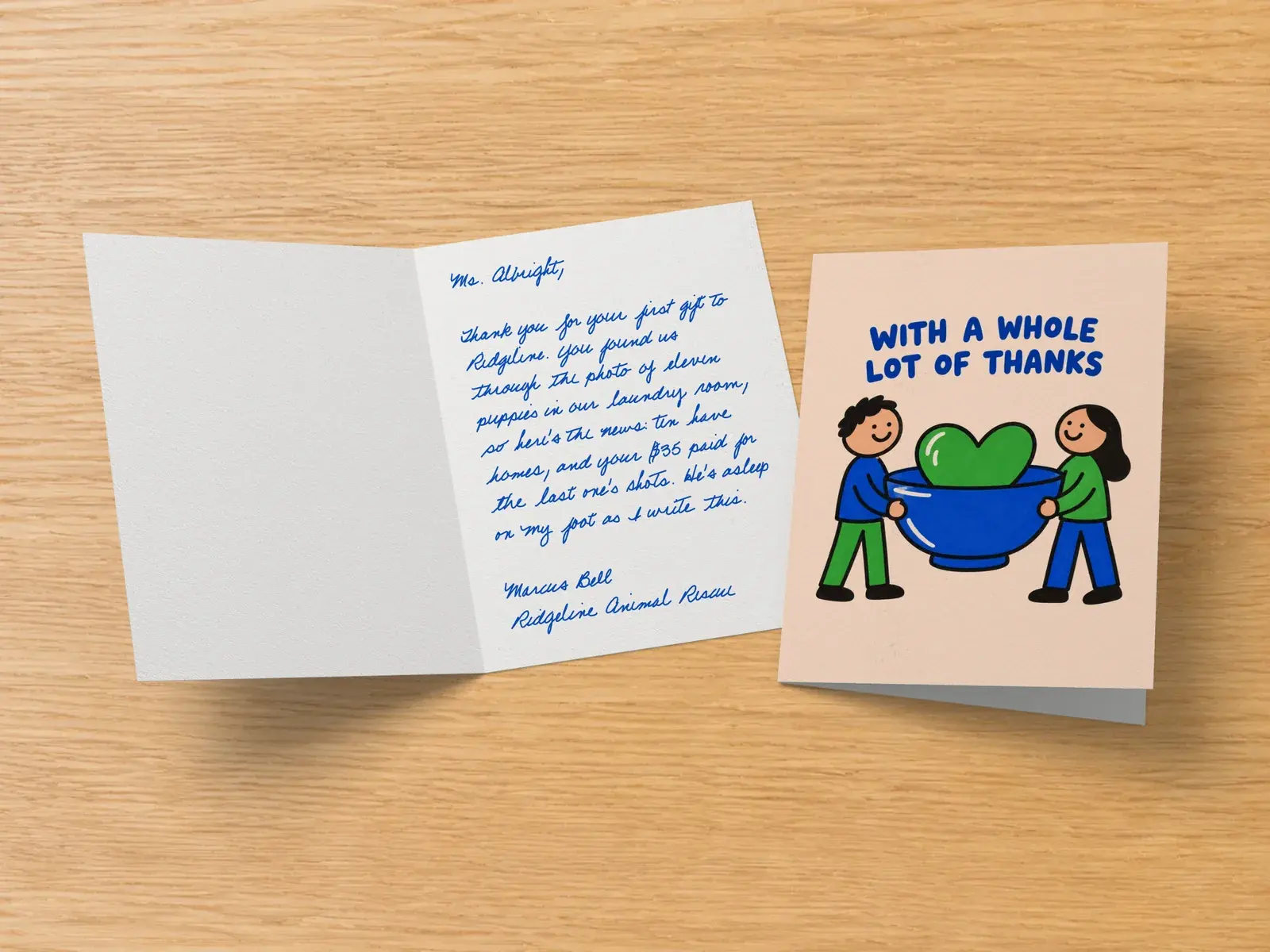
Ms. Albright, Thank you for your first gift to Ridgeline. You found us through the photo of eleven puppies in our laundry room, so here's the news: ten have homes, and your $35 paid for the last one's shots. He's asleep on my foot as I write this. Marcus Bell Ridgeline Animal Rescue
Invented. Say what brought them in. If your donation form doesn't ask "How did you hear about us?", add it this week.
Returning donor, on their fourth Giving Tuesday
Glenn, This is your fourth Giving Tuesday with us. Your first one bought the beanbags in the reading room (still there, a little flatter). This one pays a tutor for Thursday nights through May. Thank you for coming back every year. Nadia Ferris, Eastgate Reading Partners
Invented. Pull their giving history first. One line about their first gift is enough.
New monthly donor who signed up on Giving Tuesday
Anjali, You signed up for $20 a month on Tuesday. By next December that's $240, which is every glaze the Saturday clay class uses for a year, plus the repair on the kiln door that sticks. Thank you, Tomás, Third Street Art Room
Invented. Do the math for them: a year of their gift, in things.
A line for gifts that were matched
Mr. Lindgren, Your $40 came in at 11:20 on Tuesday morning, before Kessler Hardware's match ran out at 4:12, so it counted twice: $80, or four Saturday grocery boxes. Thank you for getting in early. Corinne
Invented. This goes in the same-day email. Gifts that came in after the match ran out are thanked for what they gave, with no mention of the match.
Peer-to-peer fundraiser who ran a page
Marisol, Fourteen people gave $1,260 because you asked them, and nine of them had never heard of Ridgeline before Tuesday. That's every vaccine for the next litter, with enough left for the senior dogs' joint pills. I owe you a coffee and a very muddy walk. Marcus
Invented. Call on Wednesday, then send the card. Give them their own numbers.
Someone who gave on a friend's fundraising page
Kenji, You gave to Ridgeline because Marisol asked you to. Your $25 feeds one of the dogs in her photos for a week. Thank you for saying yes to her. Marcus Bell
Invented. Name the friend. That's why they gave.
The business that put up the match
Ray, Your match ran out at 4:12 on Tuesday afternoon. By then 151 people had given $10,000, and you doubled it. Three of them told us they gave because of the sign by your register. That's 1,000 Saturday grocery boxes. I'll bring the January numbers by the store myself. Corinne
Invented. Call first and mail the card the same day. A week later, send one page: gifts matched, the total, when the match ran out and every place you thanked them by name. Ask before you use their logo.
The volunteer who ran your social posts
Jules, You wrote all nine of our Giving Tuesday posts, and the one about the empty peanut butter shelf brought in more gifts than the other eight together. The shelf is full. Thank you for giving us your whole Tuesday. Corinne
The board member who made the calls
Paul, Eight calls in two evenings. Mrs. Osei told me yours was the first call she'd ever had from a charity that didn't ask her for anything. She mentioned it twice. Thank you, Corinne
Invented. Thank the people who worked the day in the same week as the donors, and name what they did.
Small gifts are normal on Giving Tuesday: in the Blackbaud data, more than half of first-time donors gave $50 or less. The $5 donor gets the same personal email as everyone else. Skip "every gift counts, no matter how small," which tells them it was small. Say what $5 buys.
A $5 gift
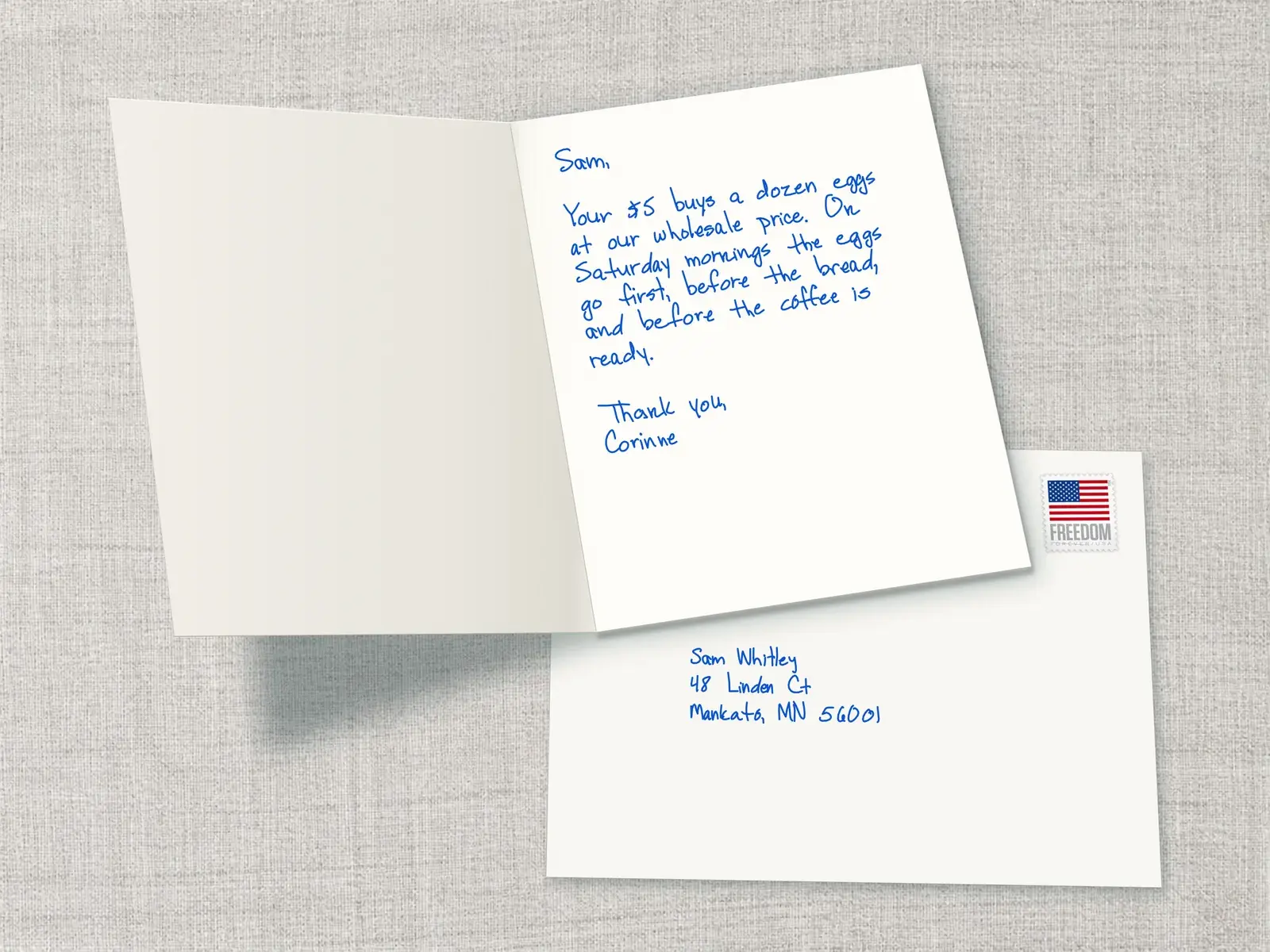
Sam, Your $5 buys a dozen eggs at our wholesale price. On Saturday mornings the eggs go first, before the bread, and before the coffee is ready. Thank you, Corinne
Above your large-gift line, the board member's call comes first and the director's card follows within the week. Mail the formal receipt separately so the card stays a thank-you.
A $5,000 gift
Dear Helen and Ward, Your $5,000 buys the clinic's second exam chair. On Wednesday nights Dr. Abara sees patients in our break room, between the microwave and the fridge. By February she'll have a real room, and I'll send you a picture of it. Thank you. Ines Calloway, Southside Free Clinic
Invented. Promise one specific follow-up, and keep it.
Donation receipts: what the IRS requires in a Giving Tuesday thank-you
Your automatic receipt email can be the donor's tax acknowledgment if it has the right wording. For any single gift of $250 or more, the donor can't take a federal deduction without one, and IRS Publication 1771 and the IRS page on written acknowledgments say it must include:
- your organization's name
- the amount of a cash gift, or a description (but not the value) of donated items
- a statement that you gave nothing in return, if that's true
- if you did give something, a description and a good-faith estimate of its value
- for a congregation that gave only intangible religious benefits, a statement saying so
Email counts, and one annual statement can cover several gifts. The donor needs it by the day they file their return, or the due date with extensions if that comes first, and charities typically send them by January 31. Separate gifts under $250 aren't added together.
Two things trip people up. If a donor pays more than $75 and gets something back, like a sweatshirt for gifts of $150, you owe them a written disclosure statement: only the amount above the item's value is deductible, with your good-faith estimate of that value. Skipping it costs $10 per contribution, up to $5,000 per fundraising event or mailing. Logo mugs and totes can fall under the token exception in Publication 1771, but its dollar limits change with inflation, so check them before you write "no goods or services."
This is also the first year your $25 donors may care about the receipt. Beginning with tax year 2026, people who don't itemize can deduct up to $1,000 in qualifying cash gifts, or $2,000 for married couples filing jointly. To deduct any cash gift, the donor needs a bank record or a written communication from you showing your name, the date and the amount. A receipt for a $10 gift is worth sending.
Receipt wording you can adapt
If you gave nothing in return: [Organization] received your contribution of $[amount] on December 1, 2026. No goods or services were provided in exchange for your contribution. If they got a thank-you gift worth more than a token: Thank you for your contribution of $150, which [organization] received on December 1, 2026. In exchange, we gave you a sweatshirt with an estimated fair market value of $35. The amount of your contribution that is deductible for federal income tax purposes is limited to $115, the amount by which your payment exceeds the sweatshirt's value. For a congregation: No goods or services were provided in exchange for your contribution other than intangible religious benefits.
Modeled on the samples in Publication 1771 and the IRS page on quid pro quo contributions.
Mistakes that undo a Giving Tuesday thank-you
- Asking for another gift. No reply envelope, no "consider making it monthly," no P.S. about year-end. If your year-end appeal mails on December 7, hold Giving Tuesday donors out until after the January update, or open their version with a thank-you for Tuesday.
- "Dear Donor" or "Dear Friend." Your form has their name. Use it, spelled and capitalized the way they'd write it.
- Waiting weeks. A thank-you that turns up in mid-December reads like an afterthought next to a receipt that arrived in two minutes. If you're late anyway, send it and say so: "This is later than I wanted."
- Thanking for the amount instead of what it does. "Thank you for your gift of $100" is a receipt. "Your $100 is five Saturday grocery boxes" is a thank-you.
- Signing it from "The Development Team." Sign as one person, with a title if the donor doesn't know them.
- Writing "no goods or services" on the receipt of someone who got a sweatshirt.
- Posting names or amounts without asking. Some people give quietly on purpose.
Frequently asked questions
How soon should you thank Giving Tuesday donors?
Send the receipt within minutes, automatically, and a personal email the same day; late-night gifts can get theirs Wednesday morning. Make board calls to your largest donors within two days, and get handwritten cards in the mail by the weekend.
Should we send a thank-you card or an email?
Both, to different people. Every donor gets the same-day email. Cards go to first-time donors, large gifts, new monthly donors, fundraisers, the match sponsor and the volunteers who ran the day. Whichever you send, the line about what the gift did matters more than the format.
Do Giving Tuesday donors need a tax receipt?
Any single gift of $250 or more needs a written acknowledgment with your organization's name, the amount and whether the donor got anything in return (IRS Publication 1771), and your automatic receipt email can be it. Receipt smaller gifts too: starting with 2026 gifts, people who don't itemize can deduct up to $1,000 in cash gifts, or $2,000 for couples filing jointly. For a grant from a donor-advised fund, the fund's sponsor has legal control of the money, so thank the person who recommended it and ask your accountant about the wording.
What should we say to a business that matched Giving Tuesday gifts?
Call the next day with the numbers: how many gifts were matched, when the match ran out and what the doubled money will buy. Mail a handwritten card the same day and a one-page report the following week. The business's own check is a gift too, so send it the same written acknowledgment as any gift of $250 or more.
Can we ask for a monthly gift in the thank-you?
Not in the thank-you. Donors in Burk's research said they wanted thanks and results before the next request. Send the January update first, then make the monthly ask in a separate message.
Is it too late to thank Giving Tuesday donors in January?
No. Say it's late in a few words and include what the gift did, since by January you know. Keep the receipts on time, though: charities typically send acknowledgments by January 31.
Reviewed .