
Most first-time donors don't give to the same charity again the next year, so the first thank-you letter carries more weight than it looks. The usual one doesn't help: "Dear Friend, thank you for your generous support," signed by a team. Add their name, the amount, what the money will do and a real signature, and the same letter belongs to one person.
This guide is for development directors, pastors, school staff and board members handed a stack of cards in December. The examples are invented; the IRS rules and research are real, with sources.
What to put in a donor thank-you letter
Every thank-you letter to donors here follows the same order. The slow part is learning what the gift will pay for, so ask your program staff for this month's real costs before December.
Write it in this order
The donor's name
Spelled the way they sign it: "Dear Mr. Lindqvist" or "Dear Sam and Rita." "Dear Friend" says nobody looked.
The gift, exactly
The amount, the date and the fund they chose. "Your gift of $75 on November 3" is a fact. "Your generous donation" could be anyone's.
What it will do
One sentence with a real cost: 15 grocery boxes, two weeks of dog food. For an unrestricted gift, name what that money covers this month, like the heating bill.
A person's signature
The executive director, pastor or head of school, or whoever knows the donor, with a title. Never "The Development Team."
The receipt, if it's needed
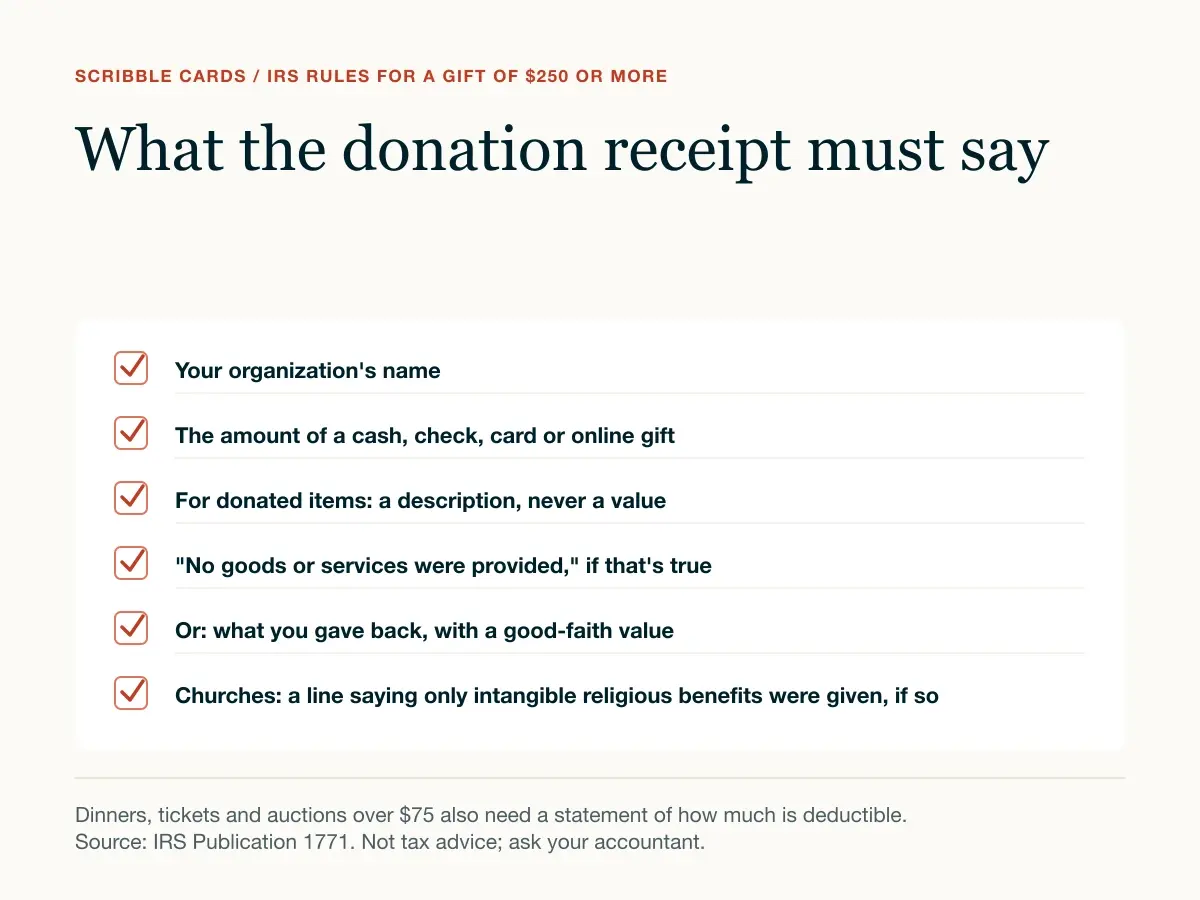
For a single gift of $250 or more, the IRS wording goes at the bottom.
Leave out the ask: no reply envelope, no "please consider a monthly gift," no P.S. about the match. A thank-you with a request in it reads like the next appeal.
A first-gift letter, printed and signed
Dear Mr. Lindqvist, Thank you for your gift of $75, which reached us on November 3. It's your first gift to Alder Street Food Pantry, and it came the week our Saturday line passed 200 families for the first time. Milk, eggs and peanut butter run out first every week. Your $75 buys all three for 15 family boxes. With thanks, Paulette Ibarra Executive Director Alder Street Food Pantry received your contribution of $75 on November 3, 2026. No goods or services were provided in exchange for your contribution.
Invented. The last paragraph follows the IRS's sample wording. A $75 gift doesn't legally need it, but it gives the donor a dated record.
Thank-you notes for first-time and monthly donors
First-time donors are the ones you're most likely to lose. In the Fundraising Effectiveness Project's report on 2024, 19.4 percent of donors who were new in 2023 gave again in 2024. For repeat donors it was 69.2 percent, and repeat donors gave 60 percent of the money raised. [6]
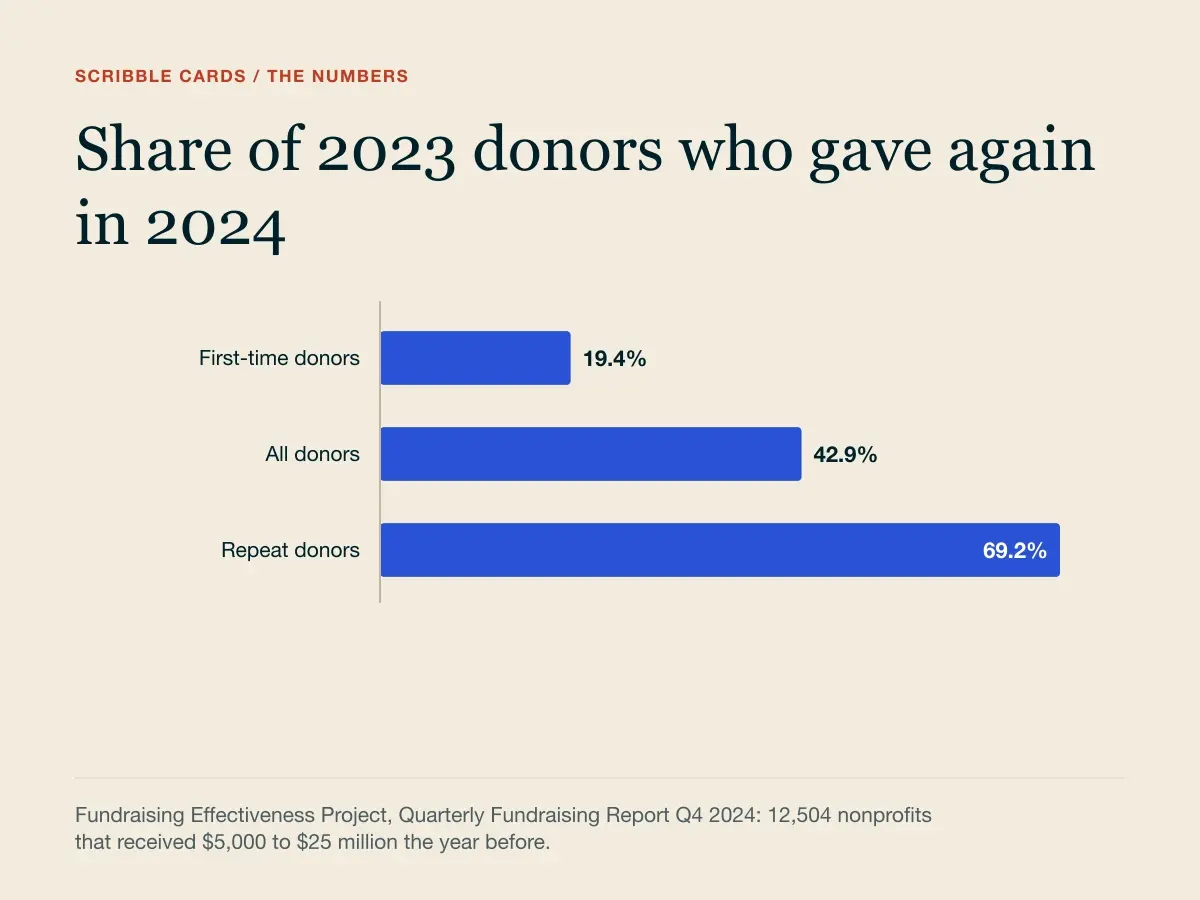
The project's report on 2025, released in April 2026, found new donor retention essentially flat. [7]
So first gifts get the most care: the letter within two days and, if someone can say something specific, a handwritten note within a week. Mention what brought the donor in.
A first-gift note from the person who saw it come in
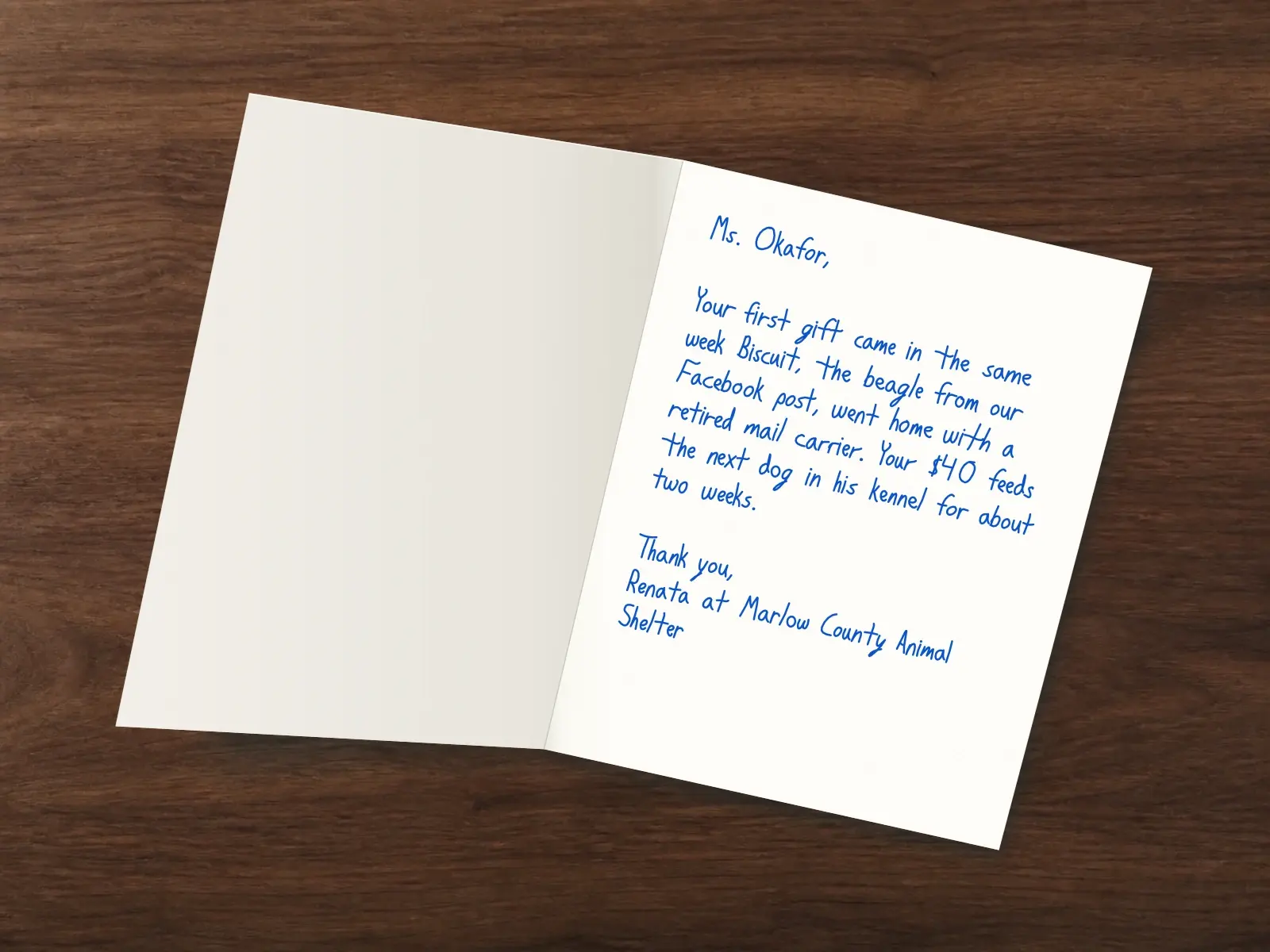
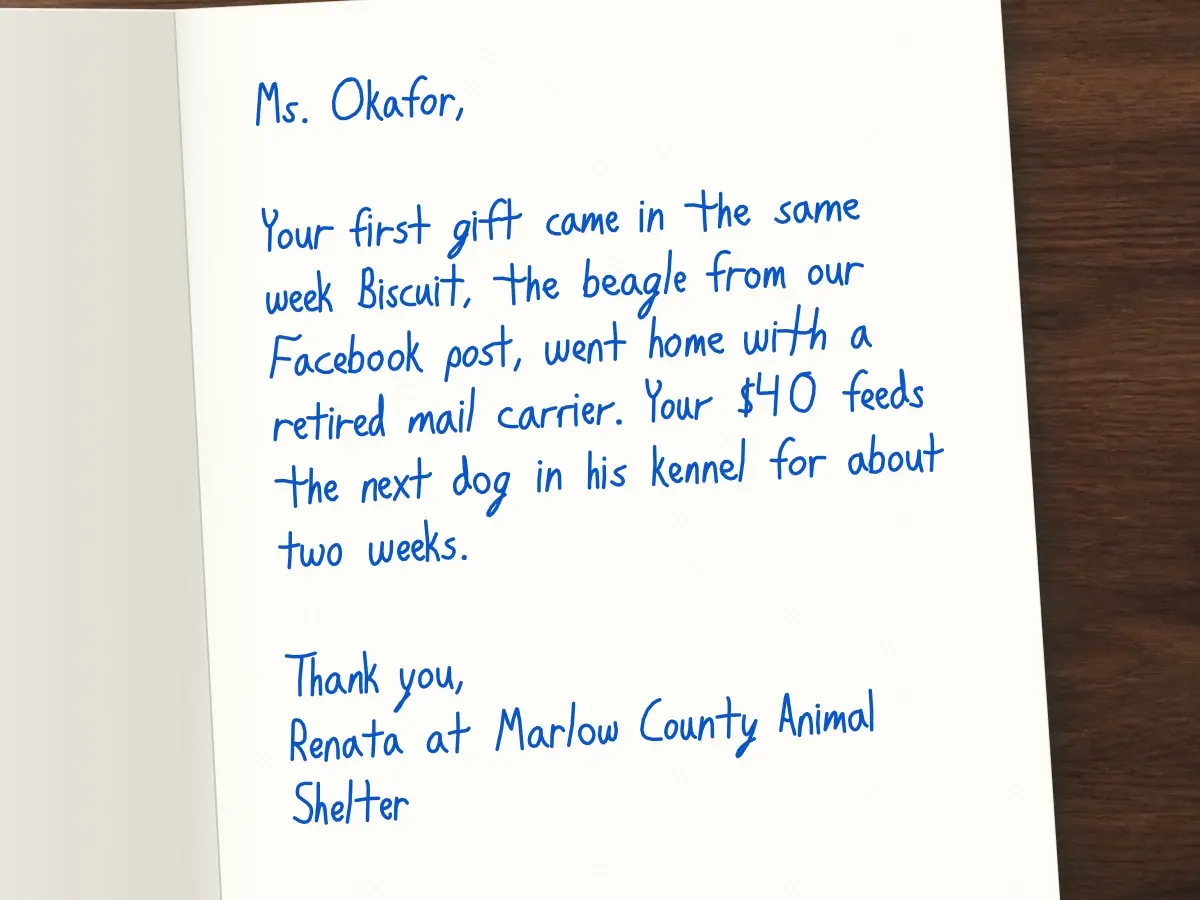
Ms. Okafor, Your first gift came in the same week Biscuit, the beagle from our Facebook post, went home with a retired mail carrier. Your $40 feeds the next dog in his kennel for about two weeks. Thank you, Renata at Marlow County Animal Shelter
Invented. She gave after a post about Biscuit, so the note starts there.
Monthly donors don't need a letter every month: an email receipt each time, a card at one year and a January statement listing every gift. The IRS lets one annual summary cover several gifts of $250 or more. They're your steadiest donors, too. Of people who gave seven or more times in 2023, 86.8 percent gave again in 2024. [1][6]
A card at the one-year mark
Arlo, A year ago you signed up for $15 a month. That's $180 so far, and because it arrives every month, we could promise the tutors at Kellogg Elementary books for the whole school year. Thank you for making next year easier to plan. Nkechi, North Branch Literacy Project
Invented. Count the months and the dollars.
Major gifts, year-end gifts and Giving Tuesday
Set your own major-gift line, say $1,000 for a small charity. Above it, the director or board chair calls within two days to thank the donor and ask how they like to hear about the work. Mail the receipt separately so the letter stays a thank-you.
A major-gift letter from the executive director
Dear Howard and Inez, Your gift of $10,000 puts our dental van on the road four days a week starting in March, up from two. Dr. Amari has already booked the two new days at Fulton and Garfield elementary schools. I'll send you photos from the first Wednesday. Thank you. Marguerite Lund Executive Director, Cedar Valley Free Clinic
Invented. It says what changes and when.
Giving Tuesday 2026 is December 1, and donors in the US gave an estimated $4.0 billion on the 2025 one. When gifts pile up, on Giving Tuesday or in the last week of December, write one template per group, keep every line true for everyone in it, and still send within two days. [8][9]
A Giving Tuesday template for the whole list
{{first_name}}, On Giving Tuesday, 212 people gave the pantry $18,400 in one day, and you were one of them. That buys the milk and eggs for every Saturday box through March. Thank you, Paulette
Invented. Update the totals before you send.
Year-end checks keep arriving in January. A check mailed to a charity counts as delivered on the date it was mailed, so keep the December-postmarked envelopes and ask your accountant how to date those receipts. [4]
In-kind gifts, memorial gifts and tribute gifts
For donated goods, describe what came in and leave off the dollar value, as the IRS asks. The donor and their tax preparer work out what it's worth. [1]
An in-kind letter with the receipt line
Dear Ms. Novak, Thank you for the 14 winter coats and the box of children's mittens you brought in on November 12. Six coats went home with families that same afternoon. The small sizes went first; they always do. Paulette Ibarra, Alder Street Food Pantry Alder Street Food Pantry received 14 winter coats and a box of children's mittens on November 12, 2026. No goods or services were provided in exchange for this contribution.
Invented. Count the items and describe them plainly.
Memorial and tribute gifts need two notes. The donor gets the thank-you and the receipt. The family, or the person honored, gets a note that says who gave and never how much. Ask on the gift form whether you may share the donor's name.
The note to the family after a memorial gift
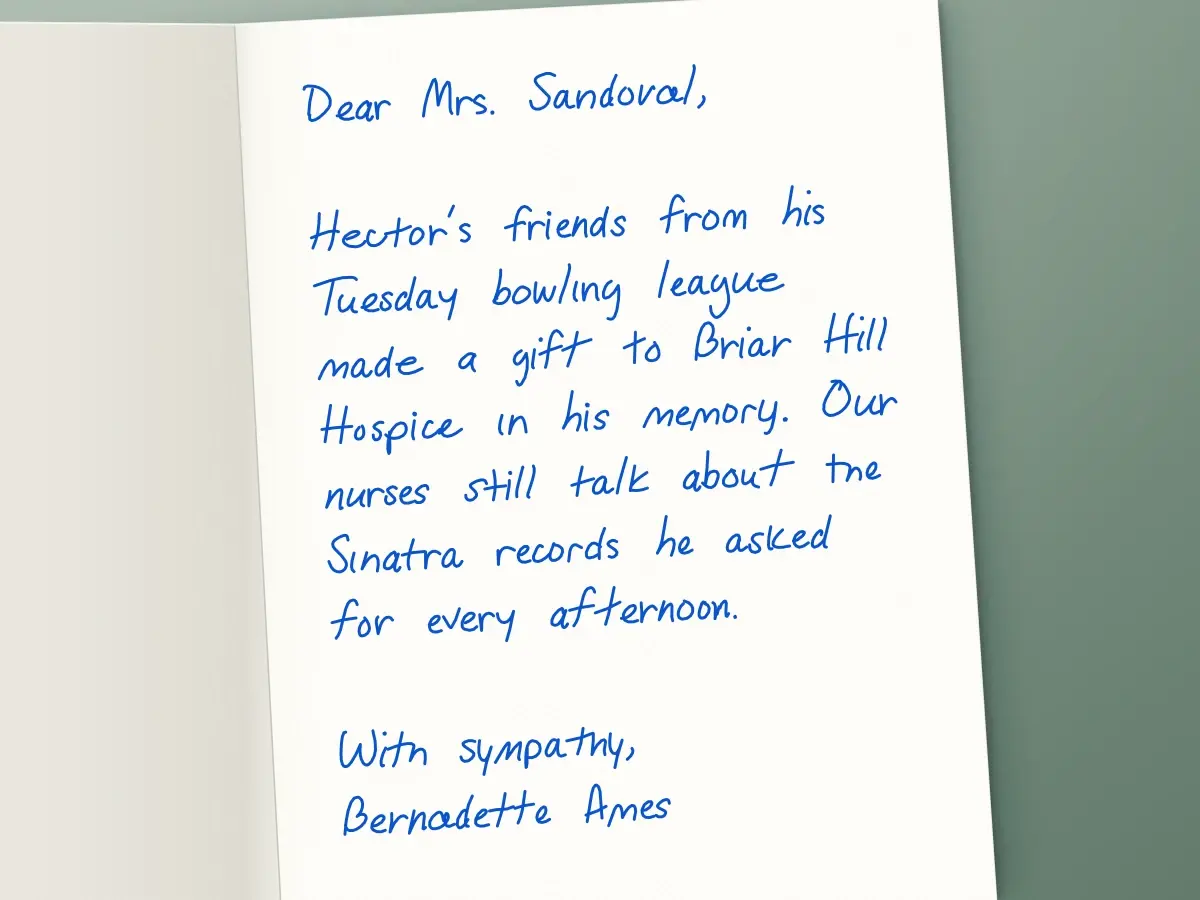
Dear Mrs. Sandoval, Hector's friends from his Tuesday bowling league made a gift to Briar Hill Hospice in his memory. Our nurses still talk about the Sinatra records he asked for every afternoon. With sympathy, Bernadette Ames
Invented. It names Hector and who gave, adds one memory and leaves out the amount.
Lapsed donors who come back, and volunteers who give
When someone gives again after years away, show you noticed without making the gap the subject. Skip "We've missed you" and say what has changed since.
To a donor back after four years
Mr. Osei, It's good to see your name again. Your last gift came in 2022, when we still met in a church basement. This one helps heat our own building through its first winter. Thank you, Lorna Kimura, Northside Youth Center
Invented. One line notices, one line says what's new.
A volunteer who also writes a check shouldn't get the form letter. The person who works with them every week should sign a note that mentions both.
To a volunteer who also gave
Yolanda, You already give us every Thursday morning at the front desk, so your check stopped me for a minute. It will pay to print the Spanish intake forms you've been asking about since June. Thank you, twice, Anders
Invented. Ask the volunteer coordinator for the one detail.
What a donation receipt must say
For any single gift of $250 or more, the donor needs your written acknowledgment to claim a federal tax deduction, and needs it by the time they file or by the filing deadline, whichever comes first. Getting it is legally the donor's job, and the IRS doesn't penalize a charity that skips it. The donor just can't deduct the gift. [1][2]
- It doesn't need the donor's Social Security number, and your EIN isn't on the IRS list (adding it does no harm).
- Email counts; so do postcards and printed forms.
- One annual statement can cover several gifts of $250 or more.
- Separate gifts under $250, like weekly church offerings, aren't added together for this rule.
- The IRS notes that charities typically send acknowledgments by January 31.
Sources [1]
Receipt wording you can adapt
A cash, check, card or online gift: Alder Street Food Pantry received your contribution of $300 on December 12, 2026. No goods or services were provided in exchange for your contribution. A church: No goods or services were provided in exchange for these contributions other than intangible religious benefits. A dinner ticket: Thank you for your payment of $150 for the Spring Supper on April 18. The dinner's estimated fair market value is $45, so the amount of your payment that may be deductible for federal income tax purposes is limited to $105.
Modeled on the samples in IRS Publication 1771. This is a guide to writing letters, not tax advice; have your accountant or auditor approve your final wording.
Dinners, golf outings, tickets and auctions have a second rule. When a donor pays more than $75 and gets something back, give them a written statement that the deductible amount is limited, with a good-faith estimate of what they received. Don't bury it in small print; the IRS says that might not count. The penalty is $10 per contribution, up to $5,000 per event or mailing. [3][1]
- A mug or tote with your logo may count as having insubstantial value under IRS limits that change every year. Check the current figures before you write "no goods or services."
- A donor-advised fund grant comes from the fund's sponsor, which has legal control of the money. Thank the person who recommended it, and ask your accountant what tax wording, if any, belongs in their letter.
- Cars, boats and planes worth more than $500 follow separate IRS rules.
How fast to send it, and who should sign
Aim for two business days on the letter. An automatic email receipt for online gifts buys you that time; if email is all you have, the thank-you is an email with the same parts. In the last week of December, keep receipts on the two-day rule and let the handwritten notes run into early January.
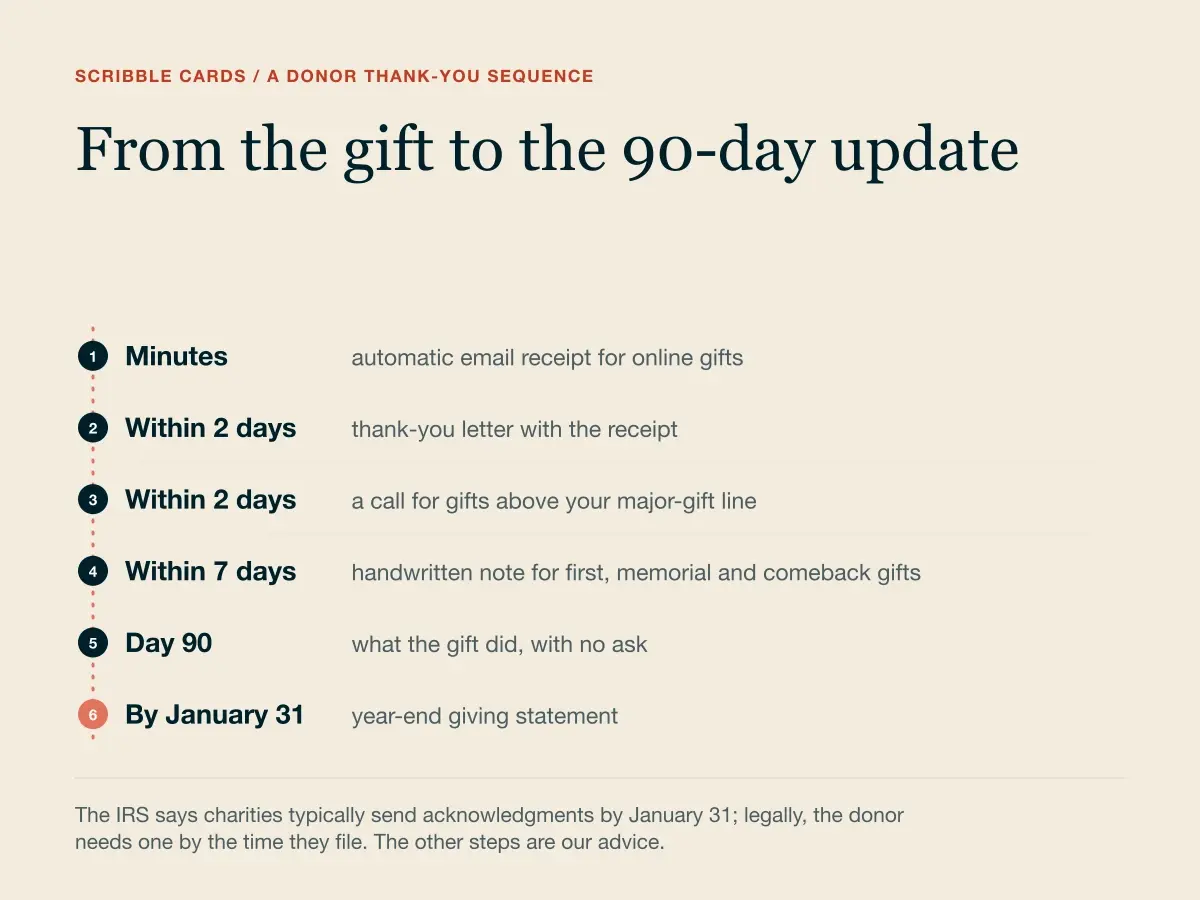
The 90-day update is the piece of donor appreciation most easily skipped: three sentences and a photo about what the gift did, with no ask. It shows the donor the letter's promise came true.
Scroll the table horizontally if needed.
| Gift | Who signs |
|---|---|
| Most gifts | The executive director, pastor or head of school |
| First gifts | The director on the letter; whoever knows the donor on the note |
| Major gifts | The director, after a call from the director or board chair |
| Memorial and tribute gifts | The director to the donor; someone who knew the person to the family |
| Monthly donors at one year | Whoever runs the program the money pays for |
| Volunteers who give | The staff member they work with |
Board members are good at notes to people they already know. Give each one five names, one fact per donor and a stack of stamped cards, and ask for them back by Friday.
When a handwritten note beats a printed letter
In the largest test of thank-you calls, about 500,000 new donors to 67 public television stations and a national nonprofit were randomly assigned a call or none. Fundraising professionals predicted an 80 percent jump in retention. The calls made no measurable difference. [10][11]
In a 2025 study, a German opera house mailed 1,132 past donors an appeal with a thank-you postcard, handwritten for half of them. Of the handwritten group, 19.3 percent gave; of the printed group, 18.7 percent, a difference too small to count. Both cards said the same generic thing and asked them to keep giving, and the researchers think the handwritten one still read as coming from an institution. [12]
So don't handwrite 2,000 notes expecting renewals to jump. Handwrite where a printed letter would feel wrong, and make the note sound like the signer, with a detail only they would know. We found no experiment testing that kind of note against a form letter, so call it judgment.
- Handwrite: first gifts someone can speak to, major gifts, the family's note after a memorial or tribute gift, comeback donors and volunteers who give.
- Print: routine gifts, monthly receipts, event tickets and year-end statements.
If December's handwritten list runs to 150 names, Scribble Cards can write the cards from your spreadsheet in real pen, address each envelope in pen and mail it with a real stamp. A column with one sentence per donor, used as a merge field, keeps every card specific. Cards are written within 1 to 2 business days, USPS usually takes 2 to 5 more, and it's US addresses only.
A thank-you plan for Giving Tuesday and year-end
Do the first four steps before Giving Tuesday on December 1.
Before and after the December rush
Write one template per group
First-time, monthly, major, memorial, Giving Tuesday and year-end. Have your accountant approve the receipt wording once.
Clean the mailing list
Merge duplicates and remove anyone who has died or asked not to be mailed.
Decide who signs and who calls
Set the major-gift line and give each board member five names.
Stock cards and stamps
Enough for every first, major, memorial and comeback gift you expect.
December 26 to 31
Send receipts every day.
By January 31
One annual statement per donor.
March
The 90-day update on December's gifts.
Frequently asked questions
How soon should you send a donor thank-you letter?
Within two business days, with an automatic email receipt right away for online gifts. Major gifts get a call within two days, and handwritten notes can follow within a week. If you're late, send it anyway and say so in a few words.
What should a thank-you letter for a donation include?
The donor's name, the amount and date, one sentence about what the gift will do, and a real signature. A single gift of $250 or more also needs your organization's name, the amount or a description of donated items, and whether you gave anything in return. [1]
Can a thank-you letter double as the donation receipt?
Yes. The IRS has no required form: a letter, postcard, email or printed form counts if it has the required information. Put the receipt paragraph at the bottom, except for major and memorial gifts, where a separate receipt keeps the letter personal. [1]
Do donations under $250 need a receipt?
The formal acknowledgment rule starts at $250. But to deduct any cash gift, the donor needs a bank record or a written receipt showing your name, the date and the amount, so receipting every gift is the simplest policy. [1]
What's a short way to say thank you for a donation?
Use their name and one specific thing: "Thank you, Ana. Your $50 is in Saturday's grocery order." Or: "Your gift came in at 11:52 p.m. on December 31. Thank you for cutting it close." Skip lines any charity could send, like "Your support makes a difference."
Sources and methodology
Reviewed .
- Publication 1771, Charitable Contributions: Substantiation and Disclosure Requirements
Internal Revenue Service · Accessed
Revision November 2023. Pages 1 to 7: the written acknowledgment for single contributions of $250 or more and what it must contain, timing, electronic and annual acknowledgments, the token exception (2023 dollar amounts, adjusted for inflation), intangible religious benefits, and the quid pro quo disclosure for payments over $75, including the $10 and $5,000 penalty.
- Charitable contributions: Written acknowledgments
Internal Revenue Service · Accessed
Page last reviewed or updated June 28, 2026.
- Charitable contributions: Quid pro quo contributions
Internal Revenue Service · Accessed
Page last reviewed or updated June 28, 2026. Disclosure required when a payment of more than $75 is partly a contribution and partly for goods or services.
- Publication 526 (2025), Charitable Contributions
Internal Revenue Service · Accessed
When To Deduct, Checks: a check you mail to a charity is considered delivered on the date you mail it.
- Donor-advised funds
Internal Revenue Service · Accessed
Page last updated October 9, 2026. Once the donor makes the contribution, the sponsoring organization has legal control over it.
- Quarterly Fundraising Report, Q4 2024 (January 1 to December 31, 2024)
Fundraising Effectiveness Project, hosted by the Association of Fundraising Professionals · Accessed
Panel of 12,504 organizations, 6.7 million donors and $10.5 billion in 2024, limited to organizations with at least three years of data and $5,000 to $25 million received in the prior year. Retention is the share of last year's donors who gave again this year. 2024: overall 42.9%, new donors 19.4%, repeat donors 69.2%, donors with seven or more gifts 86.8%. Repeat-retained donors gave 60% of dollars.
- Fundraising Effectiveness Project Reports Strongest Revenue Growth in Five Years, Even as Fewer Donors Give
Fundraising Effectiveness Project, via PR.com · Published · Accessed
Release for the Q4 2025 report: overall retention edged up from 43.1% to 43.3%, and new donor retention remained essentially flat.
- GivingTuesday
GivingTuesday · Accessed
Site navigation: GivingTuesday, Dec 1, 2026.
- Generosity Sweeps the Globe: Participation and Donations Rise on Another Record-Breaking GivingTuesday
GivingTuesday · Published · Accessed
GivingTuesday Data Commons estimate: $4.0 billion donated in the US on GivingTuesday 2025, up 13% from 2024, with 19.1 million people making financial contributions.
- Do Thank-You Calls Increase Charitable Giving? Expert Forecasts and Field Experimental Evidence
American Economic Journal: Applied Economics, abstract via IDEAS/RePEc · Published · Accessed
Anya Samek and Chuck Longfield, volume 15, issue 2, pages 103 to 124, DOI 10.1257/app.20210068. About 500,000 new donors randomized to a thank-you call or none. Fundraising professionals predicted an 80% increase in retention; the authors found a precisely estimated null effect.
- Do Thank-You Calls Increase Charitable Giving? Expert Forecasts and Field Experimental Evidence (AEARCTR-0008263)
AEA RCT Registry · Accessed
Partners were 67 US public television stations and one national nonprofit. Calls thanked new donors after a first gift, explained its impact and did not ask for another gift.
- Gratitude in fundraising: do 'thank you in advance' and handwritten thank you notes impact fundraising success?
Experimental Economics (Cambridge University Press), open-access PDF · Accessed
Maja Adena, Steffen Huck and Levent Neyse, Experimental Economics 28(4), pages 900 to 909 (2025), DOI 10.1017/eec.2025.10033. Study 2: 1,132 past donors of a German opera house received an appeal plus a handwritten or printed thank-you postcard asking for continued support; 19.3% and 18.7% gave, not a significant difference.