
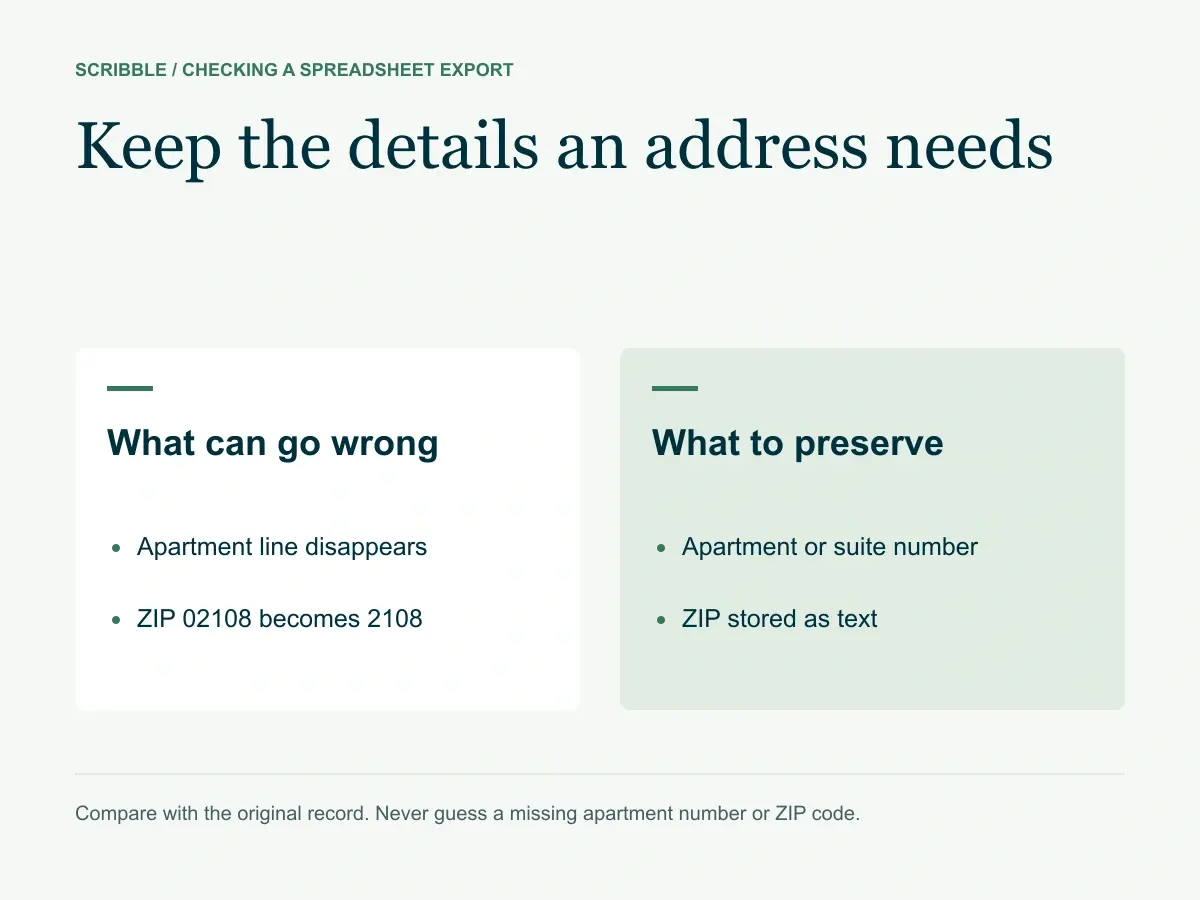
The mailing list looks cleaner after an export: consistent columns, tidy street names, no empty second address line. Unfortunately, that second line contained the suite numbers.
Address cleanup is about keeping useful information in the right place. A spreadsheet that looks uniform can still produce bad envelopes. Check what survives the entire trip from the original contact record to the printed address.
Make a copy before changing anything
Keep the original fields and a stable contact reference. Work on a copy so you can compare a proposed correction with what the customer actually provided. If a street number changes unexpectedly, you should be able to find out why.
Use consistent fields for the name, street, secondary unit, city, state, and ZIP. Avoid broad find-and-replace rules across the entire sheet. An abbreviation that helps a street line may damage a person’s name or company name.
USPS Publication 28 describes postal address formats. Use the relevant rule for the kind of address you have; don’t force unfamiliar addresses into a pattern by guessing. [1]
Keep the apartment or suite
An optional address line is optional only for addresses that don’t need it. Keep Apartment 7B or Suite 410 when it is part of the address. USPS recognizes designators such as APT and STE and gives placement rules for secondary units. [2]
Scroll the table horizontally if needed.
| Original detail | What to do |
|---|---|
| Apartment 7B | Keep the unit; use APT where the output calls for that abbreviation |
| Suite 410 | Keep STE 410 through the export and preview |
| # 12, type unclear | Preserve the detail and clarify it; don’t invent a unit type |
| Street and suite in one field | Check both are present after splitting the fields |
If the destination software allows only certain line lengths, shorten or rearrange using its supported format. Don’t silently cut off the end. Preview the full envelope; that is where a lost unit number becomes visible.
Treat ZIP codes as text
A ZIP code is an identifier, not a quantity. Import that column as text before a spreadsheet converts it to a number. Otherwise a value beginning with zero can lose a character.
If the original value was 01234 and the sheet now says 1234, formatting the cell to display five digits only hides the problem. Check the original source before claiming the value has been repaired. This is a fictional example of a leading zero, not a verified mailing address.
Keep ZIP+4 formatting consistent with the receiving system. Don’t guess the final four digits from a neighboring row. Likewise, don’t uppercase the customer’s message greeting simply because you standardized the postal address.
Separate a formatting fix from a missing fact
Changing a known state name to its two-letter code is a formatting decision. Adding a missing apartment number is a factual decision that needs a source. Keep uncertain rows aside while you ask for the missing information.
For example, if eight records in a 150-person list have unresolved address questions, send the 142 you can properly prepare and work on the remaining eight. Making every row pass an upload check is not the same as making every address usable.
Scribble requires the recipient name, street, city, state, and ZIP, and checks their format. It does not provide CASS-certified deliverability verification. [3]
Inspect a small sample before the full import
Include a leading-zero ZIP, a suite number, a long name, and a deliberately incomplete address in your test file. Confirm that correct fields survive and that the incomplete row is caught. Use fictional data for that test.
Then check the real mailing’s record count and several rendered envelopes. When a correction is confirmed, apply it to the original contact system too. Otherwise the next export will bring the same error back.
Frequently asked questions
Does standardization prove an address is deliverable?
No. It organizes known address components. Matching against a postal reference and confirming the intended recipient are separate checks.
Can I leave address line 2 out of my export?
Only if none of the selected addresses needs the information. Apartment and suite details must survive somewhere in the final address. [2]
What is the best way to handle ZIP codes in a spreadsheet?
Import and store them as text, then compare the values with the original file. Check the format your mailing system accepts.
Sources and methodology
Reviewed .
- Publication 28: Postal Addressing Standards
USPS · Accessed
- Publication 28 section 213: Secondary Address Unit Designators
USPS · Accessed
- Scribble address requirements and validation limits
Scribble · Accessed