

The first thing a customer reads in your box is whatever sits on top of the tissue paper. It's tempting to spend that spot on a 10%-off card and a request for five stars. The coupon belongs on its own card further down. The request for five stars can cost an Amazon seller their account.
Below: the inserts that earn their place, what goes in each kind of order, what Amazon, Etsy and the FTC let a review card say, and what it all costs. There are notes to copy and a kit to download. I started and ran two direct-to-consumer brands before Scribble Cards (Herbivore Industries, then Van Woof), so the opinions here are a seller's. The shops and names in the examples are made up. The rules and prices are real and linked to their sources.
Package insert ideas worth paying for
Give every insert one job you can name. A card without a job gets thrown out with the packing paper, and it can take the thank-you note with it. These six earn their place.
Scroll the table horizontally if needed.
| Insert | Its job | Best for | Skip it when |
|---|---|---|---|
| Thank-you note | Shows a person packed the order | Every order. Add a handwritten line to first orders. | Never. Keep it to two or three sentences. |
| How to use or care for it | Answers the first question before it turns into an email, a bad review or a return | Skincare, cast iron, leather, plants, anything that needs setting up | The product explains itself |
| Returns or exchange card | Makes a return one step instead of a hunt through your website | Clothing, shoes, anything sized, and every gift | People rarely send it back, and your packing slip already says how |
| A dated reason to order again | Gives them a date to act on: when it'll run out, a restock, a holiday order-by date | Coffee, candles, pet food, skincare, and anything shipped before a holiday | It's a gift, because the person opening it didn't buy it |
| Referral card | Gives a happy customer something to hand a friend | Repeat customers and big orders from your own store | First orders and Amazon orders |
| Sample | Introduces the thing they're most likely to buy next | The conditioner in a shampoo order, a second roast in a coffee order | It's just whatever you have too much of |
And what to leave out:
- Anything past three or four pieces of paper. Every extra one makes the others easier to skip.
- Prices and the invoice, in any order that's a gift.
- A coupon or a pitch inside the thank-you note. Put the offer on its own card, so the thanks still reads as thanks.
- Review cards that ask for five stars, offer anything for a review, or tell unhappy customers to email you first. The rules are further down.
- On Amazon orders, your email address, phone number, website and QR codes. More on that below.
- Business cards, unless your customer has some reason to call you.
What to put in a package for customers, by order type
Who's opening the box decides what goes in it. A first-time customer wants to know you're a real shop. A regular wants to know you noticed. Someone opening a gift shouldn't find out what it cost, and someone whose order came late wants to hear about it from you before they have to ask.
Scroll the table horizontally if needed.
| Order | Put in | Leave out |
|---|---|---|
| First order | A thank-you card with one handwritten line, the how-to or care card, returns information | Referral cards and review requests, because they haven't used it yet |
| Repeat customer | A note that shows you noticed, when it's likely to run out, a referral card | The welcome brochure they already have |
| Gift | The buyer's message, a gift receipt with no prices, the care card, how to exchange | The invoice, anything with a price on it, review requests |
| Late or damaged | A short apology: what happened, what you did about it, and that there's nothing they need to do | A review card, and a discount code in place of a fix |
| Big order | A packing list by item, a note signed by the owner, a direct contact for reorders (not on Amazon) | A pile of single-order inserts in every box |
First orders get the handwritten line. You don't have to write the whole card: print it, leave a blank line, and write their first name and one sentence about what they bought. Hold the referral card and the review request. Nobody refers a friend to something they haven't opened yet.
For repeat customers, count. "Third order" in your handwriting tells a regular you noticed. A second or third order is also the best sign they'd recommend you, so that's the box for the referral card. If what you sell runs out (coffee, candles, skincare, pet food), add the date it probably will.
Gift orders are the easiest to get wrong in December. Copy the buyer's message onto a card by hand, word for word. On Etsy, a buyer can mark an order as a gift at checkout, and the packing slip then leaves out what they paid. If a buyer tells you some other way that it's a gift, you can mark the order as a gift yourself. Etsy's gift slip also has a QR code to your shop and room for a coupon code, so the recipient can find you again. A review card doesn't belong in a gift: the person opening it didn't buy anything.
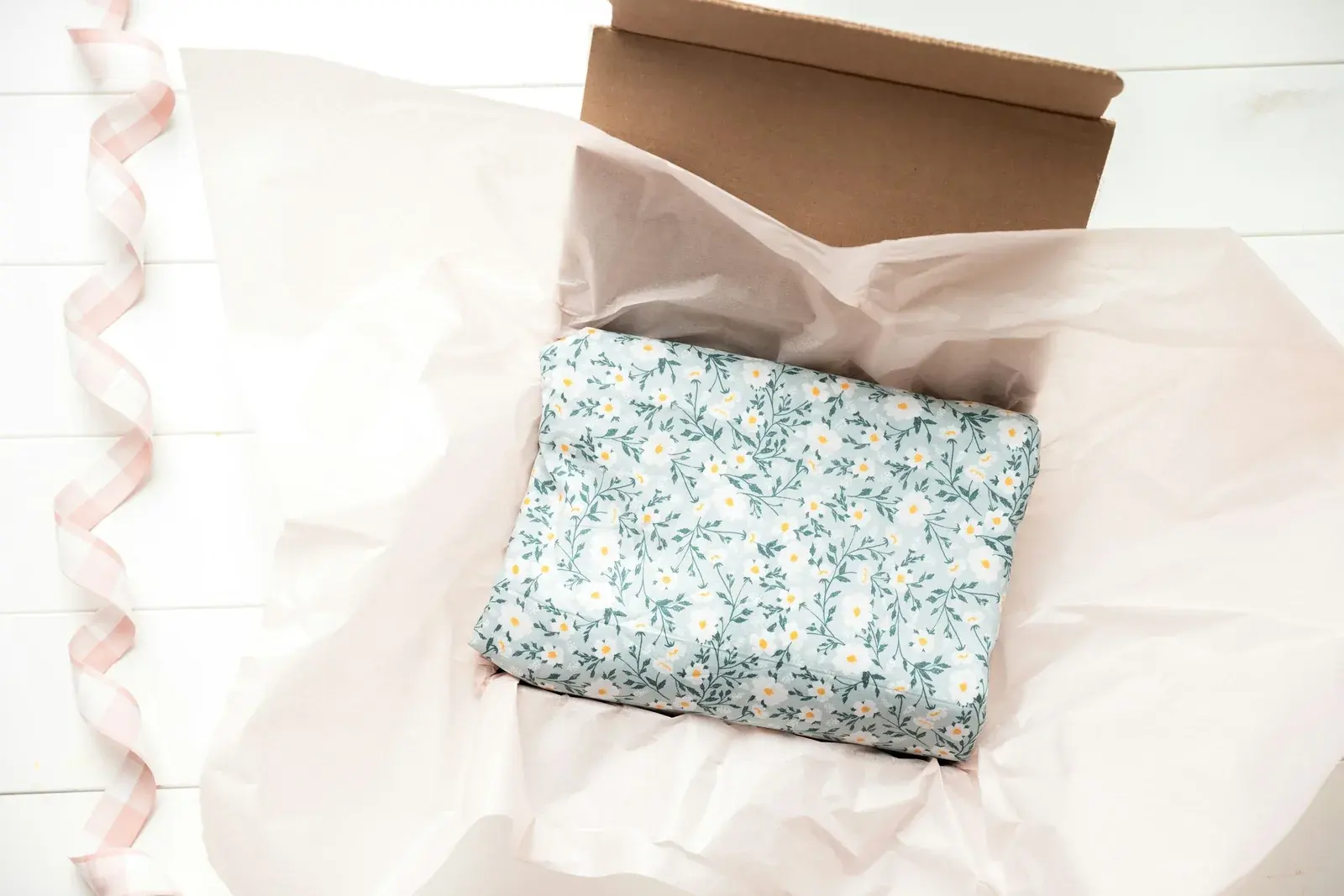
If you know an order is late when you ship it, the apology goes in that box. If it arrived broken, the apology goes in the replacement. Either way, do the refund or replacement through the platform you sold on, then say in the note that it's done.
Big orders, like 40 jars of honey for a company's clients, are often unpacked by someone who didn't place them, so the packing list matters as much as the note. On Amazon orders, point them to Amazon's messaging for reorders instead of giving a number.
Thank you for your order cards: notes to copy
Every note below has one detail that couldn't be on anyone else's card. Swap in yours. Two or three sentences is plenty, and the last line should be the best one. For more wording, there are 58 thank you for your order messages sorted by kind of order, custom work included.
Template: a printed card with one handwritten line (first orders)
Thank you for your first order from [shop]. [One true line about how you make or pack things.] [First name], [one sentence about what they ordered]. [Your first name]
Print the first paragraph on every card. Write the rest by hand, in pen.
Filled in: a candle shop
Thank you for your first order from Hollow Pine. Every candle is poured in our garage in Asheville, 24 at a time. Anna, the cedar one is my favorite too. Burn it for two hours the first time, so the wax melts all the way to the edge. Mae
The care tip is the detail. It also heads off a tunneled candle, and the email that comes with one.
A printed card for your busiest weeks
Packed by ______ on ______. Every Hollow Pine candle is poured in Asheville, 24 at a time. Thank you for ordering one. If anything arrived cracked, email [your address] and a new one goes out the next day.
For December weeks when a full line on every card isn't realistic. Initials and a date in pen still show a person packed it. On Amazon, change the last line to "message us from your Amazon order."
Repeat customer (a tea shop)
Odile, Third order, and the first time you've strayed from the Assam. The smoky one wants water just off the boil and three minutes, no longer. Thank you for coming back, Tomás
Look at their order history before you write. The order count is the easiest detail you'll find.
Gift order: a card for the person opening it
For Sabine, from Mireille "Happy 30th. Hang it where I can see it on our calls." If the frame doesn't suit your wall, the gift receipt in this box is all you need to swap it. Mireille won't hear about it from us. Leo at Northlight Prints
Copy the buyer's message word for word. The last line answers the question most recipients have and few ask.
Late order: an apology in the box
Ms. Castell, Your quilt was due on the 4th and left here on the 9th. Our fabric came in short, and I should have emailed you the day I knew. I've refunded your shipping, and there's nothing you need to do. I'm sorry, Joelle
For a damaged order, put the note in the replacement and change the middle: what broke, and how you packed the new one.
Big order: a note for whoever unpacks it
Kim, Forty jars of wildflower honey, packed ten to a box. The packing list is taped inside the lid of box one, so you can check them off before they go out to your clients. If a jar arrived cracked, text a photo to [your number] and a new one ships that day. Hollis
A dated reason to order again (printed, dates filled in)
Roasted November 30. Best within four weeks. Order your next bag by Monday, December 14, and it'll reach you before this one runs out. That's also our last day for Christmas gifts in the lower 48.
Write or stamp the dates on each card. Set your Christmas cutoff a few days before USPS's recommended send-by dates for the lower 48 (Thursday, December 17 for Ground Advantage, Friday, December 18 for Priority Mail), so you have time to pack.
Packaging insert rules for Amazon, Etsy and your own store
Amazon allows inserts. Its do's and don'ts for product inserts, posted by Amazon staff in its Seller Forums, encourage thank-you notes, your brand story, care instructions and assembly guides. The don'ts:
- Don't ask for positive ratings or any other "specific biased feedback," and don't ask anyone to change a review.
- Don't offer anything for a review: no coupons, free products, refunds or payment.
- Don't ask customers to contact you outside Buyer-Seller Messaging. All communication goes through it, so leave your email and phone number off the card.
Sellers argue about links. One Amazon staff member answered a seller plainly: a QR code that links to an outside website isn't allowed, and it's enforced by removing the product or the seller's selling privileges. I'd keep your website off Amazon inserts as well.
Amazon also says it inspects products in its warehouses for package inserts that ask for reviews in exchange for compensation. If an insert breaks the rules, the insert guide tells sellers to pull every unit with that insert out of FBA, and it reminds them that the seller is responsible for all the packaging material.
Etsy is friendlier to inserts. Its help center says you can add a personalized note or a coupon code for a future purchase to your packing slip. Etsy lets sellers share links to their own websites and social media, but it doesn't allow QR codes that send buyers off Etsy, or asking a buyer to complete a purchase somewhere else. On reviews, Etsy counts extortion and shilling (anything that falsely inflates a shop's review score) as policy violations, so a card that trades a discount for five stars is out.
On your own store, and on top of any marketplace's rules, there's the FTC's rule on consumer reviews and testimonials, in effect since October 21, 2024. Two parts touch an insert card. You can't offer anything for a review on the condition, stated or implied, that it be positive (or negative). And you can't use threats or intimidation to stop a negative review, or claim the reviews on your site are all or most of them when you've hidden the bad ones. The FTC can seek civil penalties from businesses that knowingly break the rule.
The rule itself doesn't ban a reward for any honest review, as long as it isn't tied to a particular sentiment. But the FTC says failing to disclose that reward could violate the FTC Act, and so could asking only the customers you think are happy. Amazon and Google ban review rewards outright, so the simplest card offers nothing.
If your card sends people to Google, Google bans offering anything for a review, discounts included, and selectively asking for positive reviews. Our guide to asking for Google reviews has the scripts and the rest of Google's rules.
Can you ask for a review in a package insert?
Yes, as long as every customer gets the same honest ask and nothing is offered for it. On Amazon, keep it neutral and link-free, or skip the card and use the Request a Review button in Seller Central. A box arrives before anyone has used what's inside, so tell them when to review as well as where.
What a review card can say:
- Ask every customer for an honest review.
- Say that good and bad reviews are both welcome.
- Say when: after a week or two of use, or once a plant has settled in.
- Say where: a QR code or short link to your review page on your own store or on Google. On Amazon or Etsy, "from your order page."
What it can't say:
- "Five stars," "a positive review" or "show us some love." A row of five filled-in stars asks for the same thing without the words.
- Anything in exchange: a discount, a free product, a refund, a gift card, an entry in a drawing.
- "Love it? Leave a review. Not happy? Email us first." That's asking only the happy ones.
- A request to change or remove a review.
- On Amazon, any email address, phone number, website or QR code that takes the conversation off Amazon.
Review card for your own store (a plant shop)
Give it two weeks to settle in. Then, if you have a minute, tell other plant people how it's doing. Good, bad or droopy, an honest review helps the next person choose. Scan the code or go to [yourshop.com/reviews]. Lupe
Every customer gets the same card, which keeps it clear of gating. On Amazon or Etsy, swap the last line for "You can leave a review from your order page." Leave it out of gift orders.
What packaging inserts cost
The paper is the cheap part. 4OVER4 prices its e-commerce thank-you cards at $42.84 for 100 (about 43 cents each), 15.6 cents each at 500 and about 4 cents each at 5,000. Avery's 5-by-7-inch insert cards are $77.50 for 250 (31 cents each), 17 cents each at 750 and 15 cents each at 1,500. Once you order 500 or more of each, a thank-you card, a care card and a returns card together come to about 50 cents an order.
What costs real money is everything around the paper: samples, special boxes, tissue and your time. In Adobe Express's survey of small sellers, the extras most often called not worth the cost, by owners who'd tried or considered them, were branded tissue paper (27%) and custom-printed boxes (26%).
Scroll the table horizontally if needed.
| Insert | Cost per order | What drives it |
|---|---|---|
| Printed thank-you, care or returns card | About 15 to 45 cents a card at a few hundred, a few cents at 5,000 | Quantity, size and paper |
| A handwritten line on a printed card | The card, plus the time it takes to write one sentence | How many first orders you ship |
| A fully handwritten note in the box | A blank card and your time | How many you write |
| Sample | What the sample costs you | Matching it to what they bought |
| A card mailed after delivery, written by you | A card, an envelope, a stamp and your time | How many you send |
| A card mailed after delivery, written by Scribble Cards | $6.99 for one card, falling to $5.59 each from 100 and $2.45 each from 10,000, US postage included | How many you send |
Where handwriting fits: in the box, or a card a week later
Small sellers already suspect handwriting works. In a survey Adobe Express ran in March of 300 small-business owners who sell physical products online, 49% said handwritten thank-you cards are the most effective packaging tactic for earning loyalty, but 62% don't include them. And 57% of the 703 consumers it surveyed said they had bought from a brand specifically because the packaging from an earlier order left a strong impression.
You don't need to write every note. Handwriting earns its time in two places.
Two places to put handwriting
In the box, on first orders
One line on a printed card: their first name and something about what they ordered. It only works on orders you pack yourself, so FBA orders get the printed card alone.
In the mail, about a week after delivery
A card that arrives on its own isn't competing with the packing paper, and by then they've used what they bought, so you can ask how it's going. Send it to first-time customers from your own store, and to your best regulars. Keep it to thanks: no coupon, no review request.
Keep mailed cards to orders from your own store. Amazon's insert guide says all communication with the customer has to go through Buyer-Seller Messaging, so don't mail an Amazon buyer a card later. Put the handwriting in the box instead.
A card mailed a week after delivery (a plant shop)
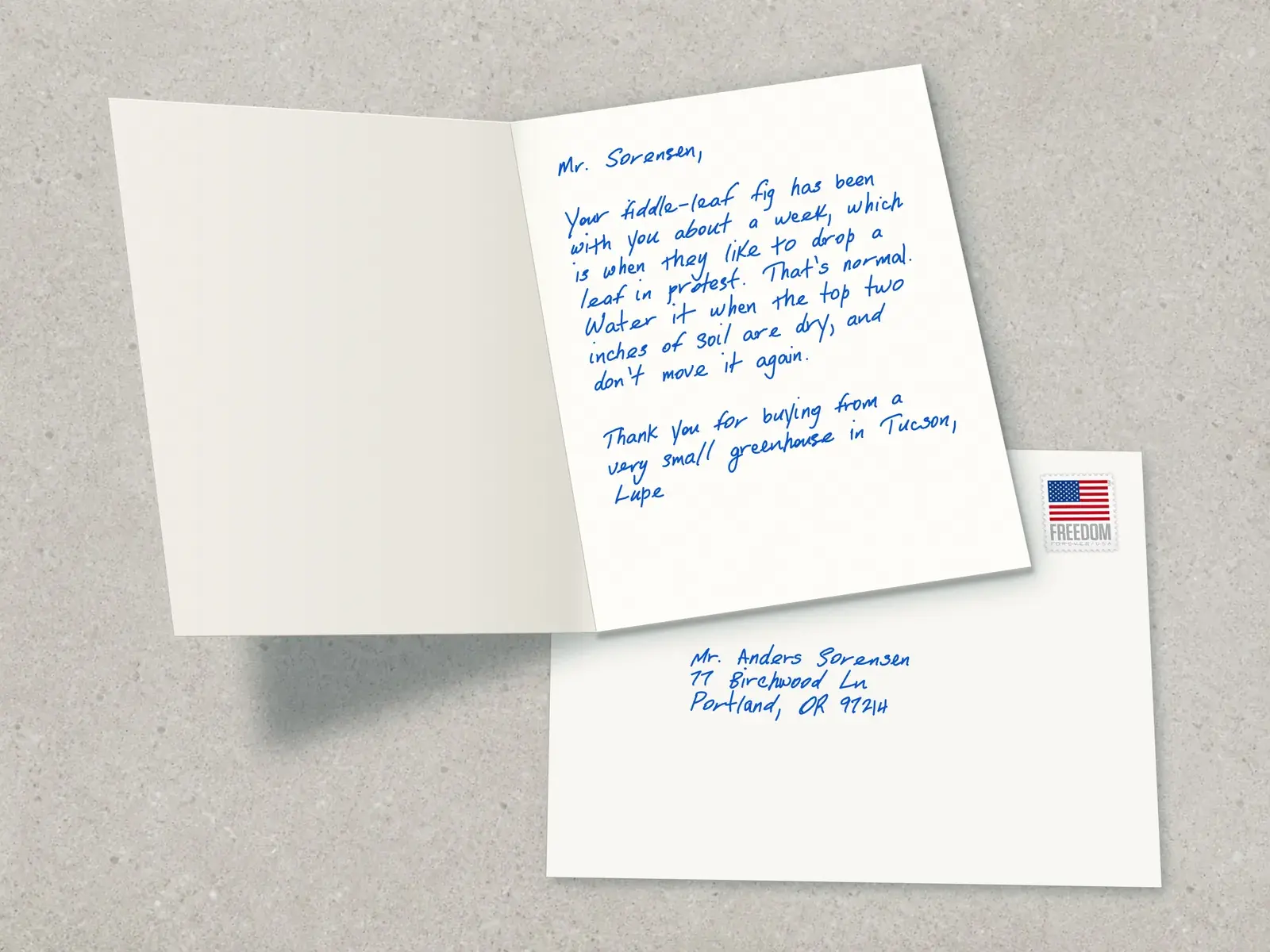
Mr. Sorensen, Your fiddle-leaf fig has been with you about a week, which is when they like to drop a leaf in protest. That's normal. Water it when the top two inches of soil are dry, and don't move it again. Thank you for buying from a very small greenhouse in Tucson, Lupe
No coupon, no review request. It's a thank-you that happens to be useful.
Thirty of those is an evening with a good pen. If it's a few hundred a month, Scribble Cards (that's us) can write them. We write each card with a real ballpoint pen within one to two business days, address the envelope in pen and mail it with a real stamp. Export last week's orders from your store as a CSV, run it through our free mailing list cleaner, and upload the list with a column for each customer's detail, or send cards automatically from Zapier. We mail cards. We don't pack anything into your boxes, so this is for the card that arrives after the order, not the note on top of the tissue paper.
For what comes after that, like a card to a customer who hasn't ordered in six months, direct mail for e-commerce covers planning and testing mailings to past customers.
Frequently asked questions
What are packaging inserts?
Anything you put in the box besides the product and the packing slip: a thank-you note, a care or how-to card, returns information, a coupon or referral card, a sample. They're also called package inserts or insert cards. In packaging design, the same word covers the cardboard or foam that holds a product in place, which is a different job.
Are package inserts allowed on Amazon?
Yes. Amazon's own insert guidance encourages thank-you notes, your brand story, care instructions and assembly guides. An insert can't ask for positive ratings, offer anything for a review, or ask the buyer to contact you outside Buyer-Seller Messaging, and Amazon staff have said QR codes to outside websites aren't allowed. With FBA, the insert has to be inside your product's own packaging, because Amazon packs the shipping box.
Should I handwrite thank-you notes for every order?
You don't have to. Handwrite one line on first orders and a short note on big orders and for your best regulars, and print the rest. For orders from your own store, a handwritten card mailed after delivery to first-time customers is the other good spot. In Adobe Express's survey, 49% of small-business owners who sell online said handwritten thank-you cards are the most effective packaging tactic for earning loyalty.
How much do insert cards cost?
About 15 to 45 cents a card for a few hundred, and a few cents each in the thousands. 4OVER4's e-commerce thank-you cards are $42.84 for 100 and 15.6 cents each at 500, and Avery's 5-by-7 insert cards are $77.50 for 250. Samples and custom packaging cost far more than the paper.
What should a thank-you card for a small business order say?
Their first name, what they bought, one true detail about making or packing it, and your first name. Two or three sentences is enough. Leave out coupons and review requests, which turn the thanks into an ad. There are 58 more examples sorted by kind of order.
Can I ask for a review in the box?
Yes, if every customer gets the same neutral ask and nothing is offered for it. Don't ask for five stars, don't tie a discount or gift to the review, and don't ask only the happy customers. The FTC's 2024 rule bans incentives conditioned on positive reviews, and Amazon and Google ban review incentives of any kind.
Can I put a coupon in an Etsy order?
Yes. Etsy lets you add a coupon code for a future purchase to your packing slip, including the special slip it prints for gift orders. Keep the code off the thank-you note itself, and never tie it to a review.
Reviewed .