
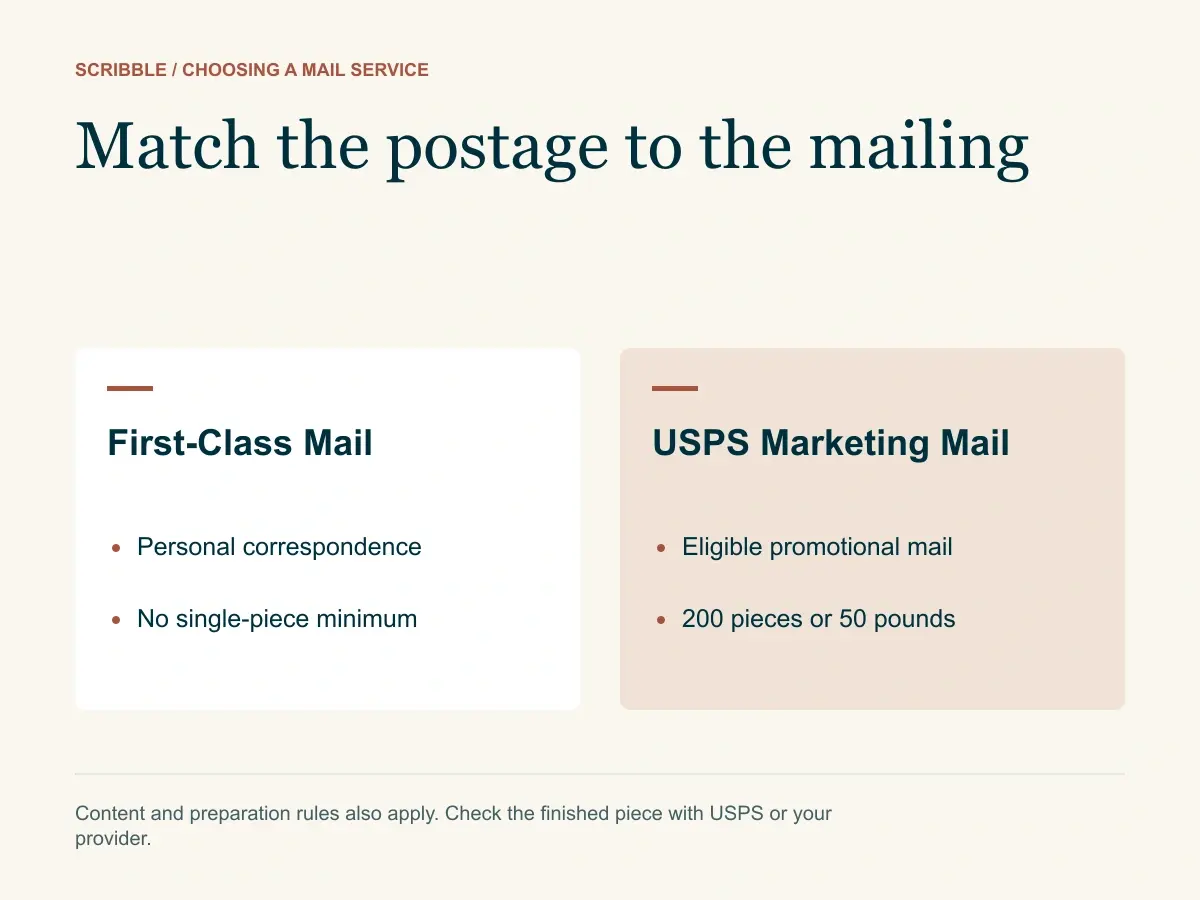
You are mailing 80 personal thank-you cards. A cheaper bulk-mail rate looks appealing, but the rate alone does not tell you whether those cards qualify. A printed promotion to 5,000 addresses is a different job.
Choose the postal class for the message and audience you actually have. Then compare the full cost of preparing and sending it. These USPS requirements were checked on September 25, 2026; confirm the current rules for your finished piece before production.
Check what is inside the envelope
USPS Marketing Mail, formerly called Standard Mail, has restrictions on handwritten or typewritten matter and personal information. There are conditions and exceptions. A personal thank-you does not become eligible simply because a business is sending it. [1]
Show your provider or USPS the full message, variable text, and any enclosure. “A marketing card” is not enough of a description to settle the classification. The handwriting, contents, size, and preparation can all matter.
If the content needs First-Class Mail, treat that as part of the project’s cost. Adding more recipients to reach a bulk threshold does not change the content rules.
Compare the quantity you intend to send
Scroll the table horizontally if needed.
| Mailing category | USPS minimum |
|---|---|
| Stamped or metered single-piece First-Class Mail | No minimum |
| Presorted or automation First-Class Mail | 500 pieces |
| USPS Marketing Mail | 200 pieces or 50 pounds |
These are starting requirements, not every condition for a discounted price. Sorting and other preparation requirements still apply. Your provider may also have its own minimums or may offer only one postal class.
Ask for a quote for the actual audience. If only 80 customers have a reason to receive a note, expanding to 200 merely to pursue a postage rate can make the overall mailing more expensive and less relevant.
For a large eligible promotion, compare production, postage, address work, sorting, and other preparation charges together. A lower postage line can be offset by added preparation or a minimum fee.
Allow time before the mail reaches USPS
USPS currently describes First-Class Mail delivery as 1–5 days. Marketing Mail can receive deferred handling and has no guaranteed delivery within a specified time. Neither service’s transit description includes the time your provider needs to prepare the mailing. [3][1]
Work backward from the recipient’s action deadline. An invitation needs time for proofing, production, transit, and the guest’s decision. A broad promotion with no immediate deadline may have more flexibility.
Do not turn a transit estimate into a promised arrival day. For a firm event or business deadline, make the details available through another suitable channel too. A faster class cannot recover time already lost waiting for the final artwork.
Ask what happens to a bad address
Forwarding, returns, and address-correction treatment depend on mail class and the selected services. USPS describes these rules in Domestic Mail Manual 507. Ask what happens to your particular piece and which fees or notices your provider will pass back to you. [4]
Name the person who will update returned addresses. Otherwise, a cheaper second mailing may repeat the same failed destinations. Do not assume a lack of returned envelopes proves that every intended person received or read a card.
If tracking matters, ask exactly what is tracked. A production update, a postal scan, and a reply from the recipient tell you different things.
Get a quote for the finished job
Before committing, confirm the class, total cost, expected schedule, and handling of returns against a completed sample. Ask which changes would require another check, such as an added insert or a larger envelope.
A card service with a fixed mailing method may still be a good fit. This comparison does not mean every service lets you select either class. Ask what the provider actually offers for your quantity and message.
Frequently asked questions
Is Standard Mail different from Marketing Mail?
Standard Mail is the former name of USPS Marketing Mail. Use the current name when asking for a quote. [1]
Can handwritten thank-you cards use Marketing Mail?
Do not assume so. The rules restrict handwritten matter and personal information, with conditions and exceptions. Have the finished piece classified before choosing the rate. [1]
Sources and methodology
Reviewed .
- Domestic Mail Manual 243: USPS Marketing Mail eligibility
USPS · Accessed
- How quantity affects commercial mail prices
USPS · Accessed
- First-Class Mail service information
USPS · Accessed
- Domestic Mail Manual 507: Mailer Services
USPS · Accessed