58 welcome to the team messages that put a new hire at ease
Welcome to the team messages that tell a new hire something useful, from a card mailed home the week before to remote hires, interns, rehires and executives.
Give them one practical thing, like where to park or which person knows everything, and tell them they're not expected to have the job figured out yet. Then sign your name. A new hire reads this card looking for reassurance, so 'lunch on day one is on us' does more than 'we're so excited to have you.'
The sections follow their first weeks: a card at home the week before, one on the desk the first morning, then notes from a manager, the team and HR. After those come remote hires, interns, people coming back and new executives. The names and details are invented, so swap in your own.
Start here: notes for almost any new hire
Any of these works for almost any new hire, whoever signs it. The last two lean on an invented name and detail, so put in your own.
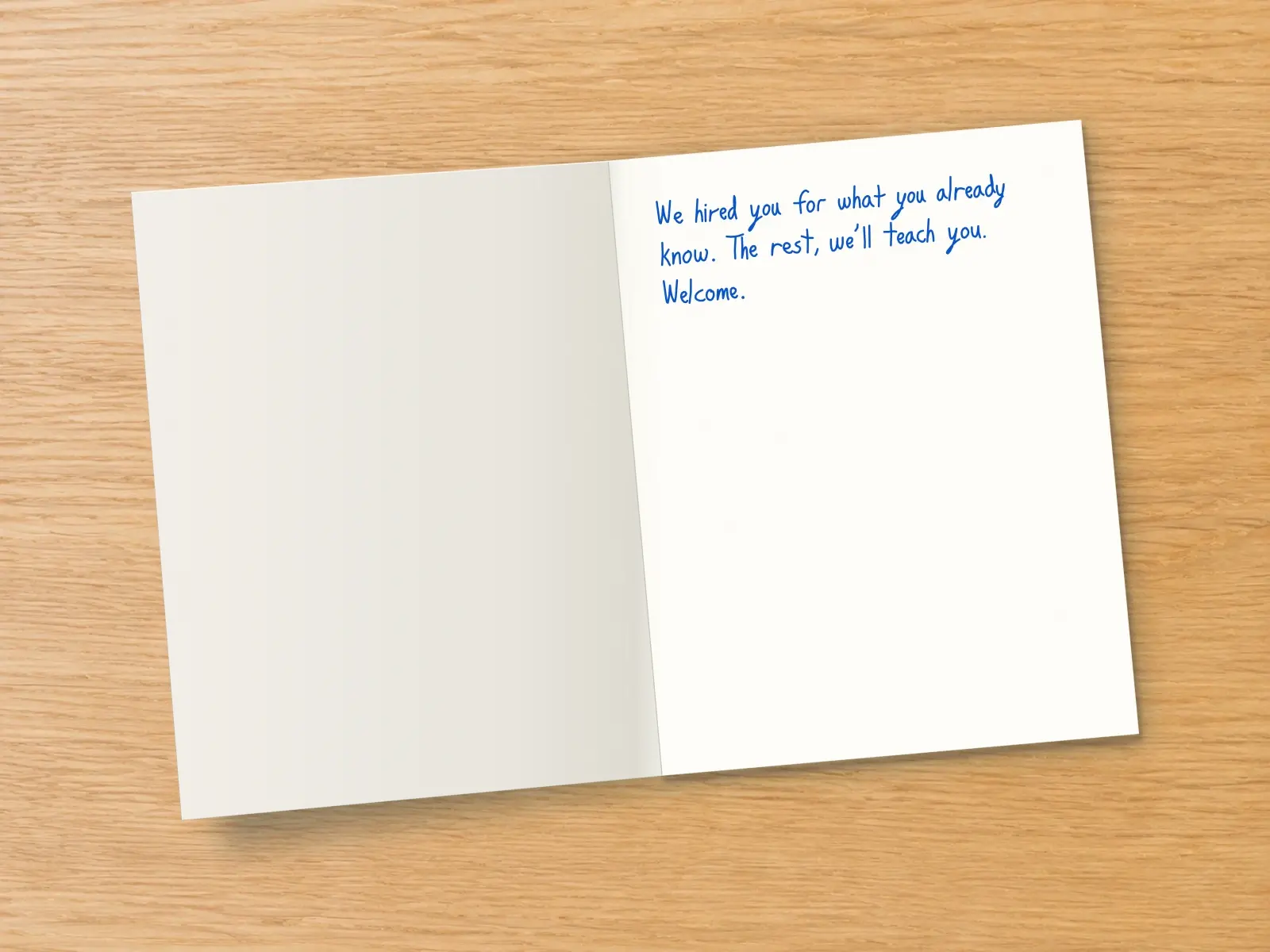
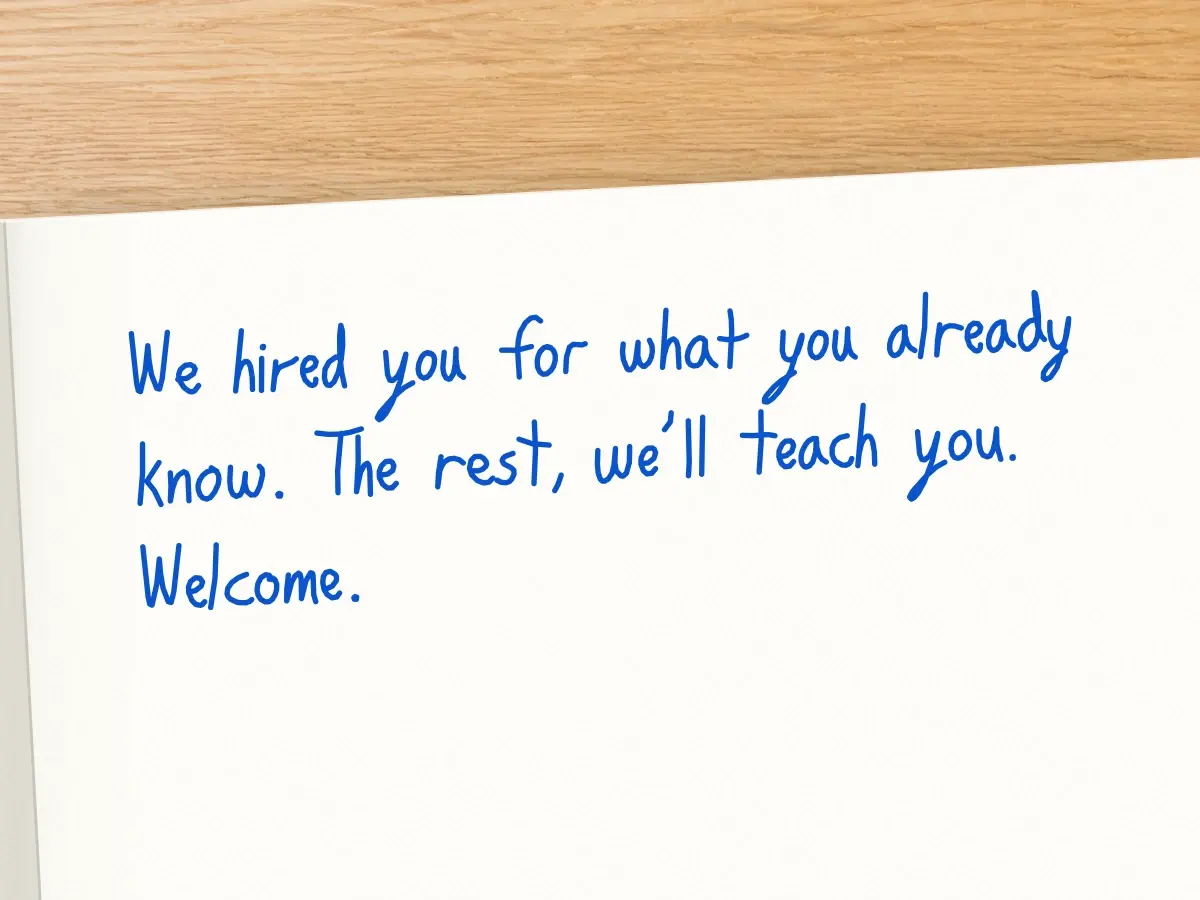
We hired you for what you already know. The rest, we'll teach you. Welcome.
Welcome to the team. For the first month, every question is a good question, and after that most of them still are.
You'll hear a lot of names this week. There's no quiz, and everyone will happily tell you theirs again. Welcome.
I'm so glad you said yes. The first few weeks are for listening, so don't worry about having ideas yet. You'll have plenty, and we'll want every one.
Ask Philippa anything about the new system, ask me anything else, and ask nobody about the old one unless you have an hour. Welcome.
The good coffee is the bag in the freezer with a warning note on it. The note isn't meant for new people. Help yourself.
From an idea to their mailbox
Put it in a card.
Choose a front, make the words yours. We’ll write it with a real pen and mail it for you.
Handwriting example · Mabel
Your edited message is previewed in the designer.
Mailed home the week before they start
This card lands at home while they're waiting to start, which is when the nerves are worst. Tell them what the first morning looks like, and leave the exact date out in case it moves.
We're glad you're coming. On your first morning, park anywhere in the back lot, come in through the glass doors by the flagpole and ask for me. That's all you need to know for now.
Your first day is mostly paperwork, a tour and lunch with the team, which is on us. Wear whatever's comfortable. Nobody here dresses up, except Petra, who dresses up for everything.
Bring a photo ID for the hiring forms. Everything else, from your login to your name tag, is already waiting at your desk.
The week before a new job is a strange one, so here's some news: your desk is set up, your laptop is charged, and the team keeps asking when you start.
Enjoy your last free week. Sleep in, see a movie on a Tuesday afternoon, and don't think about us at all. We'll be thinking about you, in a normal, not-weird way.
Your new coworkers have been told you like hiking and are firmly pro-Oxford comma, which is everything we learned in the interviews. Expect questions about both.
You're starting a job and a new city in the same month. If you need a dentist, a pediatrician or a good dry cleaner, ask Paolo. He's lived here forty years and will happily rank all three.
On their first day
A card waiting on the desk gives them something to read while the laptop updates. One useful fact and a plain welcome is plenty; the orientation packet can do the rest.
Happy first day. Lunch is at 12:30, the team is taking you, and you're not allowed to pay.
Good morning, and welcome. Your laptop will take about twenty minutes to update. Use them to find the kitchen, where someone left a croissant with your name on the bag.
The bathroom key is the one tied to the giant wooden spoon. Nobody remembers why, so don't ask.
Today is for meeting people and figuring out the phones. The actual job starts next week, and even then we'll go easy on you.
If today feels like too much, that's because it is. Every first day is. Come find me at three, and we'll go over whatever didn't make sense.
The three people you'll need this week are Marlene for IT, Joaquin for payroll and me for everything else. Everyone else can wait.
From their manager
Say in a line why you hired them, then what you don't expect from them yet. A time for your first one-on-one or a name to ask is worth more than telling them they'll be great.
Our first one-on-one is Thursday at 10. Bring questions, not updates. You won't have updates for a while, and that's how it should be.
I hired you because of how you talked about the clinic expansion in your interview. I don't expect anything like that for at least six months. Learn the place first, and ask me anything.
You'll shadow Ximena for your first two weeks. She's been here nine years, she knows where everything is filed, and she asked to be the one to train you.
One honest thing: our systems are older than they should be, and the first month is a lot of 'we know, we're fixing it.' If something seems confusing, you're not missing anything. It really is that confusing.
You told me in the interview you'd never used our software. Neither had I when I started. I'll teach you the parts that matter in a week, and the rest nobody uses.
You're going to make a mistake in your first month. Everyone does. When it happens, tell me first, and I promise it'll be a five-minute conversation.
From the team
Pick one real tip instead of five people each writing 'welcome.' Swap in your own lunch spot, cake or shift, and list everyone's first name at the bottom.
Welcome from all five of us. Between us we've made every mistake you're about to make, so ask first, and we'll tell you how ours went.
Friday lunch is a standing thing, and you're invited every week. You get to pick the place once. After that it's the Thai place. It's always the Thai place.
From the whole support team: welcome. The queue looks scary on day one. By week three it'll look like any other Tuesday.
We celebrate every birthday here with the same grocery-store carrot cake. You'll hate it at first. By your second birthday here, you'll defend it.
We've been short a person since March, so you're walking into a team that's very glad to see you. Don't let us pile everything on you in week one. Pushing back is allowed.
Welcome to nights. Your sleep will be a mess for about a week, and then it settles. Until then, lunch at midnight is the best part of the shift, and we always bring too much food.
Templates for every new hire
These are templates for a whole new-hire list. The only merge field is {{first_name}}, so every other line has to fit every new person, whatever the job. Sign it with your name and what you do, like 'Imogen, HR.'
{{first_name}}, welcome. You'll get a lot of paperwork from me this week. This is the only piece of it you don't have to sign.
Welcome, {{first_name}}. Your first few weeks are for learning, and that's all. If anyone expects more than that, send them to me.
{{first_name}}, welcome to the team. You're not expected to know how anything works yet, including the room booking system, which nobody fully understands.
{{first_name}}, I still remember the first person who ever agreed to work here, and I'll remember you too. Thank you for saying yes. Welcome.
{{first_name}}, my office is the one next to the break room. Ask me anything: pay, benefits or where all the extra chairs went.
Here's our fifteen-minute rule, {{first_name}}: if you've been stuck that long, ask someone. Everyone here follows it, including me.
For remote hires
For a remote hire, a card at home may be the only welcome they can hold. Tell them who to text when something breaks, and say plainly that small questions are fine to send.
Your laptop should arrive by Thursday. If it doesn't, text me from your phone and we'll sort it out. First remote days never go perfectly.
Half the team is three hours ahead of you, so replies may land before you're awake. Answer them when you are.
Message me anytime, even if it feels too small for a message. On a remote team, the small questions are most of the job.
The first week of a remote job can be quiet in a way that makes you wonder if you're forgetting something. You're not. That's just what week one sounds like from home.
You'll meet everyone on screens first, so here's a head start: Kalani has the surfboard on the wall, Arnav has three monitors, and I'm the one still using the default background.
Spend your home-office budget on a good chair first. It's in the onboarding email, and you'll thank me around day four.
For interns
Interns worry about looking like they don't know things, which is the whole point of an internship. Give them one person to go to, and tell them their work will actually get used.
You're here to learn, which means you're allowed to not know things all summer. Most of us are still using that permission.
Your project this summer is the price comparison we've been putting off for two years. We stopped putting it off the day you accepted.
Ten weeks goes fast. Ask everyone you can for twenty minutes and a coffee. Almost everyone will say yes, and you'll learn more from those than from any assignment.
Don't worry about the dress code. Worry about the office paper-airplane contest, which an intern has won every summer since 2022.
I was the intern here eight years ago, at the same desk you're sitting at, and I was just as nervous. It works out. Welcome.
For rehires
Someone coming back already knows the building, so skip the orientation tone and tell them what's changed. Don't ask why they left or why they came back.
You left to see what else was out there, and you came back. I'm taking that as the best review this place has ever had. Welcome back.
Welcome back. You'll find some new faces, a new expense app and the same broken blinds in conference room B. Some traditions we keep.
Nobody figured out the postage machine after you left, so you might want to start there.
Two years away, and you came back knowing things we don't. That's why we hired you back. (We also missed you.)
Your old desk went to Hiroshi, who says he'll trade it back for the sesame cookies you used to bring on Fridays. Welcome back.
For an executive hire
An executive gets plenty of formal welcomes, so a short note from the CEO or a peer stands out. Say what you're glad they're taking on, plus one honest thing only an insider would tell them.
I've been doing the CFO's job and my own since March, and I've never been happier to hand something over. The finance team has been counting down. So have I. Welcome.
You'll hear plenty of opinions in your first month here. Mine is that our delivery drivers are the best thing about this company, so spend a morning in a truck with one of them early.
So you know what you're walking into: we've had three directors in four years, and we'd like you to be the last one for a long time. Welcome from all of marketing.
This company is 140 people, and most of them eat lunch in the same room. Sit at a different table every day for your first month. You'll learn more there than in any meeting.
Everyone will tell you the first three months are for listening, and they're right. Tell me when you hear something nobody else will say out loud.
Time it for the week before
Aim for the card to arrive in the week before their first day. First-Class Mail usually takes 2 to 5 business days, so mail it about ten days before the start date. If we're writing it, choose a send date about two weeks out: each card takes 1 to 2 business days to write, and you get an arrival window rather than an exact day.
Leave the date off
Start dates move. Write 'your first morning' instead of 'Monday the 12th,' and the card still makes sense if the start slips a week. Wait until the offer is signed and any background check has cleared before you mail it.
Where to send it
Use the mailing address on their new-hire paperwork, and keep it with whoever addresses the envelopes; the people writing the message don't need it. Put the name they go by on the envelope, which isn't always the one on their ID. One 82-cent Forever stamp covers a standard card; a square envelope needs 49 cents more.
Sign so they can place you
Sign with your first name, and add your role if you haven't met: 'Odessa, your manager' or 'Bram from the warehouse.' A new hire meets dozens of people that first week, and a role next to a name is how they'll remember which one you were.
Keep the logistics in email
Put logins, start times and what to bring in an email they can search later. The card is for the reassurance, and it shouldn't be the only place the parking instructions live. A standard card fits about 300 characters before the writing gets smaller, which is two or three sentences.
One useful fact and one reassurance. Tell them who meets them on the first morning or where to park, then that the first few weeks are for learning. 'We hired you for what you already know. The rest, we'll teach you' covers the reassurance in two short sentences.
Should a welcome card arrive before the first day?
If you can manage it, yes. The week before a new job is the most nervous one, and a card at home that week tells them the job is real and people are ready for them. Mail it about ten days before the start date, once the offer is signed.
What do you say to a new employee on their first day?
Keep it practical: when lunch is, who handles IT, when you'll check in. A card on the desk works well because it's there before the laptop finishes updating. Save the big speech about the company for later; on day one they're mostly trying to remember names.
How do you welcome a new employee professionally?
Use their name, say plainly that you're glad they're joining, and give them one concrete next step, like the time of your first meeting. Sign with your full name and title if you haven't met. Skip phrases like 'hit the ground running,' which add pressure in a week that already has plenty.
Should the whole team sign a welcome card?
Yes, if each name comes with something useful. Put one real tip in the message and everyone's first names underneath, and the names double as a list of people to look for on day one. For real signatures, have the card mailed to you first and pass it around.
What do you write to a new hire you haven't met?
Introduce yourself in a line, say what you do, and offer one specific kind of help: 'I'm in payroll, so anything about your first paycheck, come to me.' Keep it short, and skip compliments you can't back up yet, since you don't know them.