

It is easy to choose a holiday card. It is harder to discover, a week before mailing, that three account managers have different client lists and the person signing the cards is on vacation.
Settle the people and dates early. Then the writing can be what it should be: a short acknowledgment of the year you shared with a customer or partner.
Choose the reason and the sender
Decide whose work or business you are acknowledging. “Thank our implementation partners for this year’s projects” gives you both an audience and something to say. Customers, employees, and prospective buyers may need different messages.
A named account manager can mention a shared project. A note from the whole company should use wording that is true for everyone on the list. Choose the signature before drafting; a CEO should not appear to remember a meeting they never attended.
Use a specific holiday greeting when you know it is welcome. Otherwise, a warm year-end or holiday-season message is a reasonable choice. The card does not need a discount, review request, or meeting link.
Combine the lists while there is time to fix them
Ask account managers for additions by one deadline, then give one person the job of combining them. Start with last year’s list if useful, but check people who changed companies, office moves, and contact preferences.
Decide whether two names at the same company should receive separate cards. If both people worked with your team, that may be appropriate. If the same person appears in two exports, remove the duplicate. Check suite numbers and preferred names before the list reaches production.
Keep a small group of uncertain addresses aside. A short, accurate list is easier to send well than a larger list padded with guesses.
Work backward from the recipient’s calendar
Aim for a window when people will be at the address. An office card arriving after the office closes for the year misses the occasion even if the postal service delivers it normally.
Scroll the table horizontally if needed.
| Time before the desired window | Work to finish |
|---|---|
| 8–10 weeks | Choose the audience, budget, and sender |
| 6–8 weeks | Combine lists and resolve missing addresses |
| 4–6 weeks | Choose artwork, write the message, review a sample if needed |
| 2–4 weeks | Finish proofs and confirm the production schedule |
| Just before sending | Check late changes and the final count |
These are suggested planning allowances, not mailing deadlines. USPS publishes current First-Class Mail service information; check it alongside your provider’s production schedule. Allow time for both, and avoid promising a specific arrival day. [1]
Put the signer’s availability on the calendar. Two feedback rounds need two actual dates. If the first proof is due while everyone is traveling, move it earlier.
Write something the recipient will recognize
A year-end note to a project partner
Hi Maya, Thank you for the care you brought to our project this year. I appreciated your clear updates and thoughtful questions. Wishing you a restful holiday season. Alex
Fictional example. Adapt the details to your relationship.
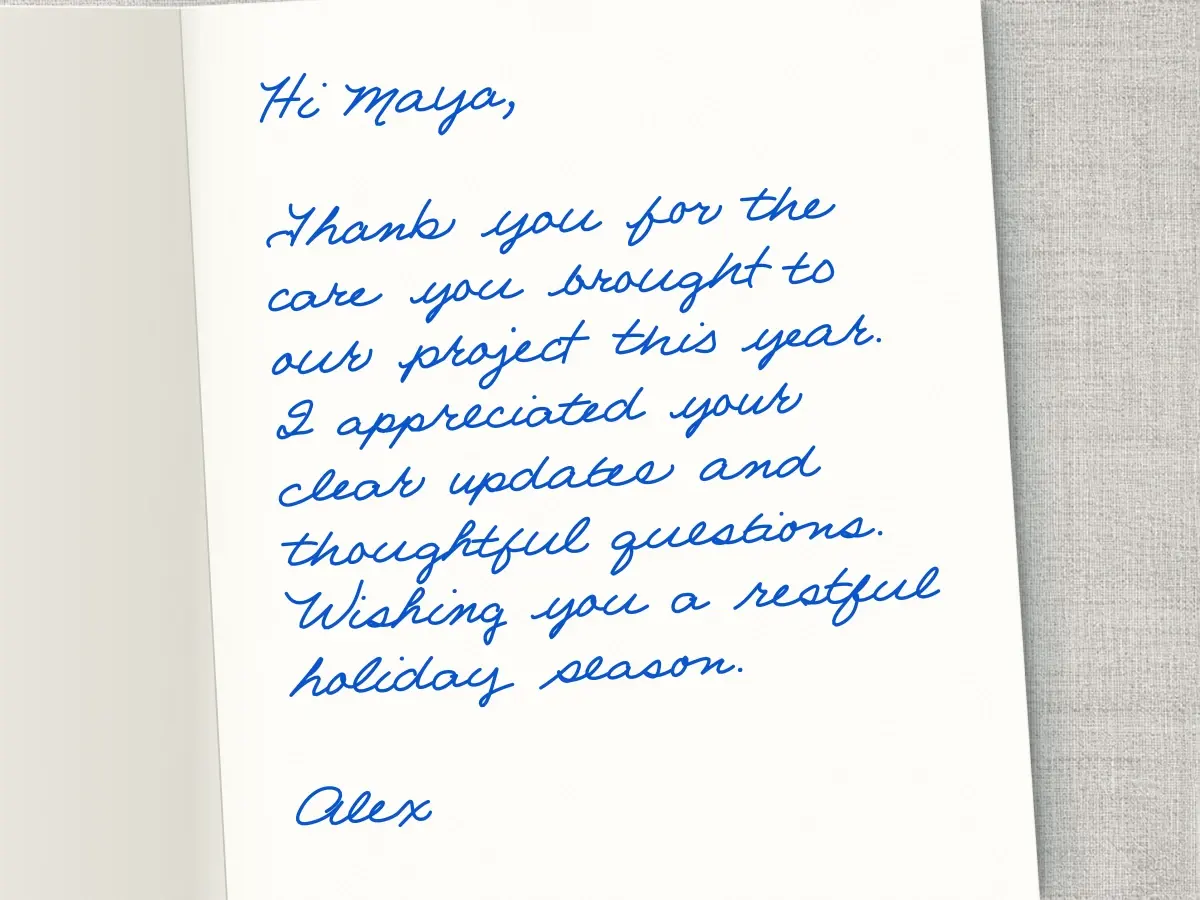
Maya can recognize the shared project and the contribution being thanked. For your own note, replace that detail with something the sender actually remembers. If one message goes to the whole list, keep the acknowledgment broad enough to be accurate.
Read the completed version aloud. If it sounds like an annual report, shorten it. “Thank you for your help with the launch” is easier to receive than a paragraph about strategic partnership and shared success.
Check the longest greeting and signature in the chosen handwriting. A seasonal card should leave enough space to read comfortably.
Have a plan for a late start
If the holiday window becomes unrealistic, send a January thank-you or choose another suitable way to reach the person. Change the wording to fit when it will arrive. There is no value in rushing an inaccurate list to preserve a date.
After mailing, update addresses that come back and note what delayed the project. Keep those lessons for next year, but review the audience again when the next holiday season comes.
Frequently asked questions
Can every client receive the same greeting?
Yes, if it fits every relationship. Use separate versions when the sender or reason for thanks differs.
What is the last date we can send holiday cards?
Check current production timing, the postal service you will use, and office closures. The planning schedule here is not a delivery guarantee. [1]
Sources and methodology
Reviewed .
- First-Class Mail service and requirements
USPS · Accessed
Current source for postal service information; the backward plan is our suggested internal workflow, not a USPS deadline.