
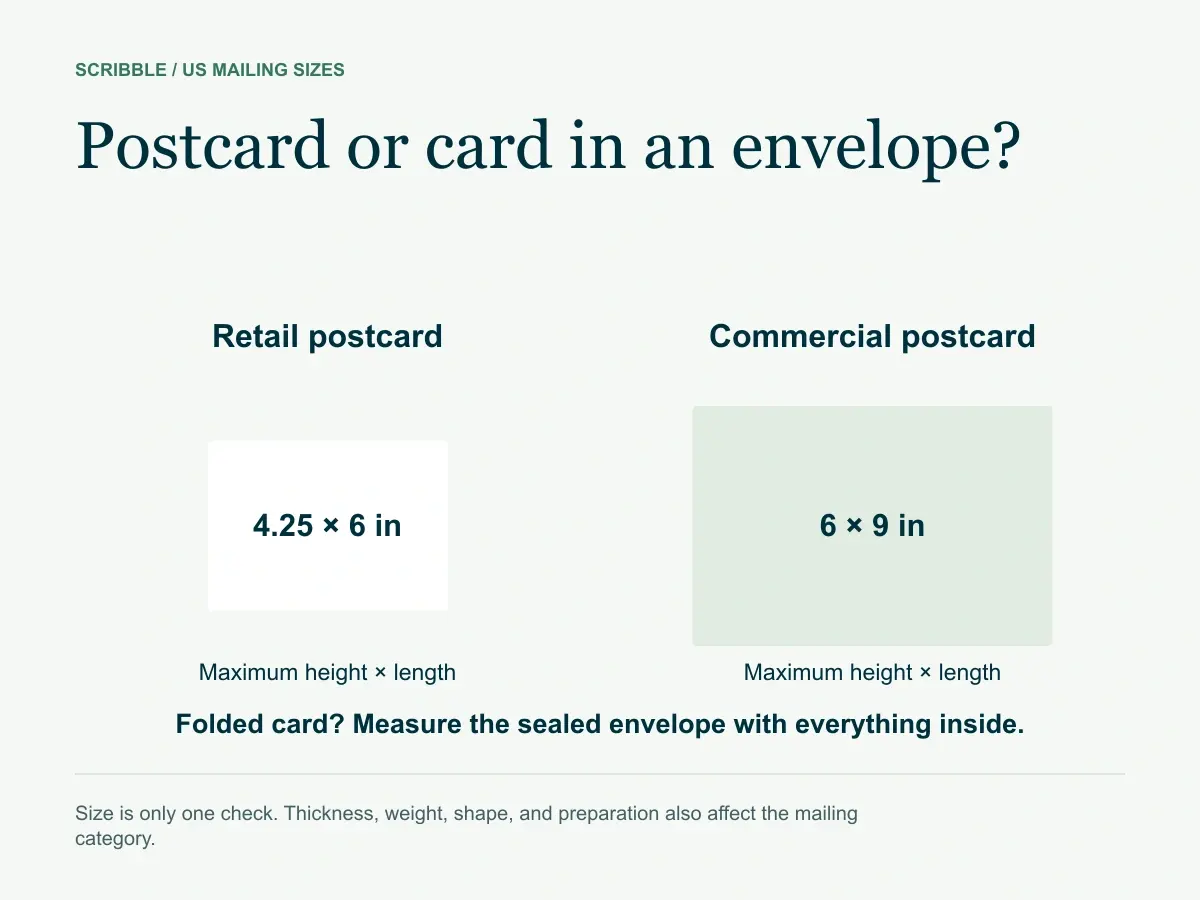
You’ve designed a 5 × 7 card. Before you order 500 copies, ask what will actually enter the mail: a flat postcard, a folded card, or a sealed envelope containing the card.
Those are different postal formats. The printer’s product name won’t tell you which price applies, and a file with the right dimensions won’t show whether the finished piece is too thick or rigid.
Choose the mailing format first
For a postcard, measure the piece as it will be mailed. For a greeting card in an envelope, measure the sealed envelope with everything inside. Keep the folded card’s dimensions for production, but use the envelope for the postal check.
Tell the printer whether you are using ordinary retail postage or a commercial mailing service. A commercial allowance is not automatically available to someone putting stamps on individual cards at the office.
Use the right size range
Scroll the table horizontally if needed.
| Format | Height × length | Thickness |
|---|---|---|
| Retail postcard | 3.5 × 5 inches minimum; 4.25 × 6 maximum | 0.007–0.016 inch |
| Commercial postcard | 3.5 × 5 inches minimum; 6 × 9 maximum | 0.007–0.016 inch; at least 0.009 above 4.25 high or 6 long |
| Retail letter | 3.5 × 5 inches minimum; 6.125 × 11.5 maximum | 0.007–0.25 inch; larger pieces have an additional minimum-thickness rule |
These are size boundaries, not a complete postage decision. Weight, shape, construction, and the preparation required for the claimed price still matter. USPS stamped cards and double cards also have distinctions from ordinary commercial postcards. [1][2]
A 6 × 9 postcard may fit a commercial postcard mailing. It exceeds the retail postcard dimensions. Ask the mailing provider to confirm the category they will actually use before approving that design.
Check the assembled sample
Put every insert into the envelope, seal it, and weigh it. Measure the thickest part. A magnet, extra card, or gift can change the physical piece even if the outer envelope is the same.
A square envelope or a stiff, uneven piece may need different handling from a standard rectangular letter. Address orientation also matters. These are among the physical characteristics covered by USPS letter standards. [1]
Give the printer or mailing service the sample when something is unusual. It is much easier to change an envelope or remove an insert before 500 pieces are assembled.
Walk through the common choices
For a 4 × 6 unenclosed postcard, the height and length fit within the retail postcard range. You still need suitable stock, thickness, weight, and an acceptable address layout. The right rectangle is only the first check.
For a folded 5 × 7 greeting card, choose the envelope first and check its outer dimensions. The insert being called a ‘card’ does not make it a postcard-price mailing. Your provider should assess the complete envelope under the applicable letter rules.
For a 6 × 9 promotional postcard, ask for a quote that includes the actual commercial preparation, printing, and mailing. A low postage figure on its own won’t tell you the finished job’s cost.
Put the postal choice into the print brief
- Finished outer format and dimensions.
- Paper or envelope stock, including thickness.
- Every insert or attachment.
- Address orientation and required clear areas.
- Mailing category confirmed by the provider.
Save the approved physical sample. If you switch envelope stock, add an enclosure, or change the finishing, check the assembled piece again. The download gives you a short measurement sheet to send with the print brief.
Frequently asked questions
Can a 5 × 7 postcard use retail postcard postage?
It is larger than the retail postcard dimension limit. Ask the provider which letter or commercial postcard preparation applies to the finished piece. [1][2]
Do I measure the card or the envelope?
Measure the outer piece entering the mail. For an enveloped greeting card, measure and weigh the sealed envelope with all contents.
Why can a card inside the size limits still cost more?
Thickness, weight, rigidity, shape, or other construction details can affect the postal category or handling. Ask about the complete sample. [1]
Sources and methodology
Reviewed .
- Domestic Mail Manual 101: Retail letters and cards
USPS · Accessed
- Domestic Mail Manual 201: Commercial physical standards
USPS · Accessed