
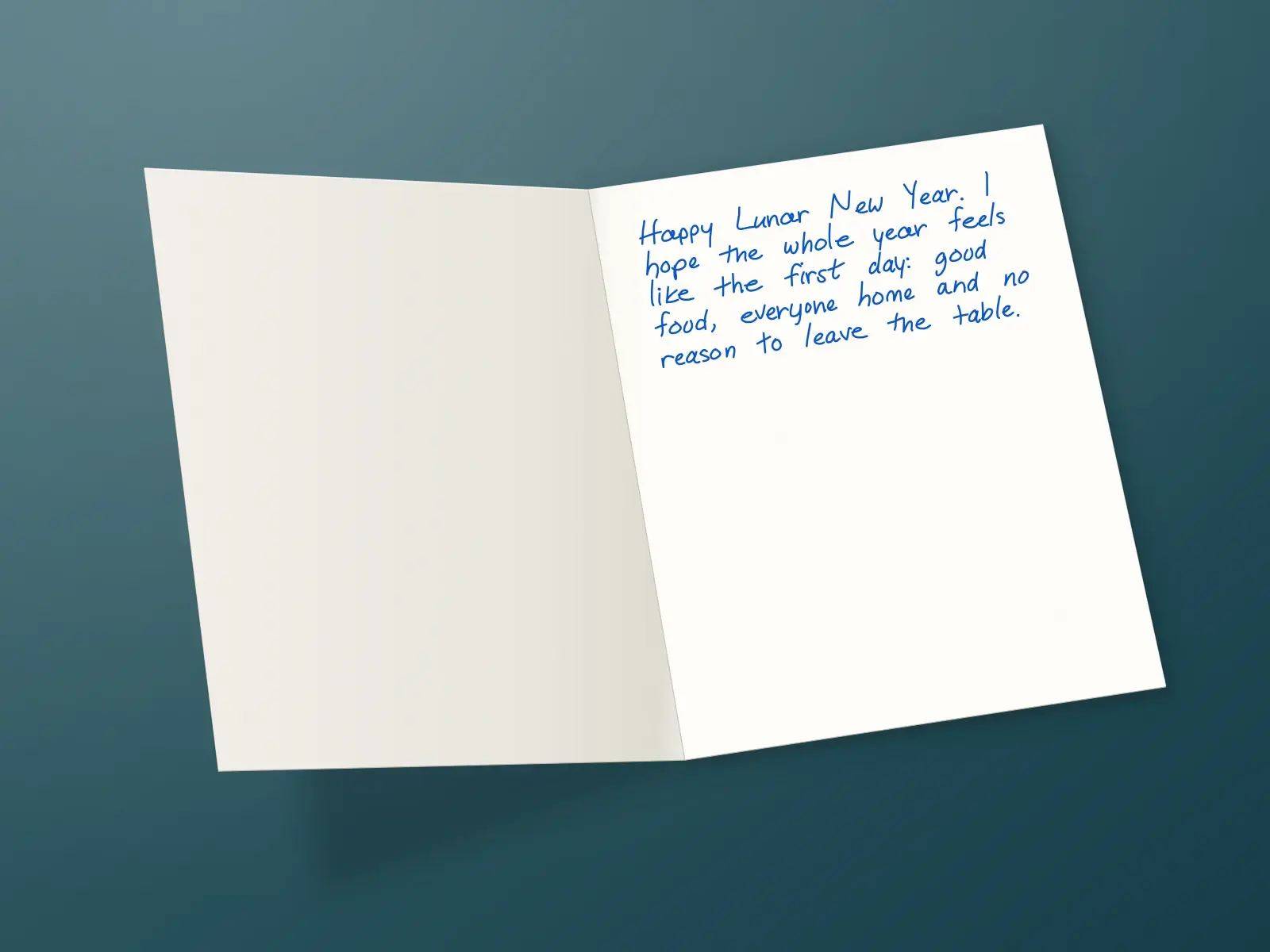
Most Lunar New Year cards open with a greeting and a wish for good health. The ones people keep add a line only you could write, like the game you lost to their grandmother last year, and then your name.
Sections run from elders and kids to coworkers, with greetings in Cantonese, Mandarin, Vietnamese and Korean. Lunar New Year begins Saturday, February 6, 2027, and in Korea, Seollal falls on the 7th. Use the name their family uses, whether that's Tet, Seollal or Chinese New Year, and swap my invented details for your own.
Start here: lines for almost anyone
These suit Chinese, Vietnamese and Korean families alike, and anyone else you'd send a card to. Where a line has a detail, like the game after dinner or last year's leftovers, swap in theirs.
Happy Lunar New Year. I hope the whole year feels like the first day: good food, everyone home and no reason to leave the table.
Save me a seat for the game after dinner, preferably not next to your grandmother. She can read my face.
May this year be lucky in the small ways too: green lights, short lines and an open seat on the train.
Last year you sent me home with enough leftovers for a week. I'd like to RSVP early for this year.
I hope good luck finds you this year. To help it along, I've written your address very clearly on the envelope.
Wherever the new year finds you, I hope you're with people who know how you take your tea.
Greetings in Cantonese, Mandarin, Vietnamese and Korean
San nin fai lok (Cantonese), xin nian kuai le (Mandarin) and chuc mung nam moi (Vietnamese) all mean happy new year, gong hei fat choy (Cantonese) wishes prosperity, and saehae bok mani badeuseyo (Korean) means "receive a lot of luck in the new year." Use the one their family uses, or write it in English if you're not sure.
Gong hei fat choy, Auntie Lan. May the Year of the Goat keep the flower shop busy and finally give you a Sunday off.
San nin fai lok, Gung Gung. Good health all year, and may the mahjong tiles fall your way for once.
Xin nian kuai le, Wei. Thank you for teaching our whole office to say that properly. Most of us are still wrestling with the tones.
Xin nian kuai le, Nai Nai. Shen ti jian kang, good health to you, and this year the dumplings are our job.
Chuc mung nam moi. May the first person through your door this year bring good luck, and preferably dessert.
Saehae bok mani badeuseyo, Mrs. Yoon. Thank you for the plate of jeon you brought over last Seollal. The kids have asked about it every week since.
For parents, grandparents and elders
Good health and a long life are the classic wishes for an elder, so lead with one, and call them what you call them at home. Tease their cooking rules or their winning streak, never their age.
This is the first reunion dinner I've ever missed. Eat my share of the fish, and call me so I can hear everybody talking at once.
Po Po, your turnip cake recipe says "a little sugar, cook until it looks right." I need you to come over and show me what right looks like.
I wrapped banh chung for the first time, following your instructions over the phone. It came out almost square. Chuc mung nam moi, Ba Noi.
Halmeoni, last year my bow was so wobbly you laughed through the whole thing. I'll do better this year, but please laugh anyway.
Thank you for the red envelope you slipped into my coat pocket last year. I found it in October, which was excellent timing.
Every New Year you wish us good health before anything else. This year I'm going first: good health to you, Dad.
For friends
Name one thing from their celebration you were part of, like the dinner, the parade or the dumplings you folded badly, and save the sweeping joke for a family that keeps the no-sweeping rule on New Year's Day. If you don't celebrate, thank them for including you rather than explaining the holiday back to them.
My dumplings at your party last year looked like tiny shower caps. Your dad ate two to be polite, then quietly refolded the rest.
Thank you for inviting me to your family's Tet party. Your aunt fed me three times and then asked if I was eating enough.
Same spot for the lion dance this year? I'll bring the coffee. You bring the earplugs.
Happy Seollal. Your mom's tteokguk was the best thing I ate all winter, and I've told her so in a separate card.
First Lunar New Year in Boise. If nobody out there sells decent mandarins yet, say the word and a box is on its way.
Happy Lunar New Year. Enjoy the one day a year when not sweeping counts as tradition.
For kids
Keep it short enough to read out loud, and if lucky money is coming, say where it's waiting. In Korean families, New Year money traditionally comes after the bow, sometimes in a silk pouch rather than a red envelope.
Happy Year of the Goat. Goats climb everything, so you two should get along fine.
Your red envelope is waiting at Grandma's. She says you have to wish her a happy new year first, in your best voice.
This is your year: you were born in the Year of the Goat. Red socks are supposed to come from someone else, so watch the mailbox.
Happy Seollal, Ji-ho. One bowl of tteokguk and you're officially a year older. Ask Grandpa if that means a later bedtime.
Happy Tet, Khoa. Wish your grandparents a long life first, then open the li xi. Your cousins will try to skip a step.
For coworkers and clients
Send these to people you know celebrate, and sign your own name. For a whole client list, use Happy Lunar New Year and one line that's true for everyone, like the template here with its first-name field.
Happy Tet, Minh. Thank you for staying late in January to get the Hanover order out. The week off is yours, all of it.
Thank you for the pineapple tarts you brought in last February. The whole floor still talks about them. Happy Lunar New Year.
I know you'd rather be at your parents' table in San Jose this week. We can't fix that, but lunch on Friday is on the team, and you're picking.
Happy Lunar New Year, {{first_name}}, to you and everyone at your table. May the Year of the Goat bring you steady work and plenty of rest in between.
We loved building your new kitchen. May the Year of the Goat fill every seat in the dining room.
For families with more than one tradition
Plenty of families keep Lunar New Year alongside Christmas, January 1 or a partner's holidays. Give the New Year its own line instead of tacking it onto the end of another greeting.
You're the only friend I have with two New Years. I'd trade you my January one for your February one, mostly for the food.
First Lunar New Year since the wedding. Your grandmother has already taught Elliot to make the dipping sauce, and she says he shows promise.
Christmas at your parents', Tet at his, and this year you two are hosting both. Your living room deserves its own card.
Lunar New Year on the 6th and Valentine's Day on the 14th. Your mom says that's lucky. I say it's two good dinners.
Latkes in December, a mountain of spring rolls in February. Your kitchen never really gets a day off.
Mail it by about January 30
USPS doesn't publish a mailing date for Lunar New Year. For most of the US, I'd mail by about Saturday, January 30, so the card lands by February 6. If we're writing it, allow 1 to 2 business days for the writing and 2 to 5 for USPS, so order by about January 26, or pick a send date now. A square envelope needs 49 cents more postage.
Use the name their family uses
Chinese families may say Chinese New Year or Spring Festival, Vietnamese families say Tet, and Korean families say Seollal. If you know which one, use it, with the greeting from that family's language. For a mixed group, or when you're not sure, Happy Lunar New Year covers everyone.
Keep names out of red ink
If you add a name or a note by hand, use blue or black. In Korean tradition, a person's name written in red is linked to death. Red is lucky almost everywhere else at New Year, from the envelopes to the decorations, so this is the one place to leave it out.
Skip the sad news, and keep it short
Many families avoid words like death, poor and pain at New Year, along with the number four, so I'd save hard news for a phone call. A card holds about 300 characters before the writing has to get smaller. That's a greeting, a line about them and your name.
Signing, addressing and the lucky money
Sign it the way they'd say your name, and list everyone in your family, kids included. Address the envelope to the household, like The Lau Family. I wouldn't mail cash. Send the card ahead and hand over the lucky money in person, after the kids have said their New Year wishes.
More help with your cards
How to address an envelope, with examples
Questions about writing your card
What do you write in a Lunar New Year card?
A greeting, a wish and your name, with one line about them if there's room. Good health is the safest wish for anyone and the classic one for elders. For example: "Happy Lunar New Year. I hope the whole year feels like the first day: good food, everyone home and no reason to leave the table." Two or three sentences is plenty.
How do you say happy Lunar New Year in Chinese, Vietnamese and Korean?
In Mandarin, xin nian kuai le means happy new year. In Cantonese it's san nin fai lok, and gong hei fat choy, which you'll see spelled a few ways, wishes you prosperity. Vietnamese families say chuc mung nam moi for Tet, and Korean families say saehae bok mani badeuseyo, "receive a lot of luck in the new year," for Seollal.
Is it Lunar New Year or Chinese New Year?
Both are right, for different things. Many Chinese families call it Chinese New Year or Spring Festival, while Lunar New Year also takes in Vietnamese Tet, Korean Seollal and other celebrations on the lunar calendar. For one person, use the name they use. For a mixed list, Happy Lunar New Year is the safe choice.
When is Lunar New Year 2027, and what animal is it?
Lunar New Year begins Saturday, February 6, 2027, the same day as Tet in Vietnam. In Korea, Seollal itself falls on Sunday, February 7, with the holiday running February 6 to 9. It's the Year of the Goat. The Chinese word yang covers sheep and goats, so you'll also see Year of the Sheep or Ram, while Vietnam calls it the goat.
What should you not write in a Lunar New Year card?
Leave out sad and unlucky words. Many families avoid talk of death, poverty and pain at New Year, and the number four, so I'd save hard news for a phone call. Keep names out of red ink, which is a Korean taboo, and use the greeting from their family's language rather than one you picked up somewhere else.
Is it OK to send a Lunar New Year card if you don't celebrate?
Yes. A card from a friend, neighbor or coworker who doesn't celebrate is a kind surprise, the same way a Diwali or Hanukkah card would be. Use the name of their holiday, write the greeting in English if you're unsure of the spelling, and don't explain the holiday back to them.
Sources and further reading
National Geographic: The top things to know about Lunar New Year
SBS Chinese: Eight Lunar New Year greetings you need to know
The Woks of Life: Chinese New Year greetings
Vietcetera: Lunar New Year greetings 101
Tuoi Tre News: Tet custom, the gift of lucky money
Vietnam Pictorial: Xong Dat, the first visitor of the new year
Korea Economic Institute of America: Korean Lunar New Year traditions
The Herald Business: Korea's 2027 calendar, with Seollal on February 7
VnExpress International: Vietnam's 2027 Tet holiday
Griffith University: Year of the Goat, Sheep or Ram?
SBS Chinese: Six taboos to avoid during Lunar New Year