

Financial services is one of the most competitive arenas for client acquisition. Digital marketing in this space is expensive, crowded, and increasingly distrusted. High-net-worth individuals, in particular, receive more targeted ads, cold emails, and LinkedIn connection requests than almost any other demographic. Standing out is not about doing digital better. It's about doing something different.
In my experience, the financial advisors who use handwritten outreach consistently win clients that their competitors can't reach. Not because they're better at their job, but because they've figured out something the industry hasn't fully caught up to: for high-value client relationships, the channel is part of the message.
This post covers how financial advisors are using direct mail and handwritten cards across the full client lifecycle -- from cold prospect to long-term retained client -- and what the numbers actually look like.
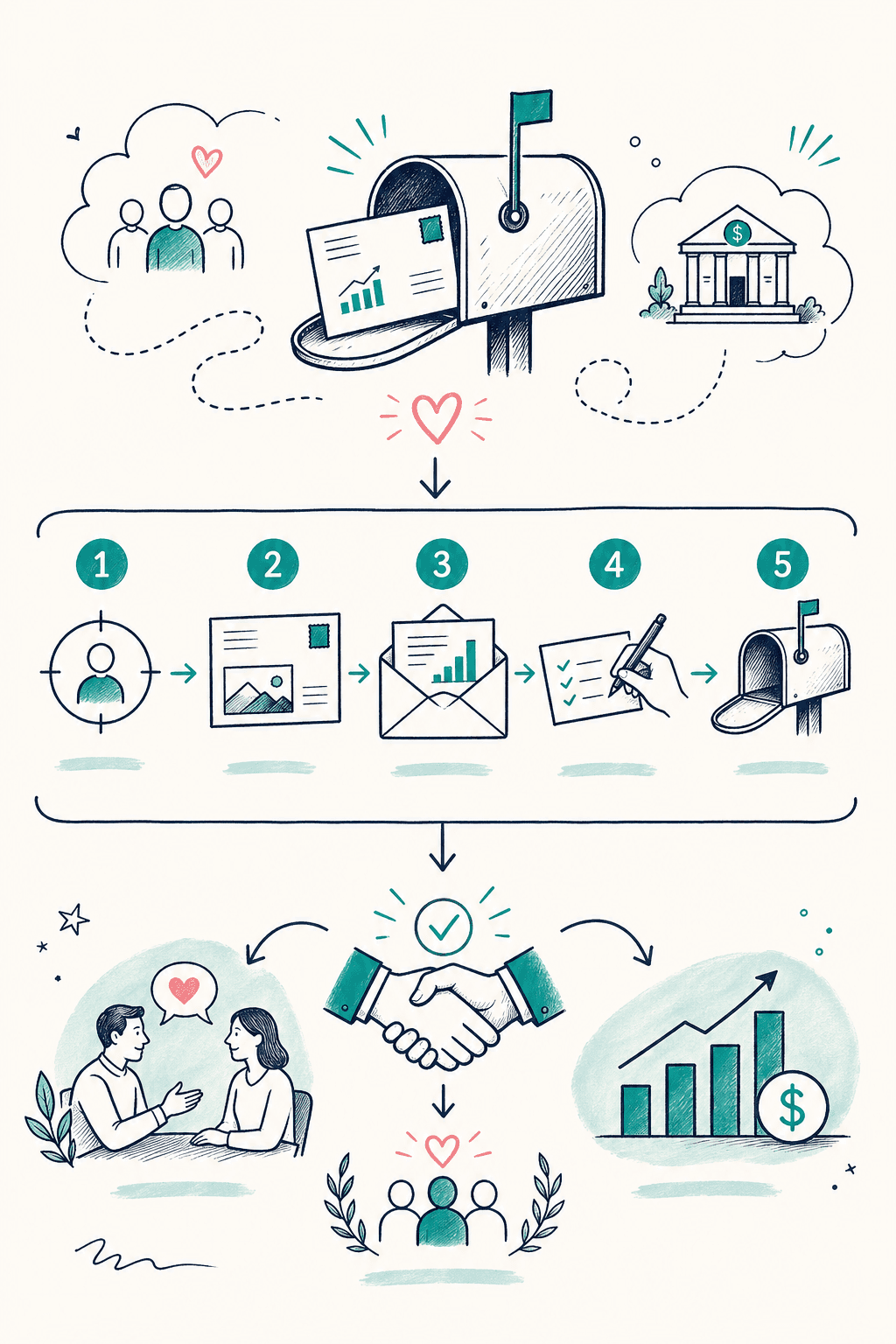
Where a Physical Note Can Fit a Client Relationship
A prospect needs to understand what the adviser offers and feel comfortable with the relationship. A physical note can follow a relevant conversation, but the format alone does not establish trust or a better acquisition result.
A physical letter gives an adviser another way to communicate with a client, but neither dispatch nor an estimated arrival window proves that the message was read. Measure client replies and useful next steps instead of assuming an open rate.
Paper mail still needs compliance review. FINRA rules apply to written communications within their scope, and investment adviser advertising can fall under the SEC Marketing Rule. Have your compliance team classify the communication and confirm approval, disclosure and recordkeeping requirements before sending.
For a deeper look at how personalization drives results in physical mail, our guide to direct mail personalization covers the principles in detail.
Five Possible Uses for Client and Prospect Mail
1. Cold Prospect Outreach in a Defined Geography or Segment
Financial advisors often work defined territories or client segments. A letter to 200 high-net-worth households in a specific zip code, or to all business owners in a specific industry vertical, can generate a quality of response that digital outreach to the same list cannot match.
The approach that works best is not a product pitch. It's a demonstration of expertise relevant to their specific situation. A letter to recently retired executives that addresses the specific tax and investment decisions that arise in the first two years of retirement signals knowledge that generic financial marketing doesn't.
Include a clear, low-commitment next step. An invitation to a seminar, a free guide, or a 20-minute introductory call. Asking for the full appointment in a cold letter is too high a barrier.
2. Post-Introduction Follow-Up
A handwritten card sent within 48 hours of a first meeting is one of the highest-ROI moves available to a financial advisor. It arrives when the prospect is still in the evaluation phase, before they've committed to someone else, and before the memory of the meeting has faded.
The card doesn't need to sell. It needs to reinforce the impression. Reference something specific from the conversation. Express genuine interest in helping them. Keep it to three or four sentences.
A note after a first meeting can thank the person for their time and restate the agreed next step. Keep the message accurate and suitable for compliance review; there is no verified client-acquisition case study behind this example.
3. Annual Review Reminders and Check-In Cards
Client retention in financial services is a function of how valued clients feel between formal review periods. Most advisors communicate well at annual review time and go quiet in between. The clients who churn often cite not hearing enough from their advisor.
A handwritten card sent at the six-month mid-point, or on a client's birthday, or on the anniversary of their first engagement with you, costs almost nothing relative to the LTV of a retained client. It keeps the relationship warm between formal touchpoints without requiring a full client meeting.

These cards don't need to reference markets or performance. They can be purely personal. That's often more powerful than anything financial.
4. Referral Requests
Referrals are the primary growth channel for most financial advisors. The most effective referral requests are specific and personal. A handwritten note to a satisfied client, asking if they know one or two people who might benefit from a conversation, gets a meaningfully higher response rate than an email equivalent.
The timing matters. Send referral request cards after a positive milestone -- a portfolio hitting a target, a tax situation being resolved cleanly, a planning challenge being navigated well. The client is at their highest positive sentiment toward you at that moment.
5. High-Value Client VIP Recognition
Use your own client-service plan to decide who should receive a recognition card. Avoid assuming that a fixed percentage of clients produces a fixed percentage of revenue, and apply your firm’s gifts and communications policies consistently.
An annual card sent at Thanksgiving or the end of the year, genuinely expressing appreciation for the relationship and referencing something specific about the client's journey with you, has compounding effects on retention. Clients who feel genuinely valued don't leave for a competitor with a lower fee.
At Scribble, we work with financial advisors who send these cards at scale across their top-tier client segment. The card is handwritten by a robot using a real pen -- the recipient experience is identical to a personally written card. For an advisor with 150 high-value clients, sending individual handwritten cards manually is not practical. Automating it without losing the personal quality is exactly what the platform is built for.
Building a Direct Mail Calendar for Your Practice
The most effective financial advisor direct mail programs are not ad hoc. They run on a predictable cadence that covers key moments in the client and prospect lifecycle.
January: new year financial review invitation (cold prospects in target segment)
March/April: tax season outreach to business owner segment
June: mid-year check-in card to all active clients
September: Q3 review invitation for review-eligible clients
November: Thanksgiving appreciation card to top-tier clients
Ongoing: post-meeting follow-up cards within 48 hours, referral request cards after positive milestones
This calendar requires six to eight direct mail touchpoints per year across different segments. With automation, this is manageable at scale without a dedicated marketing team. For more on running effective campaigns, see our direct mail marketing tips.
Compliance Considerations
Financial advisers should confirm that claims, performance references, testimonials and endorsements meet the rules that apply to their firm. Keep the approved communication and required records. A friendly tone or handwritten format does not remove these obligations. FINRA Rule 2210. SEC investment adviser marketing guidance.
Ask your compliance team to classify even a brief greeting before including it in a program. Audience, content and context affect the rules that apply. This guide does not give birthday or thank-you cards a blanket exemption from advertising or recordkeeping requirements.
Working with a direct mail platform that provides record-keeping of sent materials is advisable. Scribble's platform logs all sent correspondence, which supports the record-keeping requirements most advisors operate under.
Measuring Results
Track results at the segment level. For cold prospect outreach, measure response rate (calls, meetings, inquiries) against the number of pieces sent. For client retention cards, measure annual churn rate against a control group that didn't receive the cards. For referral request cards, track referrals generated per card sent.
Estimate the contribution retained after the cost of serving a client, not just annual fees. A relationship’s future duration is uncertain. Include mailing and staff costs, and keep attributed responses separate from any estimate of additional clients caused by the program. Further reading: handwritten outreach.
Frequently Asked Questions
Is direct mail effective for financial advisors?
A mailing may fit a particular client-service or acquisition plan, but there is no verified general response rate for financial-adviser mail here. Test the approach with an appropriate audience and your compliance team’s approval.
What should a financial advisor include in a direct mail piece?
For cold outreach: a specific, relevant insight about the recipient's situation, a clear next step, and contact details. For follow-up and retention: a personal, specific reference to the relationship or a recent interaction. No generic boilerplate. The more specific the content to the individual, the higher the response rate.
How often should financial advisors send direct mail?
Six to eight touches per year covers the key lifecycle moments without being intrusive. Cold prospects: one to two times per year per segment. Existing clients: four to six times per year, mixing formal review invitations with purely relational check-in cards.
Can financial advisors use handwritten cards at scale?
Yes, through platforms like Scribble that automate the handwriting process. Cards are written by robots using real pens, producing results that are visually identical to hand-written cards. CRM integration means cards can be triggered automatically based on client events, removing the manual burden while preserving the personal quality.
What is the ROI of direct mail for financial advisors?
There is no verified Financial Planning Association study here supporting a five-to-ten-times return. Use the firm’s own costs and measured outcomes, with assumptions and uncertainty stated clearly.
Final Thoughts
Financial advising is a relationship business. Everything that builds the relationship has a return. Everything that feels like mass marketing has diminishing returns over time.
Choose one appropriate client-service moment, get the message reviewed and track the outcome. Continue the program only if the process, compliance requirements and cost fit the firm.
Start a campaign with Scribble and see what physical outreach adds to your practice.