
A correct name is a basic check, not a guaranteed response-rate lift. Useful personalization connects the message to something relevant, such as a conversation, completed project or requested follow-up.
It rarely is.
A mail merge can insert a name, but the rest of the message still needs a reason for contact. Check that the opening explains why this recipient is receiving it.
The gap between those two things is where most direct mail campaigns live. Closing that gap is where the real returns are.
Why Personalization Hits Differently in Physical Mail
Digital personalization is table stakes. Everyone gets "Hi [Name]" emails. Everyone gets retargeted ads that follow them around the internet based on what they looked at last Tuesday. The bar for what feels "personalized" online has collapsed because the tools are ubiquitous.
Physical mail gives you room for a personal message, but the recipient still needs a reason to care. Use the available details accurately and avoid treating a broad consumer survey as a prediction for your own customers. Further reading: direct mail statistics roundup.
Test whether the extra work of personalization changes the result for your audience. Keep the offer, mailing window and response definition consistent so the comparison answers a useful question.
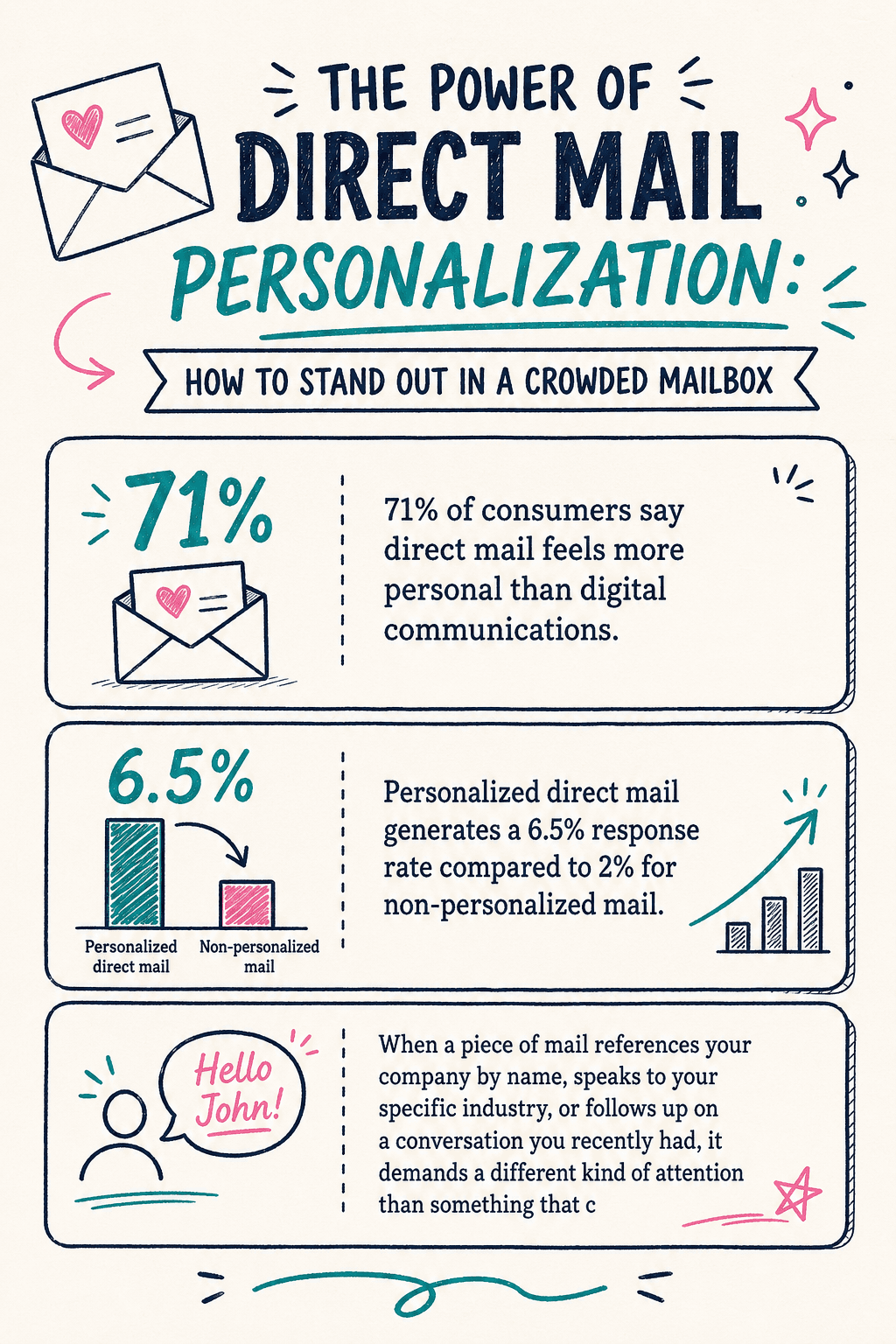
The reason isn't mysterious. People respond to things that are clearly about them. When a piece of mail references your company by name, speaks to your specific industry, or follows up on a conversation you recently had, it demands a different kind of attention than something that clearly went out to 10,000 people.
The Four Levels of Direct Mail Personalization
Not all personalization is equal. Here's how I think about it, from the floor to the ceiling:
Level 1: Name and Company Personalization
This is the minimum. Getting the recipient's name and company right, spelling them correctly, using the right job title. It sounds obvious, and it is. But bad data kills campaigns before they start. A card addressed to someone who left that company six months ago, or that misspells the recipient's name, does more damage than no personalization at all.
Check names, capitalization, missing fields and the longest merged message before sending. A template that exposes an empty field can undermine the attention you intended to show.
Level 2: Segment-Level Personalization
This is where most sophisticated B2B teams operate. Instead of a single generic message, you write three or four variations based on the recipient's industry, role, or stage in the buying process.
A financial services prospect gets a card that references the compliance challenges their industry faces. A real estate agent gets one that speaks to farming and relationship maintenance. A VP of Sales gets messaging focused on pipeline velocity. None of these cards could have been written for a generic audience, even though they share a base template.
Segment-level personalization doesn't require custom writing for every recipient. It requires thinking carefully about your audience segments and writing one genuinely relevant message per segment, then routing recipients to the right version.
Level 3: Trigger-Based Personalization
This is where direct mail starts behaving more like a well-run email nurture sequence. Instead of a scheduled blast, you send cards in response to specific behaviors or moments.
These are possible triggers to test when the event is relevant and recorded accurately:
Cards sent within 48 hours of a sales call or demo
Win-back cards sent after a prospect goes cold at 30 or 60 days
Client anniversary cards sent on the one-year mark of a contract signing
Cards triggered by a prospect visiting a high-intent page on your site
The personalization in these cases goes beyond the message content. The timing itself is personalized. The card arrives in a context where the recipient is already thinking about you, or recently was.
Prospecting is one of the highest-impact use cases. Our guide to sales prospecting letters covers 12 templates built around personalization at every level.
Level 4: Handwritten, Bespoke Messages
This is the ceiling, and it's a significant distance above the levels below it.
A handwritten card with a message that references a specific conversation, a shared connection, or a detail specific to that person is not "personalized direct mail." It's correspondence. It signals an entirely different level of investment than anything that gets run through a mail merge.
The challenge is scale. Writing genuinely personal messages by hand doesn't work at volume. This is the problem Scribble was built to solve. The platform uses robots fitted with real pens to write personalized messages on real paper cards, at scale, with handwritten envelopes included. The result is a card that reads like it was written for that one person, because functionally it was, even when you're sending hundreds of them.

The Personalization Mistake That Kills Results
I want to flag the most common error I see in B2B direct mail personalization, because it's worse than not personalizing at all.
It's the pseudo-personal message. It looks like this:
"Hi [Name], I know you're busy running [Company Name], so I'll be brief..."
This is the worst of both worlds. It's clearly a template. The personalization tokens are obvious. And it leads with a cliche opener that signals immediately that no one thought carefully about this message.
Use details the recipient would reasonably expect you to know. An unexplained reference to sensitive personal information can feel intrusive, even if the data is available to you.
The fix is straightforward but requires more upfront work: write messages that are genuinely relevant to the segment, not just messages that insert segment-specific tokens into a generic frame. The difference is whether the message could only have been written for this audience, or whether it's a generic message with names dropped in.
Scaling Personalization Without Losing Authenticity
The practical challenge for any B2B team is scale. Sales teams want to run personalized outreach to hundreds of prospects at once. Account management teams want to send personalized retention cards to an entire client roster at contract renewal time. Neither of those is compatible with writing every card from scratch.
Here is a practical process to try:
Start with CRM data. The richest personalization comes from data you already have: industry, company size, sales stage, tenure, last touchpoint date, and any notes from previous conversations. Most CRMs have this. Most direct mail programs don't use it. Import your segmentation criteria before you write a single word of copy.
Write one strong message per segment, not one weak message for all. A B2B direct mail campaign targeting CFOs and one targeting marketing directors are two different campaigns. They should sound like it.
Use triggers to drive timing. The most personalized thing about a win-back card isn't the message. It's the fact that it arrived 30 days after silence. Build trigger-based sends into your workflow wherever your CRM data supports it.
Decide which relationships call for a handwritten note. A project thank-you, a welcome or a follow-up after a conversation gives you something specific to say. Scribble supports sending cards to a list and connecting your CRM.
Measuring the Impact
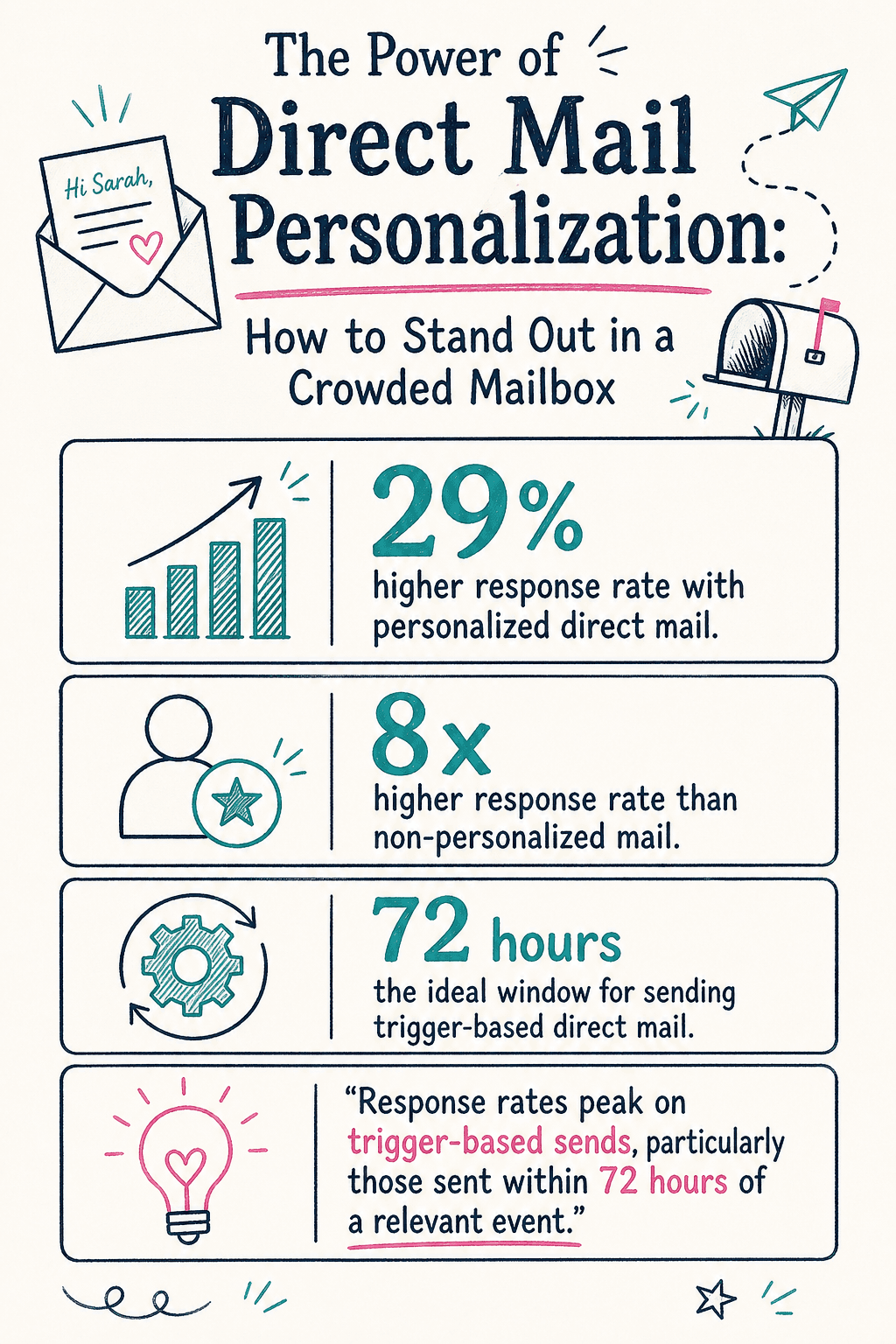
Personalization is worth nothing if you can't attribute results to it. The simplest approach is to run A/B tests within your direct mail campaigns: the same offer, the same format, different levels of personalization. Given that personalized direct mail generates more than three times the response rate of non-personalized mail, the lift should be visible quickly.
You can check card progress and arrival windows in Scribble. Once a card is mailed, we know it has been handed to USPS; we do not know whether the recipient has opened it. Record replies and outcomes in your own CRM to compare messages and timing.
For teams new to tracking direct mail results, the basics are: include a unique URL or QR code per campaign variant, count inbound contacts who reference the card, and track conversion rates from those contacts against your baseline pipeline.
The Bottom Line
Direct mail is already doing something digital channels stopped being able to do reliably: getting opened and read on the day it arrives. Adding genuine personalization to that foundation is the highest-leverage improvement most teams can make to a direct mail program.
That means more than names in a template. It means messages written for a specific audience at a specific moment, arriving at a time that's relevant to where they are in their relationship with you.
If your current direct mail reads like a blast email on cardstock, that's the gap to close. The response rate data tells you exactly how much it's worth.
Frequently Asked Questions
What is direct mail personalization?
Direct mail personalization is the practice of tailoring the content, timing, and targeting of physical mail pieces to the individual recipient. It ranges from basic name insertion to segment-specific messaging, trigger-based timing, and fully bespoke handwritten notes. The more relevant the message to the recipient, the higher the response rate.
How much does personalization improve direct mail response rates?
There is no fixed lift to promise from a recipient’s name or a triggered mailing. Compare relevant, accurately personalized messages with your existing approach and include the preparation cost.
What data do I need to personalize direct mail at scale?
At minimum you need accurate name, title, and company data. For segment-level personalization, industry, company size, and role type are most useful. For trigger-based campaigns, you need CRM data tied to sales events such as demo bookings, proposal sends, or a prospect going cold at a set number of days.
Is direct mail personalization worth the extra cost?
Yes, consistently. The response rate difference between generic and personalized direct mail is large enough that even if personalization adds cost per piece, the cost per response comes down significantly. For high-value B2B contacts, the math is particularly clear since a single closed deal covers the cost of a large campaign.
How is handwritten mail different from standard personalized direct mail?
A pen-written card offers a different physical format from a printed message. Whether the difference justifies the extra cost depends on your audience and outcome. Test comparable messages and include preparation costs.
Start a campaign with Scribble and see what genuinely personalized direct mail looks like in practice.