Most businesses spend thousands acquiring a new client. They invest in ads, sales reps, demos, proposals, and follow-ups. Then the deal closes, and they send a generic email. "Thank you for your business. We look forward to working with you." Delete. On to the next one.
The businesses that actually keep clients - the ones with strong retention, steady referrals, and loyal accounts - do something different after that handshake. They send a personalized, handwritten thank you card. It takes two minutes to write and it signals something no email ever can: that you noticed, that you care, and that you remember specifics about this person and this deal.
This guide covers what makes a business thank you card genuinely personal, wording examples for every common situation, and how to maintain that personal touch when you are sending cards at scale.
Why Personalization Actually Matters in Business Thank You Cards
Generic thank you emails disappear. They hit the inbox, get skimmed in two seconds, and are buried by the next message. There is no physical object, no moment of attention, and no signal of effort. The recipient learns nothing about how you feel about them specifically.
A personalized, handwritten card does the opposite. When a client picks it up, opens it, and reads something that references their company by name, mentions the specific project you just finished, or acknowledges a detail from a conversation you had last month, it creates a different kind of impression. Psychologists call this the effort heuristic: when people perceive that someone put real effort into something for them, it triggers reciprocity. They feel genuinely valued, and they remember it.
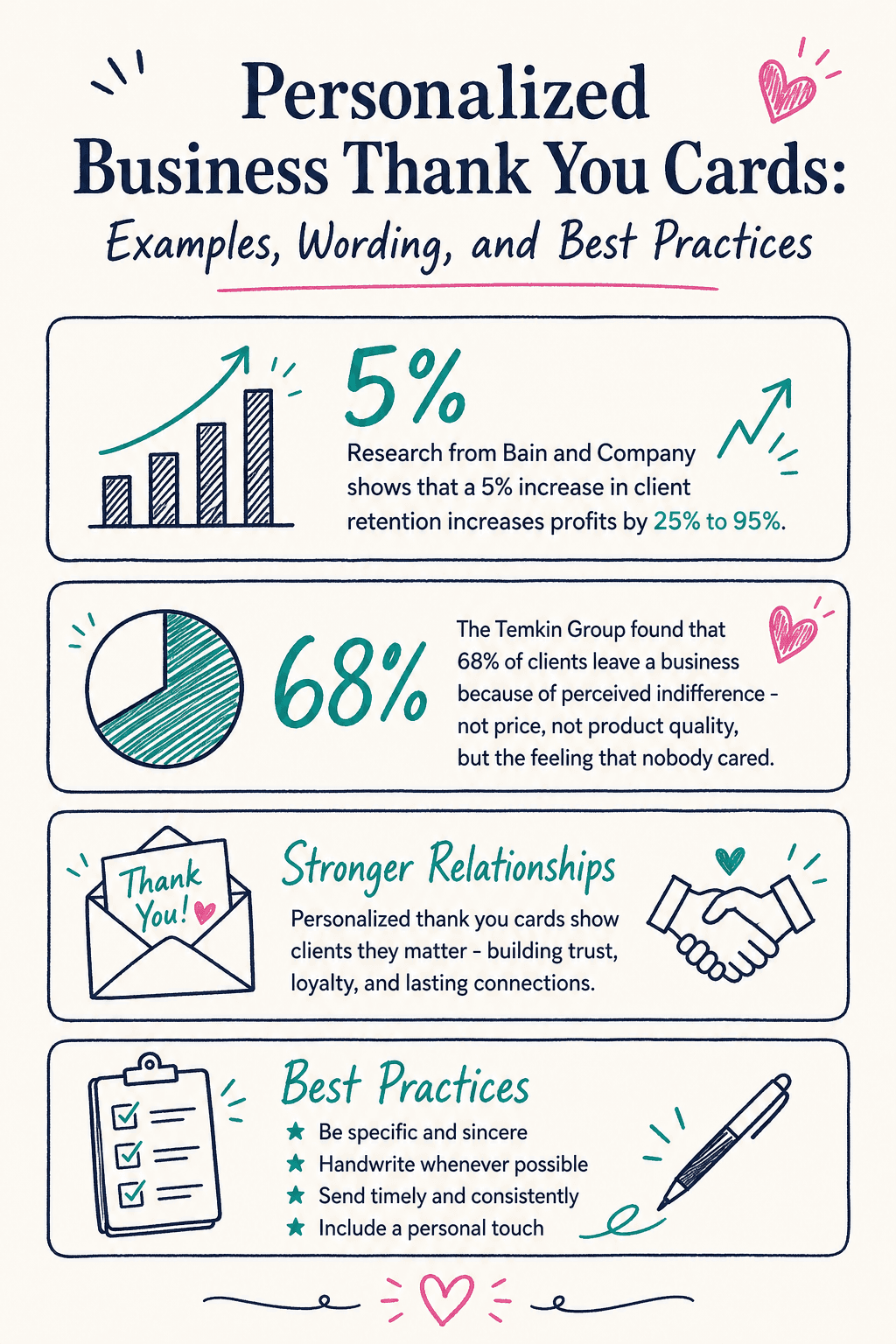
A useful thank you names something the client actually did or shared. That is a practical way to recognize the relationship; it does not establish a fixed retention or profit increase. Measure whether your own program changes renewals or repeat business.
Referrals follow the same logic. Clients who feel genuinely appreciated are five times more likely to recommend your business to someone else. That is not a small number. The most effective referral strategy in most B2B businesses is not a formal program - it is making clients feel so valued that they want to talk about you.
What Makes a Business Thank You Card Genuinely Personal
There is a spectrum between "thank you for your business" and a genuinely personalized card. Most businesses never move past the first. Here are the four elements that put a card in a different category:
Reference something specific. Mention the deal, the project name, a challenge you worked through together, or something the client said in a meeting. "I know the timeline on this one was tighter than either of us wanted" lands very differently than "thanks for the opportunity."
Use the client's name and their company name. Not "Dear Valued Client." Not just a first name in the salutation. Reference both - it signals you know who you are talking to.
Handwritten, not printed or typed. Printed cards with a "personal" message are recognizable immediately. The slightly imperfect letterforms of actual handwriting signal human attention in a way that no font can replicate.
Signed by a real person, not 'The Team'. A card signed by the account manager who worked the deal carries real weight. A card signed by "The Scribble Team" carries almost none.
Business Thank You Card Wording: Examples by Situation
The goal with each of these is a business register that feels human - not stiff, not overly casual, just the kind of thing a senior account manager would actually write.
After Closing a New Client
Example 1: "Sarah, I am genuinely excited to get started on this. The challenges you walked me through in the discovery call gave me a clear picture of where we can make a real difference for Horizon Group. Looking forward to getting into the work together."
Example 2: "Mark, thank you for trusting us with this. I know you had options and I do not take that lightly. The team is already thinking through the approach for your onboarding and I am looking forward to showing you what we can do."
Example 3: "Lisa, closing this contract was the highlight of my week - and I mean that. The vision you have for what you want to build at Meridian is exactly the kind of challenge our team gets excited about. Let us make something great."
After Completing a Project
Example 1: "James, wrapping up the Q1 launch with your team was one of the best collaborations I have had this year. The way your people showed up when things got complicated in week three was impressive. I hope we get to do it again soon."
Example 2: "Carol, the final numbers on the campaign came in and they reflect the work your whole team put in. I wanted to make sure I said thank you properly - not just in a Slack message. It was a genuine pleasure."
Example 3: "Tom, six months from kickoff to delivery is not easy, and your team made it possible. Thank you for the clear communication, the quick turnarounds, and the trust throughout. This one was a real team effort."
For a Client Anniversary or Milestone
Example 1: "Karen, three years ago you took a chance on us before we had much of a track record. I think about that often. Thank you for the loyalty and for growing with us - it means more than I usually say."
Example 2: "David, five years is a long time in this industry. I am proud that we have been part of your journey at Clearfield and I am grateful for the trust you have placed in us year after year. Here is to many more."
Example 3: "Rachel, I heard Apex just crossed the 100-employee milestone. Congratulations. Watching your company grow over the time we have worked together has been one of the best parts of this work. Really proud of what you have built."
After Receiving a Referral
Example 1: "Michael, I found out you were the one who referred Bentley Partners to us. That is one of the most meaningful things a client can do and I want you to know how much it means. A referral is an expression of trust and I do not take it lightly."
Example 2: "Susan, thank you for sending Vantage our way. A referral from someone with your reputation in this industry carries real weight and I promise we will look after them. I genuinely appreciate it."
Example 3: "Chris, I heard the intro you made resulted in a first meeting this week. Whether or not it moves forward, I want you to know I value that gesture enormously. It says a lot about how you think about your relationships."
After a Difficult Situation or Resolution
Example 1: "Jennifer, I want to acknowledge the situation we worked through in March. It was not how any of us wanted things to go, but the way you handled it - directly, professionally, and with patience - made the difference. I am grateful we came out the other side of it stronger."
Example 2: "Paul, fixing what went wrong on the Lakeview project was one of the most stressful months I can remember. But your willingness to stay in it with us and work toward a resolution says a lot about you and your organization. Thank you for not walking away."
Example 3: "Angela, not every client relationship survives a delivery failure. Ours did, and that is because of how you approached it. I appreciate the grace you extended and I want you to know it will not be forgotten."

Best Practices for Business Thank You Cards at Scale
Personalization at volume sounds like a contradiction, but it is not. Here is how teams that send cards regularly keep quality high:
Send within 48 hours of the trigger event. A card that arrives two weeks after a deal closes feels like an afterthought. Timing is part of the signal.
Keep a CRM note with personal details for every client. Kids' names, company milestones, sports teams, the project they mentioned wanting to tackle next. These details are what make a card feel genuinely personal rather than templated.
Use those details in the message. Pull from your CRM note before you write. One specific reference transforms a polite card into something memorable.
Handwriting matters - do not use printed fonts that mimic handwriting. Clients can tell instantly. The imperfections of actual handwriting are the point.
Quality card stock signals quality business. A thin, cheap card undercuts everything you write. Stock matters.
Consistency beats occasional grand gestures. A card after every major milestone, sent reliably and on time, is more powerful than an elaborate package sent once a year.
Personalized Business Thank You Cards vs. Printed Cards vs. Email
Not all thank you gestures are equal. Here is how they stack up:
Personalized handwritten card: highest impact, highest retention signal, requires real effort or a reliable partner. The physical object stays on desks. Clients remember it.
Printed generic card: medium effort, low impact. Better than nothing, but the lack of personalization is immediately obvious. It says "we send these to everyone."
Email thank you: zero effort, lowest impact. Expected and forgotten. An email thank you after a major deal is table stakes at best.
The effort is the signal. A client who receives a card that references their company, their project, and something specific about the work you did together understands immediately that you paid attention. That perception is the foundation of a long client relationship.
How Scribble Helps Businesses Send Personalized Cards at Scale
Scribble uses real pens and real ink - not printed fonts, not digital simulations. You provide the message (or a template with merge fields for client name, company, and project details), and Scribble handles production and mailing. The result is a genuinely handwritten card that arrives at the client's office.
It works for teams sending 50 cards a month or 5,000. You can set up triggers based on CRM events - deal close, project delivery, anniversary date - so cards go out automatically without anyone having to remember. The personalization comes from your CRM data, the handwriting comes from Scribble.
If you are building out a retention strategy, it is worth reading more about handwritten thank you cards for client retention and how these fit into a broader account management approach. If you are on the sales side, the same principles apply - see how handwritten notes for sales teams use physical touchpoints to stand out at every stage of the pipeline.
Get started at app.scribblecards.com.
Frequently Asked Questions
What should I write in a business thank you card?
Reference something specific to the relationship - the project you just completed, the deal you closed, a challenge you worked through together. Use the client's name and company name. Keep it to three to five sentences. The goal is to make the recipient feel seen, not to write a long letter.
How personalized does a business thank you card need to be?
Specific enough that the recipient knows it was written for them and not adapted from a template. That usually means one or two references to something only they would recognize - a project detail, a timeline, something mentioned in conversation. Generic language like "we value your business" can stay, but it needs to be anchored by something real.
Should business thank you cards be handwritten?
Yes, for any situation where the relationship matters. A printed card is better than no card, but the handwriting itself carries meaning. It signals that a person took time, used their hands, and wrote something just for you. That signal is lost the moment you switch to print or a handwriting font.
When should you send a business thank you card?
The most important moments: after closing a new client, after delivering a completed project, after receiving a referral, at a client relationship anniversary, and after successfully resolving a difficult situation. The 48-hour window matters - the sooner the card arrives after the trigger event, the stronger the impact.
Can you automate personalized business thank you cards?
Yes, with the right partner. Services like Scribble connect to your CRM and trigger card production and mailing based on deal stages, project milestones, or anniversary dates. The personalization pulls from your CRM fields - client name, company, deal details - so each card reads as individual even when the process is automated.
Final Thoughts
The businesses that keep clients the longest are not always the ones with the best product. They are the ones that make clients feel noticed and valued over time. A personalized thank you card is one of the most direct ways to do that - and one of the most underused tools in B2B account management.
The bar is genuinely low. Most of your competitors are sending generic emails or nothing at all. A card that references the client's name, their project, and something specific about the work you did together puts you in a different category. That is the kind of gesture clients talk about.