
Handwritten Cards Service: The Business Buyer’s Guide
A handwritten cards service lets you send real, pen-written notes at scale — without hiring an intern to hand-cramp through 500 envelopes. If you’re here, you’re probably evaluating your options. Maybe you’ve sent a few handwritten cards yourself and seen the response rates. Maybe your competitors are already doing it and you want to catch up. Either way, this guide covers what to look for, how the major handwritten card companies compare, and what separates a great service from one that’ll waste your budget on printed fonts pretending to be handwriting.
Services including Scribble, Handwrytten and Simply Noted use equipment that guides real pens. Ask for a sample and inspect the actual product; a pen-written message does not prove a staff member wrote each card personally.
What Is a Handwritten Cards Service?
A handwritten cards service is a company that writes and mails physical cards on your behalf using actual pens. The best services use robotic arms or pen plotters that hold real ballpoint or felt-tip pens, pressing ink into card stock the same way a human hand would. The result is genuine handwriting with real ink — not a printed font designed to look like handwriting.
A pen-written card and a printed handwriting-style message are different products. Ask for a sample to compare the paper, ink and appearance. The format alone does not establish a spending or response-rate improvement. Further reading: Current handwriting samples.
There’s a spectrum in this industry. On one end, you have traditional print shops that use cursive-style fonts on card stock. On the other, you have automated handwritten cards services that use real pens controlled by machines. The technology behind the pen is the single biggest differentiator between providers.
Who Uses Handwritten Card Services?
Handwritten card services aren’t niche anymore. Here are the industries and roles that use them most:
An agent can acknowledge a closing or thank someone for a referral. Track the source of future introductions; a card does not guarantee a commission.
Sales teams and SDRs use handwritten notes to break through inbox noise. When every competitor is sending the same automated email sequence, a physical card on someone’s desk stands out. We covered this in depth in our guide to handwritten notes for sales.
An online retailer can include a thank-you note in an order or send a card separately. Those have different costs and timing.
For e-commerce, test a thank-you card with a defined group of customers and compare later purchases after costs. Do not assume a fixed repeat-purchase lift from adding a note.
Financial advisors send cards to clients during life events — birthdays, retirements, new homes — to strengthen relationships in an industry where trust is everything.
A wealth-management firm can include cards in its approved client-service plan. Check the applicable communications and gifts policies, and assess results in the firm’s own client data.
Nonprofits can use cards to acknowledge donors. A personal note can complement a receipt, but it does not replace required acknowledgment details or guarantee another gift.
What to Look for in a Handwritten Cards Service
Not all handwritten card companies are created equal. Here’s what to evaluate before you commit to a provider:
1. Real Handwriting vs. Printed Fonts
This is the most important factor. Ask the provider: does a real pen touch the paper? Some services use inkjet printers with handwriting-style fonts. These look passable in photos but obvious in person. Real pen-on-paper has ink variation, slight pressure differences, and occasionally imperfect letter spacing — exactly what makes it believable.
2. Personalization Depth
Can you personalize more than just the name? The best services let you customize the greeting, body text, closing, and even the handwriting style per recipient. Variable data fields (first name, company name, custom lines) should be standard.
3. CRM and Automation Integrations
For repeated sends, compare manual preparation with the provider’s documented automation options. Verify the trigger, exclusions and plan requirements. A manual upload can still be appropriate for a small, carefully reviewed list.
4. Turnaround Time
Confirm the provider’s production and postal estimates for your mailing date. Ask separately about preparation, dispatch and any delivery estimate; do not treat them as the same milestone.
5. Pricing Model
Compare quotes at the quantity you actually need. Check the card, envelope, writing, postage, subscriptions and any setup costs, rather than relying on an advertised volume floor.
6. Sample Process
Any reputable provider will send you a sample card before you commit to a large order. If a company won’t send a sample, that’s a red flag. You need to see and feel the card stock, evaluate the handwriting quality, and confirm the ink looks real.
How Scribble Works
Full disclosure: I work at Scribble, so I’m going to explain how our service works. I’ll keep it factual.
Real pen, real ink. Scribble uses robotic pen technology that holds actual ballpoint pens. The pen touches the card stock and writes with real ink. It’s not printed. You can feel the indentation on the back of the card where the pen pressed down.
Card progress. Scribble shows production progress and estimated arrival windows. A mailed status means the card was handed to USPS; it does not confirm delivery, opening or a recipient’s QR scan.
Design-first approach. Scribble is building toward being a beautiful card design focused platform. Every card includes a printed design on the front with a handwritten message inside, plus a handwritten envelope with a real postage stamp.
30 handwriting styles. Choose from the current customer-selectable styles and inspect a preview with your actual message. Saved older designs can retain their legacy style. Scribble handwriting styles.
CRM connections. Scribble supports documented API and inbound-hook workflows. Check the current integration page for named connector availability; HubSpot is a pilot, and a general API is not the same as a native CRM app.
Bulk and automated sending. Prepare recipients by CSV or use a documented API or inbound-hook workflow. Review quantity limits, credits, message fit and failures before scaling a program.
Pricing. A standard Scribble card is $6.99, including handwriting, envelope and US postage. The $2.45 rate requires buying 10,000 prepaid credits in one purchase; smaller purchases use the current volume table. Current Scribble credit prices.
Handwritten Cards Service Comparison
There are several solid handwritten card companies on the market. Here’s an honest comparison of three of the most popular options. I work at Scribble, but I’ve done my best to keep this fair — biased comparisons help no one.
Scribble vs. Handwrytten
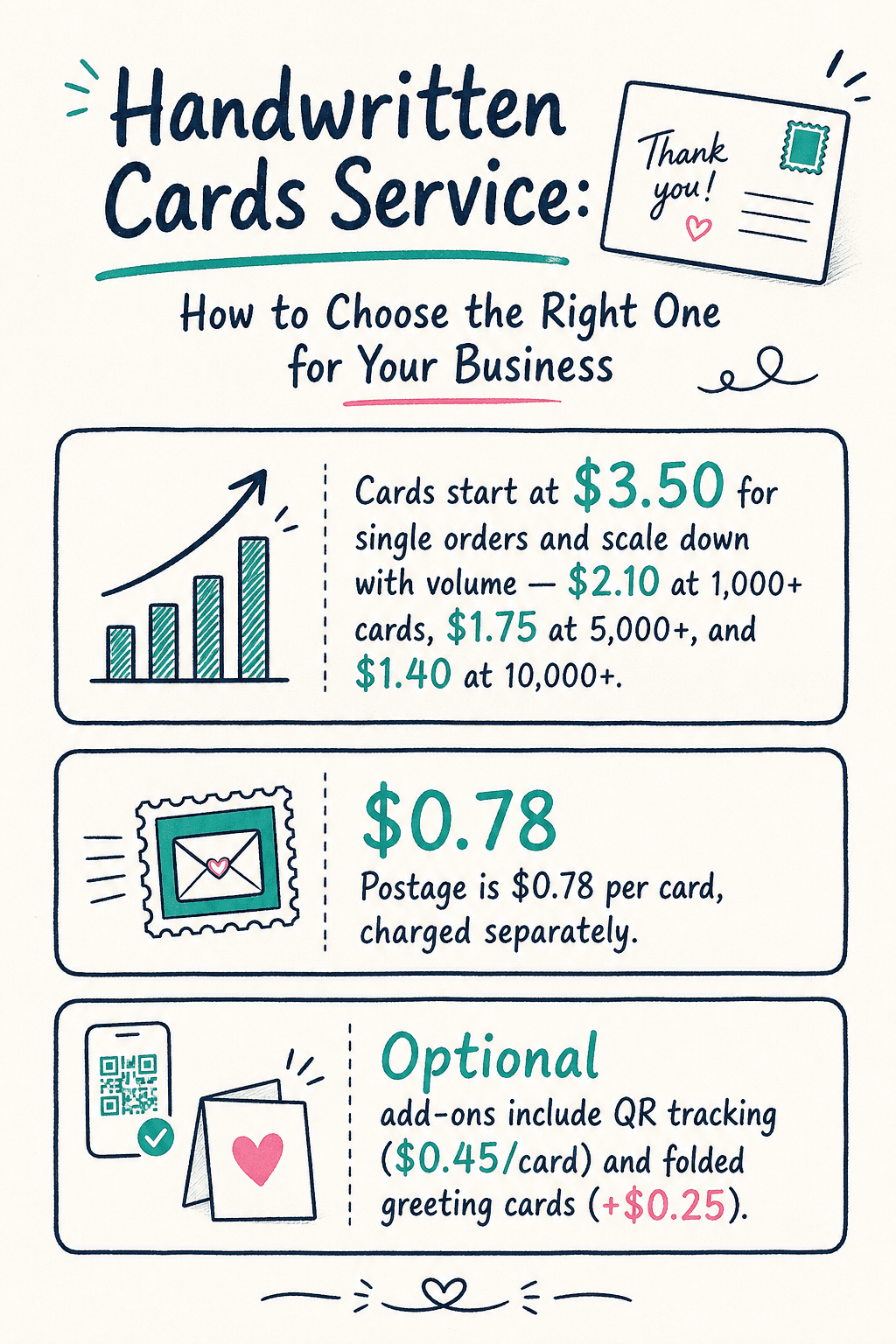
Handwrytten is another provider to evaluate. Compare its current minimum, postage treatment, handwriting samples and CRM connection against your requirements. Verify the exact plan and integration before buying; historical prices and review counts are not a current quote.
Scribble vs. Simply Noted
Simply Noted is another provider to evaluate. Ask for the total price at your quantity, whether postage is included, credit terms and the exact integration you need. Avoid choosing from an old volume-price comparison.
Compare a physical sample and a small mailing from your shortlist. No verified response-rate multiplier establishes that one of these services will outperform the others for your audience. Further reading: direct mail statistics.
Businesses can request a free Scribble sample before planning a larger mailing. The sample request is separate from starting a paid campaign. Further reading: Business mailing information. Further reading: Business mailing information. Request a free business sample.
Once you know what to look for, it helps to see the options side by side. Our full breakdown of the best handwritten card services in 2026 compares ten providers on real pricing, minimums, and integrations.
Frequently Asked Questions
How much does a handwritten cards service cost?
Prices vary by quantity and provider. A standard Scribble card is $6.99, including handwriting, envelope and US postage. The $2.45 rate requires buying 10,000 prepaid credits in one purchase; smaller purchases use the current volume table.
Can I automate handwritten cards through my CRM?
Check the current integration documentation for the tool you use. Scribble has API and inbound-hook workflows, while named connectors have their own availability and setup requirements. Do not assume a native connector or a 1,000-card minimum.
How long does it take to send handwritten cards?
Allow for writing and preparation as well as postal transit. Standard US card timing is an estimate, typically 1–2 business days for preparation plus 2–5 business days with USPS. Scheduled cards use an arrival window; no exact delivery day is promised.
Is the handwriting actually real or is it a printed font?
It depends on the provider. Scribble, Handwrytten and Simply Noted describe pen-writing equipment. Other products use printed handwriting-style text. Request a physical sample of the exact format before ordering a larger mailing.
What’s the ROI of sending handwritten cards for business?
There is no fixed ROI for a handwritten-card program. Estimate the additional contribution from purchases or retained business, subtract the full campaign cost, and compare with similar customers who did not receive the mailing when practical. Further reading: Direct mail statistics.
Choosing a handwritten cards service comes down to three things: real handwriting, strong integrations, and a provider you can trust with your brand. Request samples from your shortlist, test a small batch, and let the results speak for themselves.
Request a free business sample to inspect the card and handwriting before deciding on a mailing. Further reading: Start your first Scribble campaign here.