

Here is a number that should reframe how you think about your marketing budget: acquiring a new customer costs 5 times more than keeping an existing one. Yet most businesses still spend the lion's share of their growth budget chasing new leads while giving their current clients the bare minimum.
That is backwards. A client who stays, buys again, and refers their colleagues is worth multiples of what you spent to land them. A client who leaves because they felt ignored is one of the most expensive outcomes in business - not just because you lost the revenue, but because replacing them costs so much.
This post covers 10 client retention tactics that actually move the needle. Not the generic 'deliver great service' advice you have already read a hundred times. Real, practical strategies that the best B2B teams use to keep their best clients around for years.

Why Client Retention Should Be Your Top Priority
Keeping a customer can protect future revenue, but the profit effect depends on margins, service costs and how long the relationship lasts. Model those inputs for your own business before setting a retention budget.
Customer lifetime value (LTV) is the metric that makes this concrete. A client who stays for three years and refers two colleagues is worth ten times more than a client who churns after six months. Yet most CRM dashboards are built around acquisition - leads, conversions, close rates. Retention metrics often live in a spreadsheet somewhere, if they are tracked at all.
Review the share of revenue and contribution that comes from existing clients in your own accounts. A project business and a subscription business have different repeat-purchase patterns; there is no universal 65% revenue share to use.
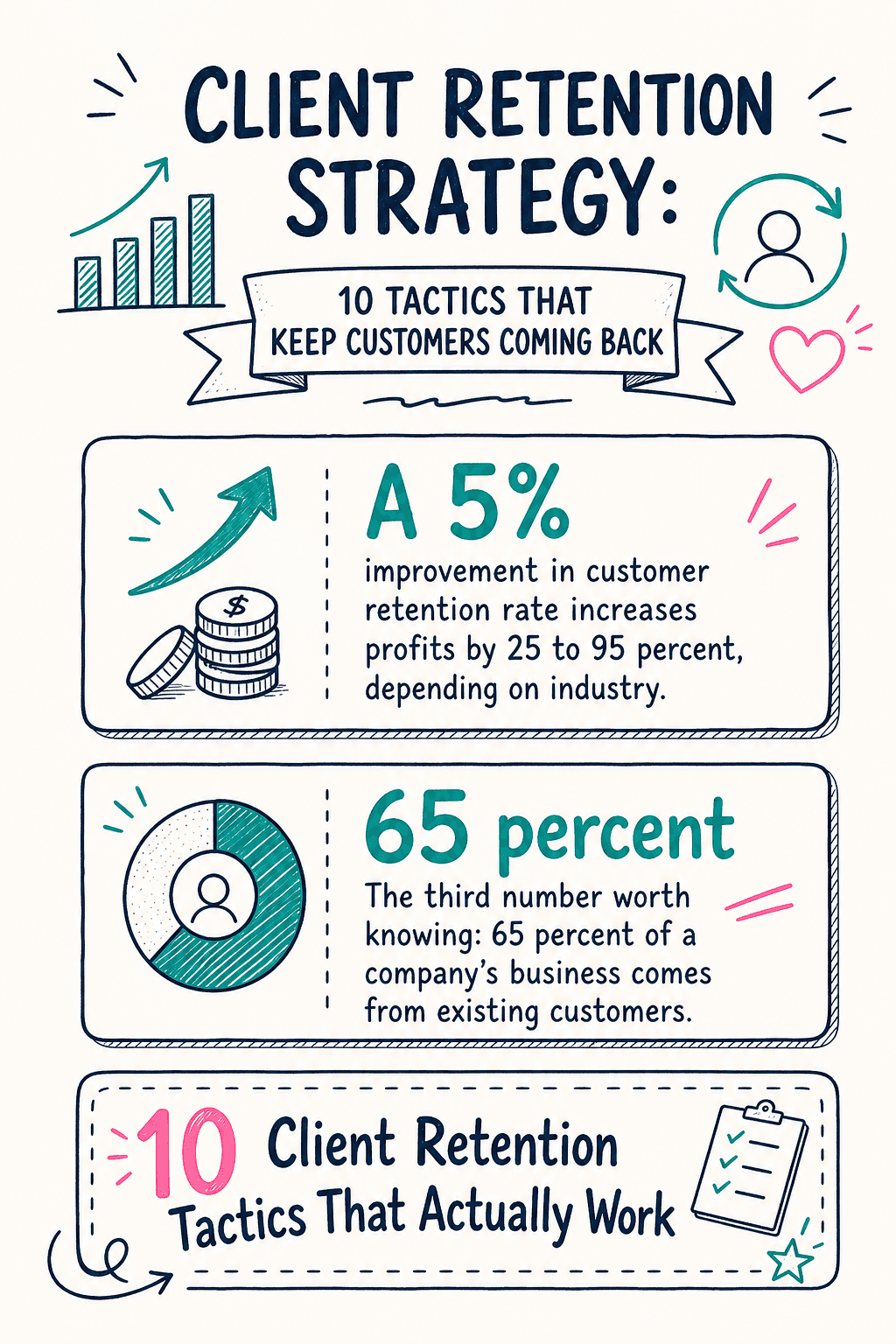
10 Client Retention Tactics to Plan and Evaluate
Tactic 1: Send a Handwritten Note After Every Milestone
The most underused retention move in B2B is also the simplest. When a client signs a contract, completes a major project, renews for another year, or refers someone your way - send a handwritten note. Nobody else does this, and that is exactly why it works.
The economics are hard to argue with. A handwritten note costs under five dollars and takes five minutes to write. The psychological impact is disproportionate. In a world of automated email sequences and generic thank-you texts, something handwritten signals genuine appreciation in a way that no digital message can replicate.
For teams sending at volume, Scribble handles the logistics - so you can send handwritten thank you cards for client retention at scale without it becoming a manual bottleneck. Pair that with personalized business thank you cards and you have a system that feels personal even when it is running on autopilot.
Tactic 2: Build a Proactive Check-In Calendar
Most client relationships go quiet between deliverables. That silence is where churn starts. Clients do not usually leave after a bad experience - they leave after a long stretch of feeling like nobody is paying attention.
Proactive check-ins are not about selling anything. They are a ten-minute call or a short email to ask how things are going, whether the work is landing the way they hoped, and whether there is anything they need. The goal is to surface issues before they become reasons to leave.
Set up a simple calendar: monthly for your newest clients, quarterly for your established ones, with a mid-year review for anyone who is a significant account. Assign ownership clearly - the person who manages the relationship should own the check-in, not a generic 'customer success' inbox.
Tactic 3: Create a Client Success Playbook
The clients who get results stay. The ones who do not, leave. And whether a client gets results often has less to do with the quality of your work than with how well they were onboarded and set up to succeed.
A client success playbook is a documented set of steps that every client goes through from the moment they sign. It covers onboarding milestones, who introduces what and when, what resources they get access to, and what success looks like at 30, 60, and 90 days. The goal is consistency - so every client gets the same high-quality experience regardless of which team member is handling them.
Poor onboarding is one of the leading causes of early churn. Clients who feel confused or unsupported in the first few weeks quietly start looking at alternatives. A playbook closes that gap before it opens.
Tactic 4: Make Renewals Feel Like a Beginning, Not an End
Most renewal processes are transactional. An invoice arrives a few weeks before the contract end date, there may be a brief call, and it either gets signed or it does not. That is a missed opportunity every single time.
The best retention teams treat renewal as a relationship moment. Before the renewal conversation, send a recap of what you achieved together over the past year - results, milestones, problems solved. Make the client feel the weight of what they would be walking away from.
Then look forward. What does the next year look like? What goals are they building toward? Frame the renewal not as 'continuing the contract' but as 'starting the next chapter.' That shift in framing changes the emotional tone of the entire conversation.
Tactic 5: Build a Feedback Loop That Actually Changes Things
Clients who fill out a survey and never hear what happened with their feedback are less likely to stay - not more. The damage done by a box-ticking feedback process is worse than having no feedback process at all, because it signals that you are asking but not actually listening.
A useful feedback loop has three components: a way to collect feedback regularly (quarterly NPS, post-project surveys, or even a simple email), a process for reviewing what came in, and - critically - a way to communicate back to clients what changed as a result of their input.
'You told us X, so we did Y' is one of the most powerful sentences in client retention. It tells your clients that their opinion shapes the product or service they are paying for. That kind of responsiveness builds loyalty that is very hard to compete with on price alone.
Tactic 6: Personalize Beyond the Account Name
'Hi [First Name]' is the floor of personalization, not the ceiling. Real personalization in a B2B context means knowing what matters to this specific client - their industry pressures, their internal politics, their strategic goals, the names of the people they mentioned in your last call.
This data lives in conversations, but it needs to be captured systematically. Build a habit of logging key details in your CRM after every client interaction. This is the foundation of direct mail personalization done well - knowing enough about a person to make every touchpoint feel like it was designed specifically for them.
Over time, this kind of detail creates a relationship that is genuinely hard to replicate. A competitor can undercut your price. They cannot replicate three years of accumulated context about how your client thinks and what they care about.
Tactic 7: Identify At-Risk Clients Before They Tell You They Are Leaving
Churn rarely happens without warning. The signals are there - clients just do not always announce them. Declining usage, missed calls, shorter email responses, delayed approvals, reduced engagement with your content, a new procurement contact replacing the one you had a relationship with: these are all signals.
Build a simple early-warning system. Decide which signals matter most for your business and check for them on a regular cadence - weekly for high-value accounts, monthly for others. When you spot a pattern, act immediately. A proactive call to an at-risk client is far more effective than a reactive one after they have already decided to leave.
A change in usage or responsiveness can prompt a useful check-in, but it does not establish that a client feels unappreciated. Ask what has changed before assigning a cause.
Tactic 8: Create a Referral Ask at the Right Moment
The best time to ask for a referral is immediately after a client has experienced a win. Not at the end of the year, not in a general email to all clients, but right after the moment when they have just seen results and are most likely to be enthusiastic about your work.
Most businesses either never ask for referrals at all, or ask at the wrong time - in a generic 'can you refer us?' email that goes to everyone regardless of where they are in their relationship with you. Both approaches underperform.
Keep the ask specific and easy. 'Is there anyone else in your network who is dealing with [specific problem]? I would be glad to have a conversation with them.' That framing is personal, relevant, and low-pressure. It does not feel transactional because you are asking them to help a colleague, not just feed your pipeline.
Tactic 9: Give Clients Something to Brag About
Some satisfied clients may be willing to describe their work with you. Ask permission and report only outcomes they can substantiate. Public advocacy alone does not prove that the client will stay.
Create opportunities for clients to be the hero of their own story. A case study should be written from the client's perspective, with their results front and center. A speaking opportunity should position them as the expert who achieved something remarkable, with your service as the tool they used.
Invite clients to share their work only when the opportunity helps them. A case study is not a retention contract; keep earning the relationship through the service you provide.
Tactic 10: Treat the First 90 Days as Your Most Important Retention Period
Most churn decisions are made in the first 90 days, even if the actual cancellation does not happen until month 8 or 12. The experience a client has immediately after signing sets the emotional tone for the entire relationship. If those first months are rough, clients start looking for exits long before they express any dissatisfaction.
The first 90 days should have clear milestones. By day 30, the client should have experienced a meaningful first result - something small enough to be achievable quickly but significant enough to create confidence. By day 60, the relationship should feel comfortable and the communication rhythm should be established. By day 90, the client should be able to articulate the value they are getting.
Invest disproportionately in this period. It is the highest-leverage time you have with any client, and the returns compound for years.

Measuring Your Client Retention Rate
Client retention rate is calculated as: ((clients at end of period - new clients acquired during period) / clients at start of period) x 100. If you started the quarter with 100 clients, added 15, and ended with 102, your retention rate is (102-15)/100 = 87%.
Define the eligible client group and period before setting a target. Compare with your own history using the same method. A project business may find repeat purchasing more useful than annual contract retention.
Track this monthly, not annually. Annual retention numbers hide a lot of mid-year erosion. A monthly view lets you spot seasonal patterns, correlate retention changes with product updates or team changes, and catch a deteriorating trend before it becomes a serious problem.
Frequently Asked Questions
What is a good client retention rate?
There is no single target for every B2B business. Contract length, customer age and the type of service affect what the measure means. Start with a consistent definition and your own baseline.
What is the biggest reason clients leave?
Clients leave for different reasons: a change in needs, poor service, price, an unresolved problem or a competing offer. Ask departing clients and review account records before deciding which problem to fix. Do not assume a single survey percentage describes your customers.
How do you measure client retention?
Calculate client retention rate by subtracting new clients acquired during a period from the total clients at the end of the period, dividing by the number of clients at the start, and multiplying by 100. For revenue-focused teams, net revenue retention (NRR) is a more nuanced metric that accounts for expansion revenue from existing clients. Track both on a monthly basis to catch trends early.
What is the difference between client retention and customer loyalty?
Client retention measures whether a client continues paying for your service. Customer loyalty measures how strongly a client prefers you over alternatives - and whether they actively advocate for you. A retained client might stay because switching is inconvenient. A loyal client stays because they genuinely prefer your solution and would recommend it to others. The goal is to build loyalty, which makes retention a natural byproduct.
How can small businesses improve client retention on a limited budget?
A small business can begin with account check-ins and a clear onboarding process. Include staff time and card costs in the budget. Measure the outcome rather than calling any tactic low-cost or high-return without that calculation.
The Bottom Line on Client Retention
Retention is not a department. It is a culture. The businesses that keep their best clients longest are the ones where every touchpoint - from the first onboarding call to the renewal conversation three years later - signals that they genuinely care about the client's success, not just the contract value. See also handwritten notes for sales for how this mindset extends into the prospecting phase.
Small gestures done consistently beat grand gestures done occasionally. A handwritten note after every milestone. A check-in call when things go quiet. A feedback response that actually shows you listened. These are not complicated tactics. But done consistently, they create client relationships that are genuinely hard to walk away from.